
Primary Aldosteronism: The Commonest Curable Cause of Hypertension
Key points
- Primary aldosteronism: autonomous aldosterone secretion independent of renin, causing hypertension with sodium retention and potassium loss. It is the commonest curable cause of secondary hypertension.
- Far more common than taught: present in around 5 to 10% of all hypertension and up to 20% of resistant hypertension, and it remains substantially under-diagnosed.
- Normal potassium does not exclude it: only around a third of patients are hypokalaemic. Screening only those with low potassium misses the majority.
- Two main causes: bilateral adrenal hyperplasia, which is treated medically, and a unilateral aldosterone-producing adenoma (Conn's syndrome), which can be cured surgically.
- Screening test: the aldosterone-to-renin ratio - a raised aldosterone with a suppressed renin. Correct hypokalaemia first, and stop interfering drugs.
- The drug that must be stopped: a mineralocorticoid receptor antagonist invalidates the test entirely and must be withheld for 4 to 6 weeks before measurement.
- Adrenal vein sampling: the gold standard for lateralisation before surgery. CT alone is unreliable because non-functioning incidentalomas are common and small adenomas are missed.
- Excess cardiovascular risk: aldosterone causes cardiac and vascular fibrosis independently of blood pressure, so risk exceeds that of matched essential hypertension.
Introduction
Primary aldosteronism is autonomous secretion of aldosterone that is not suppressed by the normal feedback of the renin-angiotensin system. The consequence is sodium and water retention with potassium and hydrogen loss, producing hypertension, a tendency to hypokalaemia and a metabolic alkalosis, with a suppressed plasma renin.
It was long taught as a rare curiosity. It is not. Systematic screening studies find it in around 5 to 10% of all hypertensive patients and in up to 20% of those with resistant hypertension, which makes it the commonest curable cause of secondary hypertension - and one of the most under-diagnosed conditions in medicine, with a typical delay of years between the onset of hypertension and the diagnosis.
Causes
| Cause | Proportion | Treatment |
|---|---|---|
| Bilateral adrenal hyperplasia (idiopathic hyperaldosteronism) | Around 60 to 70% | Medical - a mineralocorticoid receptor antagonist |
| Unilateral aldosterone-producing adenoma (Conn's syndrome) | Around 30 to 35% | Surgical - laparoscopic adrenalectomy, which is potentially curative |
| Unilateral adrenal hyperplasia | Under 5% | Surgical |
| Adrenocortical carcinoma | Under 1% | Surgical, with adjuvant therapy; prognosis poor |
| Familial hyperaldosteronism types I to IV | Rare | Type I is glucocorticoid-remediable aldosteronism, caused by a chimeric CYP11B1/CYP11B2 gene and treated with low-dose dexamethasone. Consider in patients under 20 or with a family history of early stroke. |
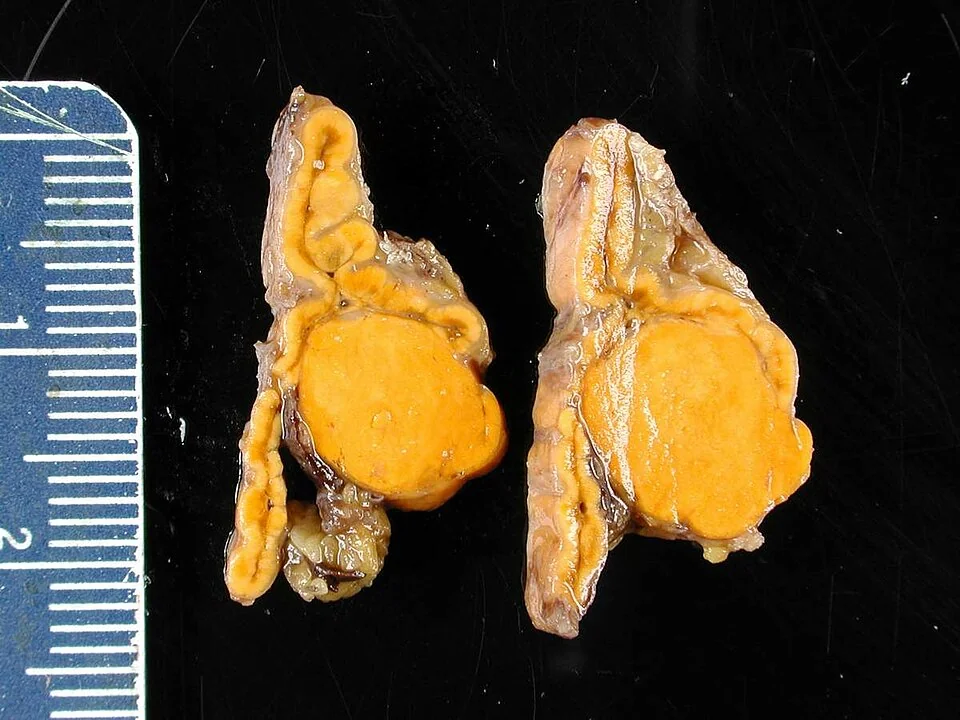
Why it matters beyond the blood pressure
Aldosterone acts on mineralocorticoid receptors in the heart, blood vessels and kidney as well as the distal nephron, promoting inflammation and fibrosis directly. Patients with primary aldosteronism therefore have higher rates of left ventricular hypertrophy, atrial fibrillation, stroke, myocardial infarction, heart failure and chronic kidney disease than patients with essential hypertension at the same blood pressure. Treating the aldosterone excess specifically - rather than simply lowering the blood pressure with any agent - is what reduces that excess risk.
Clinical features
The great majority of patients present simply with hypertension, often resistant, and are otherwise asymptomatic. There is no characteristic appearance, which is why the diagnosis depends entirely on thinking of it and testing.
- Hypertension - often moderate to severe, of early onset, or resistant to three or more drugs
- Hypokalaemia - present in only around a third, and frequently only after a thiazide or loop diuretic has been started. Spontaneous hypokalaemia in a hypertensive patient is a strong pointer and should always trigger testing.
- Symptoms of hypokalaemia - muscle weakness, cramps, paraesthesia, tetany, constipation and palpitations
- Polyuria and polydipsia - from hypokalaemia-induced nephrogenic diabetes insipidus
- Oedema is characteristically absent, because of the phenomenon of aldosterone escape - after a few days of sodium retention, atrial natriuretic peptide and pressure natriuresis restore sodium balance, so the patient becomes hypertensive rather than oedematous
- Metabolic alkalosis on the blood gas or bicarbonate
Investigations
Step 1: screening with the aldosterone-to-renin ratio
The screening test is the aldosterone-to-renin ratio (ARR). The characteristic result is a raised or normal aldosterone with a suppressed renin, giving a high ratio. Renin is suppressed because the volume expansion caused by aldosterone shuts off the renin-angiotensin system - which is exactly what distinguishes primary from secondary aldosteronism, where both are high.
Step 2: confirmatory testing
- A positive ARR is a screening result and usually requires confirmation that aldosterone is genuinely autonomous - by demonstrating failure to suppress with sodium or volume loading
- Options include the saline infusion test, oral sodium loading, the fludrocortisone suppression test and the captopril challenge
- Confirmatory testing can be omitted where the picture is unequivocal - spontaneous hypokalaemia, an undetectable renin and a clearly elevated aldosterone together are sufficient
Step 3: determining the subtype
- CT of the adrenals (thin-slice) - performed in everyone with confirmed disease, principally to exclude adrenocortical carcinoma, which is suggested by a lesion over 4 cm with irregular or heterogeneous features
- CT alone is unreliable for lateralisation. Aldosterone-producing adenomas are frequently under 1 cm and may be invisible, while non-functioning adrenal incidentalomas are common, especially over the age of 35 - so a visible nodule is not necessarily the culprit, and an apparently normal CT does not exclude a unilateral source.
- Adrenal vein sampling (AVS) - the gold standard. Aldosterone and cortisol are sampled simultaneously from both adrenal veins and peripherally; the cortisol-corrected aldosterone ratio identifies whether secretion is unilateral (surgically curable) or bilateral (medically managed). It is technically demanding and performed in specialist centres.
- AVS should be performed before surgery in essentially all patients over 35 who would accept an operation. It may reasonably be omitted in patients under 35 with spontaneous hypokalaemia, marked aldosterone excess and a clear unilateral adenoma on CT, where a non-functioning incidentaloma is very unlikely.
- Genetic testing - consider in patients presenting under 20 years, or with a family history of primary aldosteronism or early stroke
Supporting investigations
- U&Es - hypokalaemia, a raised bicarbonate reflecting metabolic alkalosis, and renal function
- Magnesium - often low alongside the potassium
- ECG and echocardiogram - for left ventricular hypertrophy and atrial fibrillation, both of which are more common than in essential hypertension
- Urinary albumin-to-creatinine ratio and eGFR - for hypertensive kidney damage
- Assessment for other end-organ damage - fundoscopy and cardiovascular risk profiling
Management
Unilateral disease - surgery
- Laparoscopic adrenalectomy is the treatment of choice for a confirmed unilateral source
- Outcomes - hypokalaemia is corrected in essentially 100%; hypertension is cured in around 30 to 50% and improved in the great majority of the remainder. Patients should be told to expect improvement rather than guaranteed cure, since long-standing hypertension causes irreversible vascular remodelling.
- Predictors of cure are younger age, shorter duration of hypertension, fewer antihypertensive drugs beforehand, female sex and the absence of vascular comorbidity
- Before surgery - control blood pressure and correct potassium, usually with a mineralocorticoid receptor antagonist
- After surgery - the contralateral gland has been suppressed, so hyperkalaemia can occur. Stop potassium supplements and the mineralocorticoid receptor antagonist at operation, monitor potassium closely in the first weeks, and reduce antihypertensives as blood pressure falls. Transient hypoaldosteronism occasionally requires temporary fludrocortisone.
Bilateral disease - medical therapy
| Drug | Notes |
|---|---|
| Spironolactone | First line. Highly effective and inexpensive. Not selective, so it also blocks androgen and progesterone receptors - producing dose-related gynaecomastia and breast tenderness in men (in up to 10% at higher doses), erectile dysfunction, and menstrual irregularity in women. Monitor potassium and renal function. |
| Eplerenone | More selective, with far fewer endocrine side effects, so it is the alternative where spironolactone is not tolerated. It is less potent, requires twice-daily dosing and is more expensive. |
| Amiloride | An epithelial sodium channel blocker rather than a receptor antagonist. Useful where mineralocorticoid receptor antagonists cannot be used, and the treatment of choice in Liddle syndrome. |
- Monitor potassium and renal function after starting and after each dose increase - hyperkalaemia and acute kidney injury are the main hazards, particularly with concurrent ACE inhibitors or ARBs, in older patients and in chronic kidney disease
- Dietary sodium restriction is particularly effective in this condition, more so than in essential hypertension, and is worth emphasising specifically
- Additional antihypertensives as needed to reach target
- Glucocorticoid-remediable aldosteronism is treated with low-dose dexamethasone to suppress ACTH, sometimes with a mineralocorticoid receptor antagonist
- Treat the whole cardiovascular risk - lipids, smoking, weight, diabetes and screening for end-organ damage
Complications
- Left ventricular hypertrophy and diastolic dysfunction - more marked than in matched essential hypertension
- Atrial fibrillation - substantially increased, and primary aldosteronism should be considered in hypertensive patients presenting with AF
- Stroke and myocardial infarction
- Heart failure
- Chronic kidney disease and proteinuria - and note that renal function may appear falsely preserved before treatment, because glomerular hyperfiltration masks underlying damage; the creatinine can rise after treatment, revealing the true baseline
- Hypokalaemia with arrhythmia, muscle weakness, rhabdomyolysis and nephrogenic diabetes insipidus
- Metabolic syndrome and type 2 diabetes - both more common than expected
- Osteoporosis - through hypercalciuria driven by sodium and volume expansion
- Obstructive sleep apnoea - bidirectionally associated
- Anxiety and reduced quality of life, which improve with specific treatment
- Treatment-related - gynaecomastia and sexual dysfunction with spironolactone, and hyperkalaemia after adrenalectomy
Red flags
Prognosis
When identified and treated specifically, the outlook is good. Hypokalaemia resolves in essentially all patients, and blood pressure is cured in 30 to 50% of those undergoing adrenalectomy for unilateral disease, with substantial improvement in most of the remainder. Patients treated medically with an adequately dosed mineralocorticoid receptor antagonist achieve comparable cardiovascular protection provided renin becomes detectable, which is a useful marker of adequate blockade.
Untreated or non-specifically treated, the prognosis is worse than for essential hypertension at the same blood pressure, because of direct aldosterone-mediated cardiac, vascular and renal fibrosis. This excess risk is the reason the condition deserves active case-finding rather than being regarded as a technicality.
The dominant determinant of outcome is how long the diagnosis took. Patients frequently accumulate years of uncontrolled hypertension, several drugs and established end-organ damage before anyone measures a renin - and vascular remodelling that has become fixed will not reverse after adrenalectomy. Testing earlier, and testing more people, is the intervention that changes outcomes, which makes primary aldosteronism an unusually clear example of a condition where the diagnostic threshold rather than the treatment is the limiting factor.
References
- Funder JW, Carey RM, Mantero F et al. The management of primary aldosteronism: case detection, diagnosis and treatment - an Endocrine Society clinical practice guideline. 2016. Available here
- NICE NG136. Hypertension in adults: diagnosis and management. 2019, updated 2023. Available here
- NICE Clinical Knowledge Summaries. Hypertension - not diabetic. Available here
- Williams B, MacDonald TM, Morant S et al. Spironolactone versus placebo, bisoprolol, and doxazosin in resistant hypertension (PATHWAY-2). Lancet. 2015. Available here
- Monticone S, D'Ascenzo F, Moretti C et al. Cardiovascular events and target organ damage in primary aldosteronism compared with essential hypertension. Lancet Diabetes and Endocrinology. 2018. Available here
- Society for Endocrinology. Clinical guidance on adrenal disorders. Available here
- BNF. Spironolactone, eplerenone and amiloride. Available here
- Michael Feldman MD PhD, University of Pennsylvania School of Medicine, CC BY 2.0, via Wikimedia Commons. Available here
This article is written for revision and education. It is not clinical guidance and must not be used to make decisions about the care of a patient. Always check current NICE guidance and local protocols.