
Secondary Hypertension: When to Look for a Cause
Key points
- Secondary hypertension: raised blood pressure with an identifiable underlying cause, accounting for 5-10% of all hypertension.
- Why it matters: many causes are curable, and treating the cause can remove the need for lifelong antihypertensive therapy.
- When to suspect: age under 40, resistant hypertension, abrupt onset or worsening, severe hypertension, or unexplained hypokalaemia.
- Commonest cause overall: renal disease - both parenchymal (chronic kidney disease) and renovascular (renal artery stenosis).
- Commonest endocrine cause: primary aldosteronism. Screen with the aldosterone-to-renin ratio; only a third of patients are hypokalaemic.
- Phaeochromocytoma: screen with plasma or urinary metanephrines. Always alpha-block before beta-blocking.
- Coarctation: radio-femoral delay with upper limb hypertension and a lower limb pressure that is lower, not higher.
- Obstructive sleep apnoea: common, under-diagnosed, and strongly associated with resistant hypertension.
Introduction
Around 90-95% of hypertension is primary (essential) - the product of genetics, age, salt, weight and inactivity, with no single cause to find. The remaining 5-10% is secondary: raised blood pressure caused by an identifiable and often treatable condition.1
That minority matters out of proportion to its size, for three reasons. Many of the causes are curable, so the patient may not need lifelong medication. Several carry risks beyond the blood pressure itself - an untreated phaeochromocytoma can kill during unrelated surgery. And secondary hypertension is heavily over-represented among the patients whose blood pressure will not come down, which is exactly where clinicians get stuck.
The skill is not knowing every cause but knowing who to screen. Screening everyone is wasteful and generates false positives; screening nobody misses curable disease in young people who then take tablets for fifty years.
Who to investigate
Before investigating, exclude the two commonest explanations for apparently resistant hypertension, both of which are far more likely than a rare tumour: poor adherence, and white coat effect. Confirm with ambulatory monitoring and an honest conversation about tablets before ordering an adrenal CT.
Renal causes
Renal disease is the commonest secondary cause overall, and it is bidirectional: hypertension damages the kidney, and the damaged kidney raises blood pressure further.
Renal parenchymal disease
Chronic kidney disease of any cause - diabetic nephropathy, glomerulonephritis, polycystic kidney disease, reflux nephropathy - raises blood pressure through sodium retention and activation of the renin-angiotensin system. Look for a raised creatinine, reduced eGFR, haematuria, proteinuria on the albumin:creatinine ratio, and abnormal kidneys on ultrasound. Polycystic kidney disease may be palpable and has a strong family history.
Renovascular disease
Narrowing of a renal artery reduces perfusion pressure to that kidney, which responds by releasing renin - raising systemic blood pressure to restore its own flow. There are two distinct populations:
| Atherosclerotic | Fibromuscular dysplasia | |
|---|---|---|
| Proportion | Around 90% | Around 10% |
| Typical patient | Older, smoker, vascular disease elsewhere | Young women |
| Site | Ostial and proximal | Mid to distal, classic 'string of beads' |
| Response to revascularisation | Usually poor - trials show no benefit over medical therapy | Often excellent, and potentially curative |
Investigate with renal artery duplex ultrasound, then CT or MR angiography. Management of atherosclerotic disease is medical - the ASTRAL and CORAL trials found that routine stenting added nothing to optimal medical therapy - with revascularisation reserved for refractory hypertension, deteriorating renal function or flash pulmonary oedema.2 Fibromuscular dysplasia responds well to angioplasty.
Endocrine causes
Primary aldosteronism
The commonest endocrine cause, and much more common than once thought - present in perhaps 5-10% of all hypertensives and up to 20% of those with resistant hypertension. Autonomous aldosterone secretion causes sodium and water retention with potassium loss.
- Screen with the aldosterone-to-renin ratio (ARR) - a high aldosterone with a suppressed renin
- Confirm with a suppression test, such as saline infusion, since the ratio alone over-diagnoses
- Localise with adrenal CT, and where surgery is being considered, adrenal vein sampling to determine whether the excess comes from one gland or both - CT alone is unreliable because incidental non-functioning adenomas are common
- Treat: a unilateral adenoma (Conn syndrome) may be cured by laparoscopic adrenalectomy; bilateral hyperplasia is treated medically with spironolactone or eplerenone
Phaeochromocytoma
A catecholamine-secreting tumour of the adrenal medulla, or of extra-adrenal sympathetic tissue (paraganglioma). Rare, but dangerous out of proportion to its frequency.
The classic presentation is episodic headache, palpitations, sweating and pallor, with labile blood pressure. Around half have sustained rather than paroxysmal hypertension. Postural hypotension in a hypertensive patient is a useful clue, caused by chronic volume depletion.
Screen with plasma free metanephrines or 24-hour urinary metanephrines, which are more sensitive than catecholamines themselves. Localise with CT or MRI of the abdomen, and MIBG scintigraphy where needed. Around 40% are associated with a germline mutation, so refer for genetic testing - think von Hippel-Lindau, MEN2, neurofibromatosis type 1 and the succinate dehydrogenase mutations.
Other endocrine causes
| Condition | Clues | First-line test |
|---|---|---|
| Cushing syndrome | Central obesity, moon face, purple striae, proximal myopathy, easy bruising, diabetes | Overnight dexamethasone suppression test, late-night salivary cortisol, or 24-hour urinary free cortisol |
| Hyperthyroidism | Weight loss, tremor, heat intolerance, atrial fibrillation; systolic hypertension with a wide pulse pressure | TFTs |
| Hypothyroidism | Fatigue, weight gain, cold intolerance; diastolic hypertension | TFTs |
| Acromegaly | Coarse features, enlarging hands and feet, sweating, headache, visual field loss | IGF-1, then oral glucose tolerance test |
| Primary hyperparathyroidism | Hypercalcaemia - 'bones, stones, groans and psychic moans' | Calcium and PTH |
Vascular and other causes
Coarctation of the aorta
A congenital narrowing of the aorta, usually just distal to the left subclavian artery. It classically presents in childhood but mild cases are diagnosed in adults investigated for hypertension.
- Radio-femoral delay - the femoral pulse arrives late and is weak
- Upper limb hypertension with a lower limb pressure that is lower, reversing the normal gradient
- A systolic murmur heard over the left scapula, and continuous murmurs from collateral vessels
- Rib notching on the chest X-ray from dilated collateral intercostal arteries, and a 'figure of 3' aortic contour
- Associations: bicuspid aortic valve (in up to half) and Turner syndrome
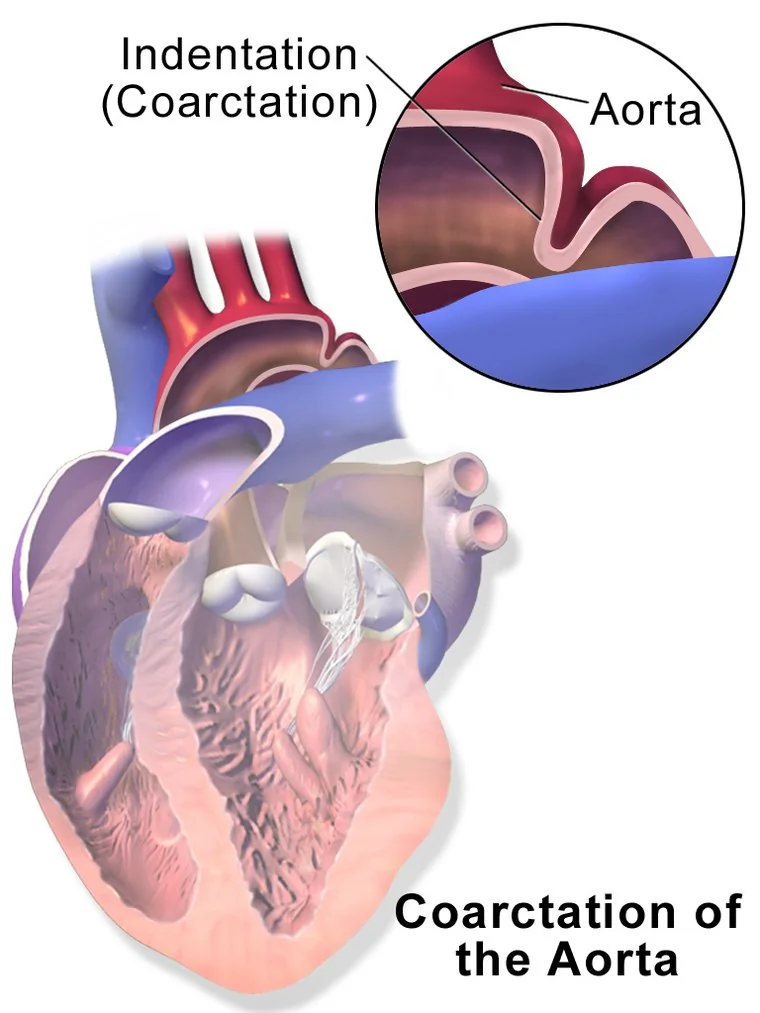
Confirm with echocardiography and CT or MR angiography. Treatment is surgical repair or stenting, though hypertension often persists afterwards and needs ongoing treatment and follow-up.
Obstructive sleep apnoea
Very common, greatly under-diagnosed, and strongly associated with resistant hypertension - repeated nocturnal hypoxia drives sympathetic activation and abolishes the normal nocturnal dip in blood pressure. Ask about snoring, witnessed apnoeas and daytime sleepiness, and use the Epworth Sleepiness Scale or STOP-BANG. Diagnose with a sleep study; CPAP produces a modest but real reduction in blood pressure.
Drugs and substances
- Combined oral contraceptive and other oestrogen-containing preparations
- Corticosteroids, and NSAIDs including over-the-counter ibuprofen
- Ciclosporin and tacrolimus
- Venlafaxine and other SNRIs
- Sympathomimetics - pseudoephedrine and other decongestants
- Erythropoietin
- Liquorice in quantity - it inhibits 11-beta-hydroxysteroid dehydrogenase and mimics aldosterone excess
- Alcohol, cocaine and amphetamines
A careful drug history, including over-the-counter and recreational use, is quicker and higher-yield than most of the investigations above.
Investigations
Everyone with hypertension has a baseline workup - U&Es, eGFR, urine albumin:creatinine ratio, HbA1c, lipids, ECG and fundoscopy. Where a secondary cause is suspected, add targeted tests rather than ordering everything.
| Suspected cause | First-line test |
|---|---|
| Renal parenchymal disease | U&Es, urine ACR and dipstick, renal ultrasound |
| Renal artery stenosis | Renal artery duplex ultrasound, then CT or MR angiography |
| Primary aldosteronism | Aldosterone-to-renin ratio, having reviewed interfering drugs |
| Phaeochromocytoma | Plasma free metanephrines or 24-hour urinary metanephrines |
| Cushing syndrome | Overnight dexamethasone suppression test or late-night salivary cortisol |
| Thyroid disease | TFTs |
| Coarctation | Four-limb blood pressure, echocardiogram, CT or MR angiography |
| Obstructive sleep apnoea | Epworth score, then a sleep study |
Management
The principle is to treat the cause, while controlling the blood pressure in the meantime with the standard algorithm. Some conditions have specific requirements that override the usual stepped approach:
- Primary aldosteronism - a mineralocorticoid receptor antagonist is the drug of choice, not an incidental step 4 addition; unilateral disease may be cured surgically
- Phaeochromocytoma - alpha-blockade before beta-blockade, then surgical excision by a specialist team
- Renal artery stenosis - optimal medical therapy for atherosclerotic disease; angioplasty for fibromuscular dysplasia. Monitor renal function closely after starting an ACE inhibitor or ARB.
- Coarctation - repair, with lifelong follow-up because hypertension frequently persists
- Obstructive sleep apnoea - CPAP, weight reduction and alcohol avoidance
- Drug-induced - stop or substitute the offending agent, then reassess before committing to treatment
Refer to a specialist hypertension service where the diagnosis is uncertain, where the patient is young, or where the blood pressure remains uncontrolled on four drugs. NICE advises specialist referral for anyone with resistant hypertension not controlled at step 4.1
Complications
The complications are those of hypertension generally - stroke, ischaemic heart disease, heart failure, chronic kidney disease and retinopathy - but secondary hypertension tends to produce them earlier and at higher blood pressures, because it often begins younger and is harder to control.
Several causes carry their own additional risks: primary aldosteronism is associated with more atrial fibrillation, stroke and left ventricular hypertrophy than blood-pressure-matched essential hypertension, probably through direct mineralocorticoid effects on the heart and vessels. Untreated phaeochromocytoma can precipitate a hypertensive crisis, arrhythmia, myocardial infarction or takotsubo cardiomyopathy, classically triggered by anaesthesia, surgery or contrast.
Red flags
Prognosis
Prognosis depends entirely on the cause and on how early it is found. Fibromuscular dysplasia treated with angioplasty, a unilateral aldosterone-producing adenoma removed surgically, or a phaeochromocytoma excised may all be cured, with blood pressure returning to normal and medication stopped.
The chance of cure falls the longer the hypertension has been present, because sustained pressure causes structural remodelling of the resistance vessels that does not fully reverse. This is the practical argument for screening young patients early rather than starting them on lifelong tablets and reviewing the diagnosis years later.
Where the cause is not curable - chronic kidney disease, atherosclerotic renal artery stenosis, obstructive sleep apnoea - identifying it still changes management, because it directs drug choice, sets the monitoring needed, and explains to the patient why their blood pressure has been difficult to control.
References
- NICE NG136. Hypertension in adults: diagnosis and management. 2019, updated 2023. Available here
- ASTRAL Investigators. Revascularization versus medical therapy for renal-artery stenosis. New England Journal of Medicine. 2009. Available here
- Funder JW, Carey RM, Mantero F et al. The management of primary aldosteronism: Endocrine Society clinical practice guideline. 2016. Available here
- Lenders JWM, Duh QY, Eisenhofer G et al. Pheochromocytoma and paraganglioma: an Endocrine Society clinical practice guideline. 2014. Available here
- NICE Clinical Knowledge Summaries. Hypertension - not diabetic. Available here
- NICE NG203. Chronic kidney disease: assessment and management. 2021. Available here
- BNF. Spironolactone - indications and dosing. Available here
- British and Irish Hypertension Society. Resistant hypertension resources. Available here
This article is written for revision and education. It is not clinical guidance and must not be used to make decisions about the care of a patient. Always check current NICE guidance and local protocols.