
Obstructive Sleep Apnoea: Sleepiness, CPAP and the Driving Conversation
Key points
- Obstructive sleep apnoea: recurrent collapse of the pharyngeal airway during sleep, causing apnoeas, hypopnoeas, intermittent hypoxaemia and repeated arousals.
- OSAHS: obstructive sleep apnoea plus daytime symptoms, principally excessive sleepiness. The syndrome, not the apnoeas alone, is what is treated.
- Classic history: loud snoring with witnessed apnoeas and choking, unrefreshing sleep, morning headache, nocturia and daytime sleepiness. The partner's account is often more useful than the patient's.
- Risk factors: obesity above all, particularly a collar size over 43 cm, plus male sex, increasing age, retrognathia, large tonsils, nasal obstruction, alcohol and sedatives.
- Sleepiness scoring: the Epworth Sleepiness Scale, scored out of 24. A score above 10 indicates excessive daytime sleepiness.
- Severity: graded by the apnoea-hypopnoea index - 5 to 14 mild, 15 to 30 moderate, above 30 severe events per hour of sleep.
- Treatment: weight loss and lifestyle change for everyone, CPAP for moderate to severe disease and for symptomatic mild disease, and a mandibular advancement device where CPAP is not tolerated.
- Driving: patients with OSAHS causing excessive sleepiness must inform the DVLA and must not drive until symptoms are controlled. Advising this and documenting it is a legal and professional duty.
Introduction
Obstructive sleep apnoea (OSA) is repeated collapse of the pharyngeal airway during sleep, producing complete cessations of airflow (apnoeas) and partial reductions (hypopnoeas). Each event causes hypoxaemia and a brief cortical arousal that restores airway tone, and the cycle then repeats - often hundreds of times a night, with the patient having no memory of any of it.
When OSA is accompanied by daytime symptoms, principally sleepiness, the condition is called obstructive sleep apnoea-hypopnoea syndrome (OSAHS). This distinction matters because treatment is directed at the syndrome rather than at the number of events on a study.
It affects an estimated 5 to 10% of UK adults, and prevalence is rising with obesity. It remains substantially under-diagnosed, partly because patients are unaware of their own symptoms and partly because sleepiness is so readily attributed to a busy life, depression or ageing.
Why the airway collapses
- The pharynx has no rigid skeletal support and depends on the tone of the dilator muscles, particularly genioglossus, to stay open
- Muscle tone falls during sleep, and falls furthest in REM sleep
- In a narrowed or crowded pharynx - from fat deposition, large tonsils, a small mandible or nasal obstruction - the negative intraluminal pressure of inspiration exceeds the dilating force and the airway collapses
- Apnoea causes hypoxaemia and hypercapnia, which drive increasing respiratory effort against a closed airway
- This triggers a cortical arousal, tone is restored, the airway opens with a loud snort, and breathing resumes - after which sleep deepens again and the cycle repeats
The consequences follow from the two elements of that cycle. Sleep fragmentation produces the daytime sleepiness and cognitive symptoms, while intermittent hypoxia with repeated sympathetic surges produces the cardiovascular and metabolic complications.
Risk factors
- Obesity - the dominant modifiable factor. Neck circumference (collar size) over 43 cm (17 inches) is a better predictor than BMI, because it reflects parapharyngeal fat directly.
- Male sex - two to three times more common, though the gap narrows sharply after the menopause
- Increasing age
- Craniofacial anatomy - retrognathia and micrognathia, a high arched palate, macroglossia
- Enlarged tonsils and adenoids - the commonest cause in children, in whom the presentation and treatment differ substantially from adults
- Nasal obstruction - septal deviation, polyps, chronic rhinitis
- Alcohol, sedatives and opioids - all reduce pharyngeal muscle tone and blunt arousal
- Smoking - through upper airway inflammation and oedema
- Endocrine disease - hypothyroidism and acromegaly, both of which are worth actively excluding
- Genetic syndromes - Down syndrome (midface hypoplasia, macroglossia, hypotonia), Marfan syndrome, Prader-Willi syndrome
- Family history, and supine sleeping position, which worsens events in most patients
Clinical features
Nocturnal symptoms
- Loud, habitual snoring - present in almost all, though most snorers do not have OSA
- Witnessed apnoeas - pauses in breathing observed by a bed partner, and the single most specific symptom
- Choking or gasping arousals
- Restless, unrefreshing sleep
- Nocturia - frequently overlooked, and caused by atrial natriuretic peptide release from the negative intrathoracic pressure swings
- Night sweats and reflux
Daytime symptoms
- Excessive daytime sleepiness - the cardinal symptom. Ask specifically about falling asleep watching television, in meetings, as a passenger, and critically while driving.
- Morning headache and a dry mouth on waking
- Poor concentration, impaired memory and reduced work performance
- Irritability, low mood and personality change - often noticed by family before the patient
- Reduced libido and erectile dysfunction
Examination
- BMI and neck circumference - measure both, and record them
- Blood pressure - hypertension is common, and OSA is a leading cause of resistant hypertension
- Upper airway - tonsillar size, tongue size, palate position (Mallampati score), nasal patency, retrognathia and dental occlusion
- Signs of an underlying cause - the coarse features and large hands of acromegaly, the dry skin and slow reflexes of hypothyroidism
- Signs of complications - peripheral oedema and a raised JVP suggesting cor pulmonale, and a plethoric appearance suggesting polycythaemia
Scoring sleepiness
The Epworth Sleepiness Scale asks how likely the person is to doze in eight everyday situations, each scored 0 to 3, giving a total out of 24.
| Score | Interpretation |
|---|---|
| 0-10 | Normal daytime sleepiness |
| 11-14 | Mild excessive daytime sleepiness |
| 15-18 | Moderate excessive daytime sleepiness |
| 19-24 | Severe excessive daytime sleepiness |
It is a subjective measure and correlates only loosely with the apnoea-hypopnoea index, so a low Epworth score does not exclude significant OSA - but it is useful for tracking response to treatment. The STOP-BANG questionnaire (Snoring, Tiredness, Observed apnoeas, Pressure, BMI, Age, Neck circumference, Gender) is a widely used screening tool with high sensitivity.
Investigations
Sleep studies
- Overnight pulse oximetry - the simplest home test, giving the oxygen desaturation index (ODI). Useful as a screen, but it under-detects events in patients who arouse before desaturating, so a normal result does not exclude OSA.
- Home respiratory polygraphy (limited-channel cardiorespiratory study) - records airflow, respiratory effort, oximetry, heart rate and body position. This is the usual UK diagnostic test.
- Full polysomnography - the gold standard, adding EEG, EOG and EMG so that sleep stage and arousals are measured directly. Reserved for diagnostic uncertainty, suspected central sleep apnoea, or coexisting sleep disorders such as narcolepsy or periodic limb movement disorder.
| AHI (events/hour) | Severity |
|---|---|
| Under 5 | Normal |
| 5-14 | Mild |
| 15-30 | Moderate |
| Above 30 | Severe |
An apnoea is a cessation of airflow for at least 10 seconds; a hypopnoea is a reduction in airflow of at least 30% for at least 10 seconds accompanied by a fall in oxygen saturation or an arousal. Treatment decisions rest on the combination of AHI and symptoms, not on the index alone.
Other tests
- Thyroid function tests - to exclude hypothyroidism
- HbA1c and lipid profile - given the metabolic associations, and to assess overall cardiovascular risk
- Full blood count - secondary polycythaemia from chronic hypoxaemia
- Arterial or capillary blood gas, or serum bicarbonate - a raised bicarbonate suggests chronic CO2 retention and should prompt consideration of obesity hypoventilation syndrome
- Spirometry - to identify coexisting COPD, which combined with OSA is termed the overlap syndrome and carries a worse prognosis
- Echocardiogram - if pulmonary hypertension or right heart failure is suspected
- ENT assessment and nasendoscopy - where anatomical obstruction is suspected or surgery is being considered
Management
Lifestyle measures, for everyone
- Weight loss - the only intervention that treats the underlying cause. A 10% reduction in weight typically reduces the AHI by around a quarter, and substantial weight loss can resolve OSA entirely. Offer structured support, and consider bariatric surgery where criteria are met.
- Avoid alcohol, particularly in the evening, and review sedatives, opioids and muscle relaxants
- Smoking cessation
- Sleep position - avoiding the supine position helps many patients, and positional devices are available
- Good sleep hygiene and adequate sleep duration
- Treat nasal obstruction - a nasal corticosteroid for rhinitis, or ENT referral for structural obstruction
Continuous positive airway pressure
CPAP is the first-line treatment for moderate and severe OSAHS, and for mild OSAHS where symptoms affect quality of life or where lifestyle measures have failed.1 It delivers a constant positive pressure through a mask, which acts as a pneumatic splint holding the pharynx open.
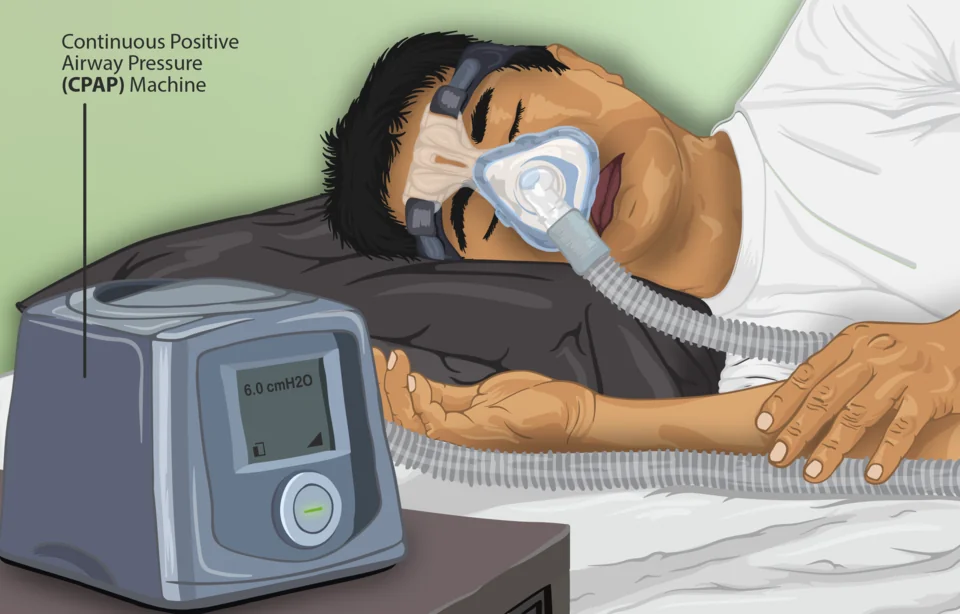
- Benefits - abolishes apnoeas, improves daytime sleepiness and quality of life, reduces blood pressure modestly, and reduces road traffic accident risk. Evidence that it reduces cardiovascular events in asymptomatic patients is weaker, which is why symptoms drive the decision to treat.
- Adherence is the limiting factor - roughly half of patients use it inadequately. Usage of at least 4 hours a night on most nights is the usual target.
- Side effects - nasal congestion and dryness (treated with humidification), mask leak and pressure sores, claustrophobia, aerophagia and dry mouth. Most are solvable with mask refitting and support, so a patient struggling with CPAP needs review rather than abandonment.
- Follow-up matters more than the initial prescription: download the machine's usage and residual AHI data, and address problems early while the patient is still willing to persist.
Other treatments
- Mandibular advancement device - a custom dental appliance that holds the mandible forward, increasing pharyngeal space. An option for mild to moderate OSAHS, for snoring, and for patients who cannot tolerate CPAP. Requires adequate dentition and a dental assessment; side effects include jaw discomfort and bite change.
- Surgery - tonsillectomy and adenoidectomy is first-line treatment in children and highly effective. In adults, nasal surgery may improve CPAP tolerance; uvulopalatopharyngoplasty has limited and unpredictable benefit; maxillomandibular advancement is effective in selected patients with craniofacial abnormality. Hypoglossal nerve stimulation is an emerging option for selected CPAP-intolerant patients.
- Non-invasive ventilation - for obesity hypoventilation syndrome or coexisting type 2 respiratory failure
- Modafinil - occasionally used for residual sleepiness despite adequately treated OSA, under specialist supervision
- Treat comorbidities - hypertension, diabetes, hypothyroidism, acromegaly, heart failure and atrial fibrillation
Complications
- Hypertension - OSA is one of the commonest identifiable causes of resistant hypertension, and should be considered in anyone needing three or more antihypertensives
- Ischaemic heart disease and stroke - risk raised roughly two to threefold in severe untreated disease
- Atrial fibrillation and other arrhythmias - including nocturnal bradyarrhythmias. Untreated OSA substantially increases AF recurrence after cardioversion or ablation, so treating it is part of rhythm control.
- Type 2 diabetes and metabolic syndrome - through intermittent hypoxia and sympathetic activation causing insulin resistance
- Pulmonary hypertension and cor pulmonale - particularly with coexisting COPD or obesity hypoventilation
- Road traffic accidents - risk increased two to sevenfold, and the reason the DVLA takes the condition seriously
- Workplace and domestic accidents
- Depression and cognitive impairment
- Perioperative complications - difficult airway, sensitivity to sedatives and opioids, and postoperative respiratory depression. Flag OSA before any anaesthetic, and continue CPAP in hospital.
- Reduced quality of life for the patient and their partner, whose sleep is often equally disrupted
Red flags
Prognosis
Untreated moderate to severe OSA carries a measurable increase in cardiovascular morbidity and mortality, largely through hypertension, stroke, arrhythmia and ischaemic heart disease, together with a substantially increased risk of road traffic accidents.
The outlook with treatment is good, and the improvement in symptoms with effective CPAP is often dramatic and rapid - many patients describe the first proper night's sleep in years within a week. Sleepiness, concentration, mood and quality of life all improve, and accident risk falls towards that of the general population. Whether CPAP reduces hard cardiovascular endpoints in asymptomatic patients remains debated, which is why current UK practice treats the syndrome rather than the index.
The determinants of long-term outcome are unglamorous: adherence to CPAP and sustained weight loss. Adherence is best predicted by early experience, so the first few weeks - mask fitting, humidification, troubleshooting and encouragement - do more for the patient's long-term prognosis than any subsequent adjustment. And in a proportion of patients, meaningful weight loss cures the condition outright, which is worth stating explicitly as a goal rather than leaving as background advice.
References
- NICE NG202. Obstructive sleep apnoea/hypopnoea syndrome and obesity hypoventilation syndrome in over 16s. 2021. Available here
- NICE TA139. Continuous positive airway pressure for the treatment of obstructive sleep apnoea/hypopnoea syndrome. 2008. Available here
- DVLA. Assessing fitness to drive: a guide for medical professionals. Available here
- British Thoracic Society. Quality standards for sleep apnoea services. Available here
- NICE Clinical Knowledge Summaries. Obstructive sleep apnoea syndrome. Available here
- Johns MW. A new method for measuring daytime sleepiness: the Epworth sleepiness scale. Sleep. 1991. Available here
- General Medical Council. Confidentiality: patients' fitness to drive and reporting concerns to the DVLA or DVA. Available here
- myUpchar, CC BY-SA 4.0, via Wikimedia Commons. Available here
This article is written for revision and education. It is not clinical guidance and must not be used to make decisions about the care of a patient. Always check current NICE guidance and local protocols.