
Phaeochromocytoma: The Catecholamine-Secreting Tumour You Must Not Beta-Block First
Key points
- Phaeochromocytoma: a catecholamine-secreting tumour arising from the chromaffin cells of the adrenal medulla. The identical tumour arising from extra-adrenal sympathetic paraganglia is a paraganglioma.
- Rule of 10s: traditionally taught as around 10% bilateral, 10% extra-adrenal, 10% malignant and 10% familial - but the familial rate is now known to be far higher, around 30 to 40%, so genetic testing should be offered widely.
- Genetic syndromes: MEN2A and MEN2B (RET mutations), von Hippel-Lindau disease, neurofibromatosis type 1, and familial paraganglioma syndromes from SDH gene mutations.
- Classic presentation: episodic headache, sweating and palpitations (the classic triad) with paroxysmal severe hypertension, pallor, tremor and anxiety - easily mistaken for panic attacks.
- First-line test: plasma free metanephrines (or 24-hour urinary fractionated metanephrines) - highly sensitive tests that should precede any imaging.
- The critical management point: alpha-blockade must be established before beta-blockade. Starting a beta-blocker first leaves alpha-mediated vasoconstriction unopposed and can precipitate a hypertensive crisis.
- Definitive treatment: surgical adrenalectomy, after adequate alpha-blockade and volume/salt loading, since these patients are typically volume-contracted.
- Follow-up: lifelong, because of the risk of recurrence, metachronous tumours and malignant/metastatic disease, particularly in familial cases.
Introduction
A phaeochromocytoma is a catecholamine-secreting tumour arising from the chromaffin cells of the adrenal medulla. When an identical tumour arises outside the adrenal gland - from the sympathetic paraganglia along the paravertebral and para-aortic chain, or from the organ of Zuckerkandl - it is called a paraganglioma. Both secrete catecholamines (noradrenaline, adrenaline, and sometimes dopamine) and are managed in essentially the same way, so the two are often discussed together.
They are rare, with an incidence of around 2 to 8 per million per year, but are important disproportionate to their frequency: they are a curable cause of hypertension, they can present with life-threatening crises, and missing the diagnosis before surgery or anaesthesia can be fatal.
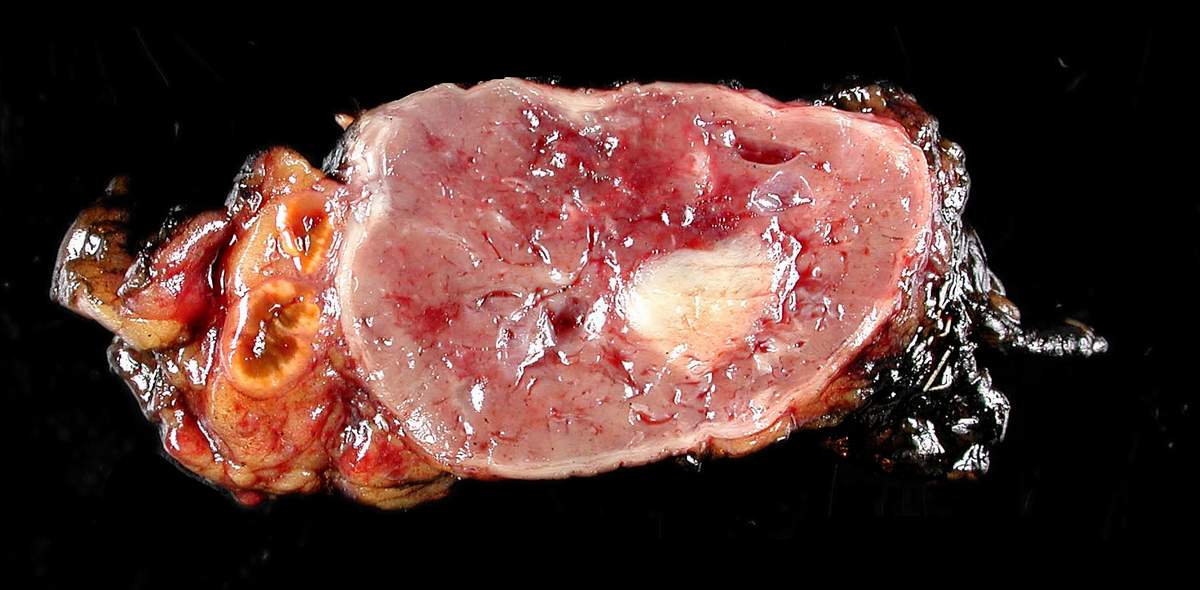
The rule of 10s - and why it is now out of date
Phaeochromocytoma has traditionally been taught by the "rule of 10s":
- 10% bilateral - more common in familial syndromes
- 10% extra-adrenal (i.e. paraganglioma)
- 10% malignant - better termed metastatic, since malignancy can only be confirmed by finding tumour at a site where chromaffin tissue does not normally occur (e.g. bone, liver, lymph nodes), not by histology alone
- 10% familial
Associated genetic syndromes
| Syndrome | Gene | Associated features |
|---|---|---|
| MEN2A | RET (proto-oncogene) | Medullary thyroid carcinoma, phaeochromocytoma (often bilateral), primary hyperparathyroidism |
| MEN2B | RET | Medullary thyroid carcinoma, phaeochromocytoma, mucosal neuromas, marfanoid habitus, no hyperparathyroidism |
| Von Hippel-Lindau disease | VHL | Phaeochromocytoma (often bilateral), retinal and CNS haemangioblastomas, renal cell carcinoma, pancreatic cysts and neuroendocrine tumours |
| Neurofibromatosis type 1 | NF1 | Café-au-lait macules, neurofibromas, Lisch nodules, phaeochromocytoma in around 1 to 5% |
| Familial paraganglioma syndromes | SDHB, SDHD, SDHC (succinate dehydrogenase subunits) | SDHB mutations carry the highest risk of metastatic disease and extra-adrenal paraganglioma; SDHD mutations are associated with head and neck paragangliomas and show parent-of-origin (imprinting) inheritance |
Clinical features
The clinical picture reflects intermittent, unpredictable catecholamine release. Symptoms are classically paroxysmal, lasting minutes to an hour, and may be triggered or spontaneous.
- Paroxysmal severe hypertension - the blood pressure may be normal between episodes, particularly in extra-adrenal or noradrenaline-predominant tumours; a minority have sustained hypertension throughout
- Pallor during attacks, rather than flushing - a useful discriminator from carcinoid syndrome, which causes flushing
- Tremor and anxiety - attacks are frequently mistaken for panic attacks or anxiety disorder, which is one of the commonest reasons for delayed diagnosis
- Chest or abdominal pain, nausea and vomiting
- Weight loss despite normal or increased appetite, from the catabolic effect of catecholamine excess
- Postural hypotension between attacks - from chronic volume contraction and down-regulated adrenergic receptors, despite the hypertension during attacks
- Hyperglycaemia - catecholamines inhibit insulin release and promote glycogenolysis
- Constipation - particularly with tumours that co-secrete vasoactive intestinal peptide or other neuropeptides
- A palpable abdominal mass occasionally, in large tumours
Differential diagnosis
- Panic disorder and anxiety states - the commonest misdiagnosis; consider phaeochromocytoma when attacks are accompanied by objectively measured severe hypertension
- Primary hyperthyroidism - tremor, sweating, tachycardia and weight loss overlap, but hypertension and pallor are not typical
- Menopausal flushing - flushing rather than pallor, and blood pressure is usually normal
- Carcinoid syndrome - flushing, diarrhoea and wheeze rather than pallor and severe hypertension
- Hypoglycaemia
- Autonomic dysreflexia in spinal cord injury
- Illicit sympathomimetic drug use - cocaine, amphetamines
- Clonidine withdrawal
- Essential hypertension with anxiety
Investigations
Biochemical confirmation first
Biochemical testing always precedes imaging. Catecholamines themselves are secreted episodically and are unreliable; tumours continuously leak their metabolites - metanephrine and normetanephrine - which are therefore a far more sensitive marker.
| Test | Notes |
|---|---|
| Plasma free metanephrines | The most sensitive test available (sensitivity around 97 to 99%), with a high negative predictive value - a normal result makes the diagnosis very unlikely. Sample with the patient supine and rested to reduce false positives. |
| 24-hour urinary fractionated metanephrines | Alternative first-line test with similarly high sensitivity; often used alongside or instead of plasma testing depending on local practice |
Localisation
- CT or MRI of the abdomen and pelvis - performed only after biochemical confirmation, since incidental adrenal lesions are common and biochemically silent ones do not need surgery for this diagnosis. MRI is preferred in children, pregnancy and where iodinated contrast is a concern.
- MIBG (metaiodobenzylguanidine) scintigraphy - a functional scan using a molecule taken up by chromaffin tissue; useful for extra-adrenal disease, multifocal tumours, and to screen for metastases when malignancy is suspected
- Ga-68 DOTATATE PET-CT - increasingly preferred over MIBG for extra-adrenal, metastatic or SDHB-related disease, with higher sensitivity
- Genetic testing - as above, in all confirmed cases
Management
Preoperative medical preparation
| Drug | Notes |
|---|---|
| Phenoxybenzamine | A non-selective, irreversible alpha-blocker; the traditional agent of choice, though it causes marked postural hypotension and reflex tachycardia and is long-acting so its effect persists after surgery |
| Doxazosin | A selective alpha-1 blocker; increasingly preferred as it causes less reflex tachycardia and its shorter action allows easier postoperative titration |
| Beta-blocker (e.g. propranolol) | Added only after adequate alpha-blockade, to control tachycardia and arrhythmia |
| Calcium channel blockers | Sometimes added or used as an alternative/adjunct where alpha-blockade alone is insufficient or causes intolerable side effects |
| Metyrosine | Inhibits tyrosine hydroxylase, reducing catecholamine synthesis itself; reserved for specialist use, particularly in malignant disease or difficult-to-control cases |
Volume and salt loading
Chronic catecholamine excess causes profound vasoconstriction and volume contraction. Once alpha-blockade removes that vasoconstriction, the circulating volume is often inadequate, risking severe hypotension at induction of anaesthesia and after tumour removal. Patients should therefore be advised to liberalise salt and fluid intake in the days before surgery, and are often admitted for intravenous fluid loading immediately preoperatively.
Surgery
- Laparoscopic adrenalectomy is the treatment of choice for most tumours, with open surgery reserved for very large or invasive tumours or where malignancy is strongly suspected
- Anticipate haemodynamic instability: catecholamine surges during tumour handling can cause severe hypertension intraoperatively, and abrupt catecholamine withdrawal once the venous drainage is ligated can cause profound hypotension - invasive arterial monitoring and close anaesthetic input are essential
- Postoperative hypoglycaemia can occur as the suppressive effect of catecholamines on insulin secretion is suddenly removed
- Bilateral disease (e.g. in MEN2 or VHL) may be managed with cortical-sparing adrenalectomy to preserve some adrenocortical function and avoid lifelong steroid replacement, balanced against the risk of local recurrence
Malignant/metastatic disease
- Managed with a combination of surgical debulking, 131I-MIBG therapy where the tumour is MIBG-avid, peptide receptor radionuclide therapy (PRRT) with DOTATATE for somatostatin-receptor-positive disease, and chemotherapy (e.g. cyclophosphamide, vincristine and dacarbazine)
- Metyrosine and alpha/beta-blockade remain important for ongoing symptom and blood pressure control
- Prognosis is more guarded than for benign disease but survival can still be prolonged over many years
Complications
- Hypertensive crisis - with the risk of stroke, myocardial infarction, aortic dissection or acute pulmonary oedema
- Catecholamine-induced cardiomyopathy - which can present as acute heart failure or a Takotsubo-like picture, and typically improves after tumour removal
- Arrhythmias, including life-threatening ventricular arrhythmias during a crisis
- Severe intraoperative haemodynamic instability
- Postoperative hypotension and hypoglycaemia
- Recurrence - local or at a new site, particularly in familial disease
- Metastatic disease - most often to bone, liver, lungs and lymph nodes
Red flags
Prognosis
The great majority of phaeochromocytomas are benign, and surgical removal after adequate alpha-blockade is usually curative, with resolution or major improvement of hypertension in most patients.
Because of the substantial rate of familial disease and the possibility of late recurrence or metachronous tumours, follow-up is lifelong, typically with annual clinical review and biochemical testing (plasma or urinary metanephrines). This is particularly important in confirmed genetic syndromes, where new tumours can develop years after apparently successful surgery.
Metastatic disease carries a more guarded prognosis, though the course can still be prolonged over many years with a combination of surgical, radionuclide and medical therapy. SDHB mutation carriers have the highest risk of metastatic disease and require closer surveillance.
References
- NICE Clinical Knowledge Summaries. Phaeochromocytoma and paraganglioma. Available here
- Lenders JWM, Duh QY, Eisenhofer G et al. Pheochromocytoma and paraganglioma: an Endocrine Society clinical practice guideline. 2014. Available here
- Society for Endocrinology. Clinical guidance on adrenal disorders. Available here
- NICE NG136. Hypertension in adults: diagnosis and management. 2019, updated 2023. Available here
- BNF. Phenoxybenzamine and doxazosin. Available here
- Fishbein L, Del Rivero J, Else T et al. The North American Neuroendocrine Tumor Society consensus guidelines for surveillance and management of metastatic and/or unresectable pheochromocytoma and paraganglioma. Pancreas. 2021. Available here
- Michael Feldman MD PhD, University of Pennsylvania School of Medicine, CC BY 2.0, via Wikimedia Commons. Available here
This article is written for revision and education. It is not clinical guidance and must not be used to make decisions about the care of a patient. Always check current NICE guidance and local protocols.