
Cushing Syndrome: Confirming Cortisol Excess and Finding the Source
Key points
- Cushing syndrome: the clinical state produced by chronic glucocorticoid excess from any cause. Cushing's disease means specifically a pituitary ACTH-secreting adenoma.
- Commonest cause by far: exogenous corticosteroids. Ask about tablets, inhalers, creams, eye drops, injections and over-the-counter preparations before investigating anything.
- Discriminatory features: proximal myopathy, easy bruising, facial plethora, violaceous striae over 1 cm wide, and in children weight gain with growth arrest. These separate Cushing's from simple obesity.
- Screening: overnight 1 mg dexamethasone suppression test, late-night salivary cortisol, or 24-hour urinary free cortisol. Two abnormal tests are needed before proceeding.
- ACTH localises the cause: a suppressed ACTH means an adrenal source - image the adrenals. A normal or raised ACTH means a pituitary or ectopic source - image the pituitary.
- Ectopic ACTH: rapid onset, marked pigmentation, severe hypokalaemic alkalosis and weight loss rather than the classical habitus. Small cell lung cancer is the usual source.
- Inferior petrosal sinus sampling: the gold standard for separating a pituitary from an ectopic source when imaging is equivocal.
- First-line treatment of Cushing's disease: trans-sphenoidal selective adenomectomy, which achieves remission in around 80% of microadenomas.
Introduction
Cushing syndrome is the clinical state resulting from chronic exposure to excess glucocorticoid. Two terms are used loosely and should not be:
- Cushing syndrome - the clinical picture, from any cause
- Cushing's disease - the specific subset caused by an ACTH-secreting pituitary adenoma, which accounts for around 70% of endogenous cases
Endogenous Cushing syndrome is rare, with an incidence of around 2 to 3 per million per year. Exogenous (iatrogenic) Cushing syndrome from prescribed corticosteroids is vastly more common, and is the first thing to exclude in any patient with the phenotype.
| Group | Cause | Proportion of endogenous cases |
|---|---|---|
| Exogenous | Corticosteroids - oral, inhaled at high dose, topical, intra-articular, intranasal or intraocular. Also potentiated by CYP3A4 inhibitors such as ritonavir given with fluticasone, and by unlabelled steroid in herbal or imported preparations. | By far the commonest cause overall |
| ACTH-dependent (around 80%) | Cushing's disease - pituitary corticotroph adenoma, usually a microadenoma | Around 70% |
| Ectopic ACTH secretion - small cell lung carcinoma, bronchial carcinoid, pancreatic and thymic neuroendocrine tumours, medullary thyroid carcinoma, phaeochromocytoma | Around 10% | |
| Ectopic CRH secretion - very rare | Under 1% | |
| ACTH-independent (around 20%) | Adrenal adenoma | Around 10% |
| Adrenal carcinoma - often with virilisation from concurrent androgen excess | Around 5% | |
| Bilateral adrenal hyperplasia - micronodular (including Carney complex) or macronodular; also McCune-Albright syndrome | Around 5% |
Clinical features
Cortisol acts on almost every tissue, and the clinical picture reflects its catabolic, metabolic, mineralocorticoid and psychological effects.
| System | Features |
|---|---|
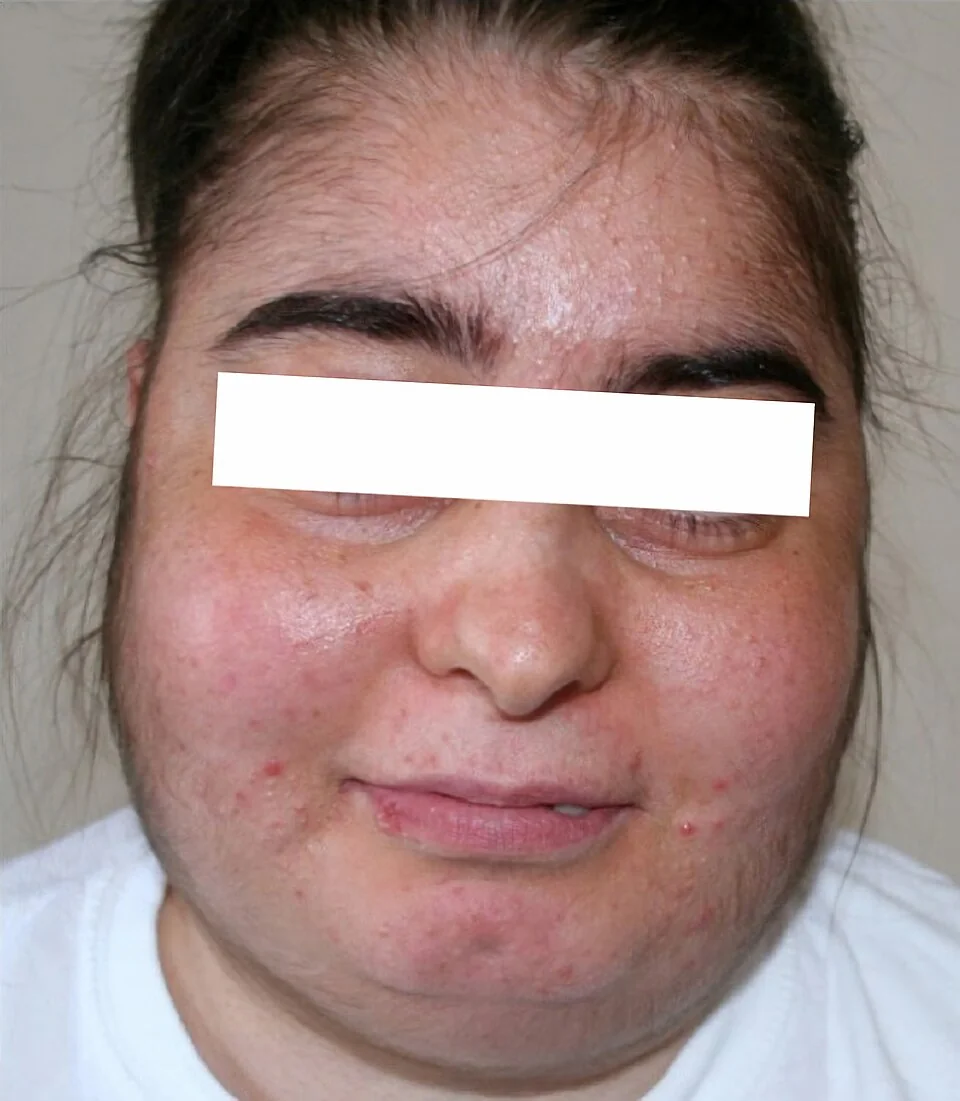
| Fat distribution | Central (truncal) obesity with relatively thin limbs, moon face, interscapular fat pad (buffalo hump) and supraclavicular fat pads |
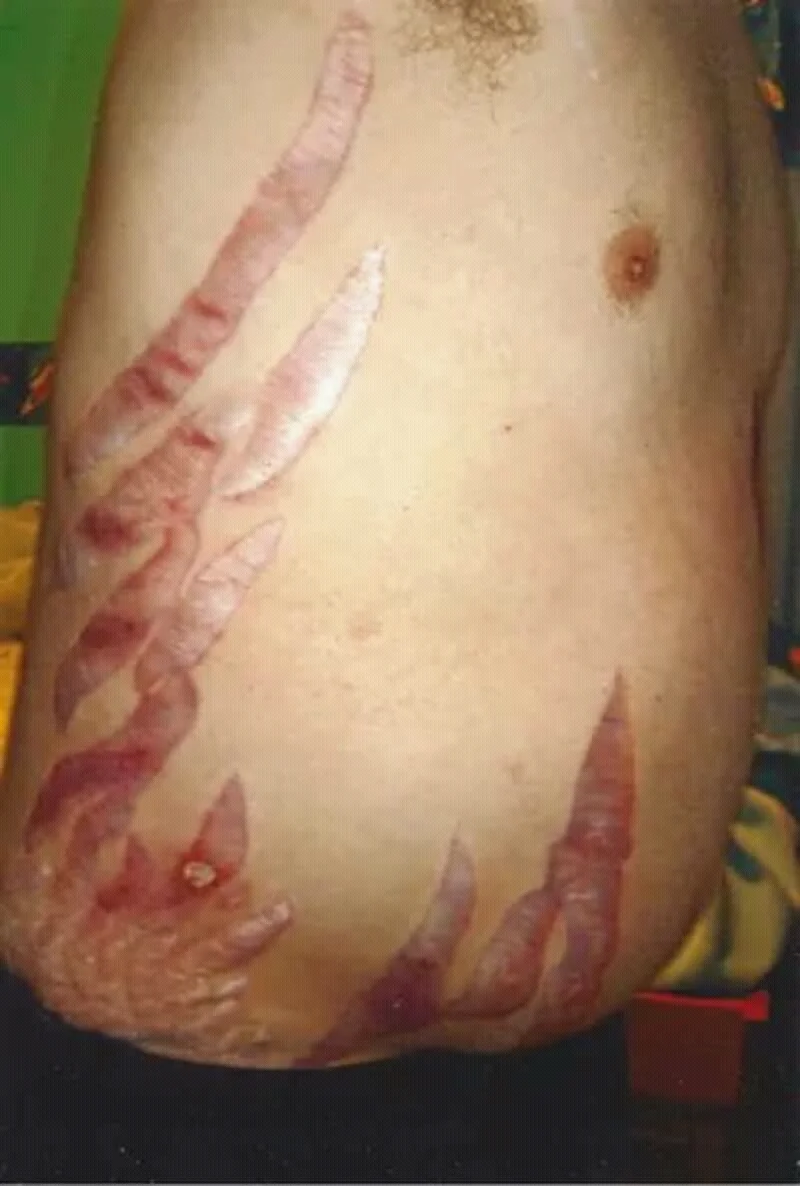
| Skin | Thin, fragile skin, easy bruising, violaceous (purple) striae wider than 1 cm over the abdomen, thighs and breasts, poor wound healing, facial plethora, acne, hirsutism and fungal infections |
| Muscle | Proximal myopathy - difficulty rising from a chair or climbing stairs without using the arms. One of the most discriminating features. |
| Bone | Osteoporosis with vertebral crush fractures, rib fractures and avascular necrosis of the femoral head |
| Metabolic | Hypertension, diabetes or impaired glucose tolerance, dyslipidaemia, and hypokalaemic metabolic alkalosis from mineralocorticoid activity - marked in ectopic ACTH |
| Reproductive | Oligomenorrhoea or amenorrhoea, reduced libido, erectile dysfunction and infertility |
| Psychiatric | Depression, emotional lability, irritability, insomnia, cognitive impairment and, occasionally, frank psychosis |
| Immune | Increased susceptibility to infection, including opportunistic infections such as Pneumocystis and reactivated tuberculosis |
| Children | Weight gain with growth arrest - a combination that is highly specific and should always prompt investigation |
Investigations
Investigation proceeds in three deliberate stages, and skipping ahead causes a great deal of confusion.
Step 1: exclude exogenous steroids
Take a meticulous drug history covering oral steroids, inhalers, nasal sprays, eye drops, skin creams (including those bought online or obtained abroad), joint and epidural injections, and herbal or traditional remedies, which not infrequently contain undeclared corticosteroid. Also ask about drug interactions - ritonavir and other CYP3A4 inhibitors dramatically increase systemic exposure to inhaled or intranasal fluticasone.
Step 2: confirm cortisol excess
No single test is sufficient. Two abnormal results from different tests are required before proceeding, because false positives are common.
| Test | Method | Abnormal result |
|---|---|---|
| Overnight (low-dose) dexamethasone suppression test | 1 mg dexamethasone at 11 pm, serum cortisol at 9 am | Failure to suppress cortisol below 50 nmol/L |
| Late-night salivary cortisol | Two samples collected at home at 11 pm | Raised - reflecting loss of the normal diurnal fall, which is the earliest abnormality in Cushing syndrome |
| 24-hour urinary free cortisol | Two complete collections | Raised above the reference range |
| 48-hour low-dose dexamethasone suppression test | 0.5 mg 6-hourly for 48 hours | Failure to suppress - more specific than the overnight test and used where that is equivocal |
Step 3: localise the source
Once cortisol excess is confirmed, measure plasma ACTH. This single result divides the differential in two.
| Plasma ACTH | Interpretation | Next step |
|---|---|---|
| Suppressed (below about 1.1 pmol/L) | ACTH-independent - an adrenal source producing cortisol autonomously and suppressing pituitary ACTH | CT or MRI of the adrenals - looking for an adenoma, carcinoma or bilateral hyperplasia |
| Normal or raised | ACTH-dependent - a pituitary or ectopic source | MRI pituitary, plus further differentiation as below |
Distinguishing pituitary from ectopic ACTH
- High-dose dexamethasone suppression test (8 mg) - a pituitary adenoma retains partial negative feedback, so cortisol suppresses by more than 50%. An ectopic source does not suppress. The test is imperfect - some bronchial carcinoids do suppress - but remains a useful discriminator.
- CRH stimulation test - a pituitary adenoma shows an exaggerated rise in ACTH and cortisol; an ectopic source shows little or no response
- MRI pituitary - but note that around 40% of corticotroph microadenomas are not visible, and incidental pituitary lesions are present in up to 10% of the population, so imaging alone cannot settle the question
- Inferior petrosal sinus sampling (IPSS) - the gold standard. ACTH is measured simultaneously from both inferior petrosal sinuses and peripherally, before and after CRH. A central-to-peripheral ACTH gradient confirms a pituitary source and may lateralise the adenoma.
- Imaging for an ectopic source - CT of the chest, abdomen and pelvis, and Ga-68 DOTATATE PET-CT for neuroendocrine tumours, which may be very small and elusive
Supporting investigations
- U&Es - hypokalaemia with metabolic alkalosis, especially in ectopic ACTH
- Glucose and HbA1c - diabetes or impaired glucose tolerance in around half
- Lipids
- DEXA bone density scan - osteoporosis is common and often already established at diagnosis
- Full blood count - neutrophilia with lymphopenia and eosinopenia is characteristic of glucocorticoid excess
- Adrenal androgens (DHEAS) - markedly raised levels with virilisation suggest adrenal carcinoma
Management
Exogenous Cushing syndrome
- Reduce the steroid to the lowest effective dose and withdraw where possible, but never abruptly - the hypothalamic-pituitary-adrenal axis is suppressed and sudden withdrawal precipitates an adrenal crisis. Taper slowly, and consider a short Synacthen test before final withdrawal in prolonged courses.
- Use steroid-sparing agents and alternative routes or formulations where the underlying condition allows
- Bone protection - calcium, vitamin D and a bisphosphonate for anyone on long-term glucocorticoids, and a DEXA scan
- Gastroprotection, glucose monitoring, blood pressure control and attention to infection risk
- Issue a steroid emergency card, and counsel about sick day rules - the dose must be increased during intercurrent illness
Endogenous Cushing syndrome
| Cause | Treatment |
|---|---|
| Cushing's disease (pituitary adenoma) | Trans-sphenoidal selective adenomectomy is first line, achieving remission in around 80% of microadenomas. Second line: pituitary radiotherapy, medical therapy, or bilateral adrenalectomy as a last resort. |
| Adrenal adenoma | Laparoscopic adrenalectomy. The contralateral gland is suppressed, so glucocorticoid replacement is required postoperatively and tapered over months while the axis recovers. |
| Adrenal carcinoma | Adrenalectomy, with mitotane as adjuvant therapy. Prognosis is poor. |
| Ectopic ACTH | Treat the underlying tumour - resect a bronchial carcinoid; treat small cell lung cancer with chemotherapy. Where the tumour is occult or unresectable, control cortisol medically or perform bilateral adrenalectomy. |
| Bilateral adrenal hyperplasia | Bilateral adrenalectomy, with lifelong glucocorticoid and mineralocorticoid replacement |
Medical control of cortisol
Used to prepare patients for surgery, while awaiting the effect of radiotherapy, or where surgery is not possible.
- Metyrapone - inhibits 11-beta-hydroxylase; the usual first choice in the UK
- Ketoconazole - inhibits several steroidogenic enzymes; requires liver function monitoring
- Osilodrostat - a newer 11-beta-hydroxylase inhibitor
- Pasireotide - a somatostatin analogue acting on the pituitary adenoma; causes hyperglycaemia
- Cabergoline - a dopamine agonist, effective in a minority
- Mifepristone - a glucocorticoid receptor antagonist, used where hyperglycaemia is prominent
- Etomidate - by infusion, for rapid control of life-threatening hypercortisolaemia in critical care
- Monitor for adrenal insufficiency during medical treatment, and use a block-and-replace approach where control is difficult
Complications
- Cardiovascular disease - hypertension, left ventricular hypertrophy, ischaemic heart disease and stroke. This is the leading cause of death in untreated Cushing syndrome.
- Venous thromboembolism - cortisol excess creates a markedly hypercoagulable state, and the risk is highest perioperatively. Thromboprophylaxis is essential.
- Diabetes mellitus and dyslipidaemia
- Osteoporosis and fragility fracture - vertebral fractures may be the presenting feature, and avascular necrosis of the femoral head also occurs
- Infection - including opportunistic infections; fever and other signs may be blunted by the steroid excess, so infection presents late
- Psychiatric illness - depression, anxiety, psychosis and cognitive impairment, which may persist after biochemical cure
- Proximal myopathy with functional impairment
- Poor wound healing and skin breakdown
- Growth failure in children
- Adrenal crisis after treatment or abrupt steroid withdrawal
- Nelson's syndrome after bilateral adrenalectomy
Red flags
Prognosis
Untreated endogenous Cushing syndrome carries a 5-year mortality approaching 50%, driven principally by cardiovascular disease, thromboembolism and infection. This is a striking figure for a condition that is often mentally filed under cosmetic change, and it is the reason investigation should not be deferred.
With successful treatment the outlook is transformed. Trans-sphenoidal surgery achieves remission in around 80% of pituitary microadenomas, and adrenalectomy is curative for a benign adenoma. Hypertension, diabetes, weight and the physical appearance improve substantially over 6 to 12 months.
Recovery is nonetheless incomplete for many. Excess cardiovascular risk persists for years after biochemical cure, bone density recovers slowly, and psychiatric and cognitive symptoms may not fully resolve - a genuinely important point to convey, because patients are frequently told the problem is fixed and then find that they do not feel well. Around 10 to 20% of Cushing's disease relapses, so follow-up is lifelong.
Adrenal carcinoma is the exception, with a poor prognosis and frequent recurrence despite surgery and mitotane. Ectopic ACTH prognosis is that of the underlying tumour - excellent where a bronchial carcinoid can be resected, poor where the source is small cell lung cancer.
References
- NICE Clinical Knowledge Summaries. Cushing's syndrome. Available here
- Nieman LK, Biller BMK, Findling JW et al. The diagnosis of Cushing's syndrome: an Endocrine Society clinical practice guideline. Available here
- Nieman LK, Biller BMK, Findling JW et al. Treatment of Cushing's syndrome: an Endocrine Society clinical practice guideline. 2015. Available here
- Society for Endocrinology. Endocrine emergency guidance - adrenal crisis and steroid safety. Available here
- NICE NG146. Adrenal insufficiency and corticosteroid replacement guidance. Available here
- BNF. Prednisolone, hydrocortisone and metyrapone. Available here
- Celik O, Niyazoglu M, Soylu H, Kadioglu P, CC BY 2.5, via Wikimedia Commons. Available here
- Masryyy, CC BY-SA 4.0, via Wikimedia Commons. Available here
This article is written for revision and education. It is not clinical guidance and must not be used to make decisions about the care of a patient. Always check current NICE guidance and local protocols.