
Bronchopulmonary Dysplasia
Key points
- Definition: a continuing requirement for supplemental oxygen or respiratory support at 36 weeks postmenstrual age in an infant born before 32 weeks - or at 28 days of life if born at 32 weeks or later.
- Who gets it: 30-40% of infants born before 28 weeks. Incidence rises steeply as gestation and birth weight fall.
- New versus old BPD: the classic fibrotic disease of aggressive ventilation has largely been replaced by an arrest of alveolar and pulmonary vascular development in much more immature babies.
- Mechanism: an immature lung sustains repeated hits - volutrauma, oxygen toxicity, inflammation and a patent ductus - during the phase when alveoli should be multiplying.
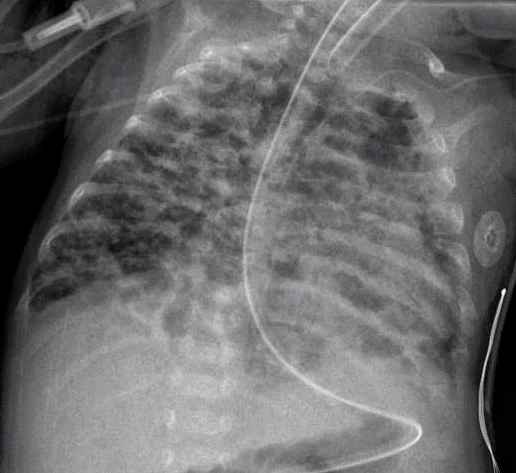
- Radiology: hyperinflation with coarse reticular and cystic change, and alternating areas of collapse and over-inflation.
- Prevention beats treatment: antenatal steroids, early CPAP rather than intubation, volume-targeted ventilation, caffeine citrate, careful oxygen targets and breast milk.
- Postnatal steroids: dexamethasone helps extubation but is associated with neurodevelopmental harm, so it is reserved for ventilator-dependent infants after explicit discussion.
- The complication to screen for: pulmonary hypertension, which develops in a significant minority and drives mortality - hence routine echocardiography.
Introduction
Bronchopulmonary dysplasia (BPD), also called chronic lung disease of prematurity, is the commonest long-term respiratory complication of preterm birth. It is defined not by a pathological appearance but by a functional one: an ongoing need for supplemental oxygen or respiratory support at a fixed point in development.
The condition was first described by Northway in 1967 in relatively mature preterm infants who had survived severe hyaline membrane disease only after weeks of high-pressure ventilation with high oxygen concentrations. Their lungs showed marked fibrosis, smooth muscle hypertrophy and squamous metaplasia - the disease now called old BPD.3
Antenatal steroids, surfactant and gentler ventilation have made that pattern rare. What has replaced it is new BPD, seen in far more immature infants who often have relatively mild initial respiratory disease. Histologically there is little fibrosis; instead there are fewer, larger and simplified alveoli with a dysmorphic capillary bed. It is a disorder of arrested development rather than of scarring, and that distinction explains both the modern management and the long-term outlook.
Definition and grading
The practical definition used in UK neonatal units assesses the infant at a corrected point rather than at a fixed postnatal age, so that babies of different gestations can be compared.
| Grade | Respiratory support at 36 weeks postmenstrual age |
|---|---|
| No BPD | Breathing air with no respiratory support, having required oxygen for less than 28 days |
| Mild | Breathing air, having required supplemental oxygen for at least 28 days |
| Moderate | Requiring supplemental oxygen at less than 30% |
| Severe | Requiring 30% oxygen or more, and/or positive pressure support - CPAP, high-flow or mechanical ventilation |
For infants born at 32 weeks or later, the assessment point is 28 days of postnatal age or discharge home, whichever comes first. Definitions have been revised several times and continue to evolve as the use of high-flow nasal cannula has blurred the boundary between oxygen therapy and positive pressure - so an exam answer should give the principle and the 36-week landmark rather than agonise over version numbers.2
Pathophysiology
Alveolar development is a late event. The lung enters the saccular stage at around 24 weeks and the alveolar stage from about 36 weeks, with secondary septation continuing well into early childhood. An infant born at 25 weeks therefore has lungs consisting of thick-walled primitive saccules with a small gas exchange surface area and a double capillary network that has not yet fused.
BPD develops when that developing lung sustains repeated injury during the period in which it should be multiplying its alveoli. The current model is one of multiple hits acting on an already vulnerable organ.
- Volutrauma and barotrauma - over-distension of compliant areas by positive pressure ventilation, which is why volume-targeted ventilation and early CPAP reduce incidence. Volume rather than pressure is the principal injurious factor.
- Oxygen toxicity - reactive oxygen species generated at high inspired concentrations, against immature antioxidant defences such as superoxide dismutase and glutathione peroxidase, which are laid down late in gestation
- Inflammation - antenatal chorioamnionitis primes the fetal lung, and postnatal sepsis and ventilator-associated infection perpetuate a cytokine-mediated injury that disrupts septation
- Patent ductus arteriosus - a significant left-to-right shunt floods the pulmonary circulation, increases lung water and prolongs ventilatory requirements
- Fluid overload, which has the same effect
- Nutritional deficiency - inadequate calorie, protein and vitamin A intake at a time of high metabolic demand
- Genetic susceptibility, which explains why two infants of identical gestation and identical management have very different outcomes
The consequences are reduced alveolar number and surface area, abnormal and reduced pulmonary vasculature, variable airway smooth muscle hypertrophy with airway obstruction, and heterogeneous lung mechanics - some regions over-distended and others collapsed. The abnormal vascular bed is what predisposes to pulmonary hypertension.
Clinical features
- Persistent oxygen requirement beyond the expected course of respiratory distress syndrome, or failure to wean from respiratory support
- Tachypnoea, subcostal and intercostal recession and increased work of breathing at rest
- Crackles and wheeze on auscultation, with a hyperinflated chest
- Episodes of desaturation and cyanotic spells, often during feeds, handling or crying
- Poor weight gain - these infants have a substantially increased work of breathing and a correspondingly increased calorie requirement
- Feeding difficulty, with the added problem that feeding competes with breathing
- Signs of pulmonary hypertension in advanced disease - a loud second heart sound, a right ventricular heave, hepatomegaly and poor growth
Investigations
- Chest radiograph - hyperinflation with coarse reticular or cystic changes, and alternating areas of atelectasis and over-inflation. Radiographic severity correlates only loosely with clinical severity.
- Blood gas - a compensated respiratory acidosis with a raised bicarbonate is typical, and reflects chronic carbon dioxide retention that is tolerated rather than corrected
- Echocardiography - to detect a patent ductus arteriosus and, importantly, to screen for pulmonary hypertension, which is recommended in infants with moderate or severe BPD
- Overnight or continuous oximetry - to define the true oxygen requirement, particularly during sleep and feeding, and to guide weaning of home oxygen
- Growth monitoring with plotted weight, length and head circumference
- Blood tests as indicated - electrolytes where diuretics are used, and a full blood count to identify anaemia contributing to oxygen requirement
- Chest CT and bronchoscopy are not routine, but are used in severe or atypical disease to identify tracheobronchomalacia, subglottic stenosis or structural abnormality
Differential diagnosis
BPD is the usual explanation for a persisting oxygen requirement in a very preterm infant, but it is a clinical definition rather than a diagnosis of mechanism, and an infant who is not following the expected slow improvement deserves reconsideration.
- Haemodynamically significant patent ductus arteriosus - a treatable cause of failure to wean, and one that should be excluded by echocardiography rather than assumed absent
- Undiagnosed congenital heart disease, particularly a left-to-right shunt causing pulmonary overcirculation
- Pulmonary hypertension complicating the BPD itself, which changes the management substantially
- Recurrent aspiration from gastro-oesophageal reflux or an unsafe swallow, which is common in this group and easily overlooked
- Tracheobronchomalacia or subglottic stenosis after prolonged intubation - suspect where there is stridor, a barking cough or episodes of acute obstruction
- Ongoing or recurrent infection, including ventilator-associated pneumonia and, occasionally, congenital infection
- Congenital lung malformation or a childhood interstitial lung disease, considered where the course is genuinely atypical
Prevention
Because established BPD is difficult to reverse, most of the effective interventions are preventive and belong to the first days of life.1
- Antenatal corticosteroids for anticipated preterm birth
- Early CPAP in preference to routine intubation, and extubation to non-invasive support as soon as feasible
- Surfactant given by a minimally invasive technique where possible, avoiding prolonged intubation
- Volume-targeted ventilation rather than pressure-limited ventilation, with permissive hypercapnia - accepting a higher carbon dioxide to allow lower tidal volumes
- Caffeine citrate, which reduces apnoea, shortens the duration of ventilation, and in the CAP trial reduced both BPD and the rate of cerebral palsy and cognitive delay at 18-21 months4
- Careful oxygen targeting - avoiding both hyperoxia, which drives free radical injury and retinopathy, and prolonged hypoxaemia
- Judicious fluid management and prompt attention to a haemodynamically significant patent ductus arteriosus
- Maternal breast milk, and adequate calorie and protein intake from the outset
- Rigorous infection prevention, since each episode of sepsis adds an inflammatory hit
Management of established disease
Oxygen and respiratory support
- Supplemental oxygen titrated to maintain saturations in the region of 92-95%. Once the period of retinopathy risk has passed, the target is set higher than during acute care, because chronic hypoxaemia drives pulmonary vasoconstriction, impairs growth and worsens pulmonary hypertension.
- Weaning is gradual, guided by oximetry during sleep and feeding rather than by spot readings when the baby is settled and awake
- Home oxygen allows earlier discharge for many infants, with community neonatal or children's nursing support, parental training, and a structured weaning plan5
- Non-invasive support - CPAP or high-flow - is continued in the more severely affected, and a small number of infants require long-term ventilation via tracheostomy
Nutrition and fluids
- High calorie intake, often 140-150 kcal/kg/day, to meet the increased work of breathing
- Fortified breast milk or a nutrient-enriched preterm formula, with iron and vitamin supplementation
- Fluid restriction where pulmonary oedema is contributing, balanced against the calorie requirement - which is the reason for using energy-dense feeds
- Nasogastric or gastrostomy feeding where oral feeding is not sustainable, and speech and language therapy input for feeding coordination
Drug treatment
- Diuretics - furosemide, or a thiazide with spironolactone - produce short-term improvements in lung compliance and oxygenation. Evidence for long-term benefit is limited, and they carry risks of electrolyte disturbance, nephrocalcinosis and, with loop diuretics, ototoxicity, so they are used with a defined purpose and reviewed regularly.6
- Bronchodilators - inhaled salbutamol or ipratropium may help infants with demonstrable airway obstruction and reversibility, but are not given routinely
- Inhaled corticosteroids - widely used but with an uncertain evidence base for altering the course of the disease
- Systemic corticosteroids - see below
- Pulmonary vasodilators such as sildenafil, under specialist supervision, where pulmonary hypertension is confirmed
Prevention of exacerbations
- Immunisation on schedule at chronological age, never corrected or delayed
- Passive RSV immunisation for infants with chronic lung disease of prematurity, who are among those at highest risk of severe bronchiolitis7
- Annual influenza vaccination for the child and household members
- A strictly smoke-free environment - tobacco smoke exposure measurably worsens outcomes in this group
- Prompt treatment of respiratory infections, with a low threshold for admission during the winter
- Palliative and comfort planning for the small number with severe, progressive disease, which should be discussed openly rather than deferred
Complications
- Pulmonary hypertension and cor pulmonale - occurs in a significant minority of infants with moderate to severe BPD and is a major contributor to mortality, hence routine echocardiographic screening
- Recurrent respiratory infections and hospital admissions, particularly with RSV, in the first 2 years
- Asthma-like airway disease with wheeze and exercise limitation through childhood
- Tracheobronchomalacia and subglottic stenosis, consequences of prolonged intubation
- Growth failure, from the combination of high energy expenditure, fluid restriction and feeding difficulty
- Neurodevelopmental impairment - BPD is independently associated with poorer cognitive and motor outcomes, over and above the effect of gestation itself
- Systemic hypertension, seen in a minority
- Reduced lung function persisting into adult life, with an obstructive pattern resembling early chronic obstructive pulmonary disease
Prognosis
The majority of infants with BPD improve steadily as new alveoli continue to form through the first years of life, and most are off supplemental oxygen by around 1 year of age. Symptoms of wheeze, cough and exercise limitation tend to diminish through childhood.
Recovery is not complete, however. Longitudinal studies consistently show that lung function in survivors, while improving in absolute terms, remains below that of term-born peers into adolescence and adult life, with an obstructive pattern and a reduced peak lung function - which matters because peak lung function determines how much reserve there is for the normal decline of later life. Preterm survivors with BPD are consequently a recognised at-risk group for early-onset chronic obstructive lung disease.
Mortality after discharge is low but not negligible, and is concentrated in infants with severe disease and pulmonary hypertension. Structured multidisciplinary follow-up - respiratory paediatrics, dietetics, physiotherapy, community nursing and developmental assessment - is therefore standard for infants discharged on oxygen, and the key messages for the family are consistent: keep the immunisations up to date, keep the home smoke-free, and seek help early with respiratory illness.
References
- NICE NG124. Specialist neonatal respiratory care for babies born preterm. 2019. Available here
- Higgins RD, Jobe AH, Koso-Thomas M et al. Bronchopulmonary dysplasia: executive summary of a workshop. Journal of Pediatrics. 2018. Available here
- Northway WH, Rosan RC, Porter DY. Pulmonary disease following respirator therapy of hyaline-membrane disease: bronchopulmonary dysplasia. New England Journal of Medicine. 1967. Available here
- Schmidt B, Roberts RS, Davis P et al. Caffeine therapy for apnea of prematurity. New England Journal of Medicine. 2006. Available here
- British Thoracic Society. Guideline for home oxygen in children. Available here
- BNF for Children. Furosemide. Available here
- UKHSA. Respiratory syncytial virus (RSV): the Green Book, chapter 27a. Available here
- Doyle LW, Cheong JL, Hay S et al. Late (7 days or more) systemic postnatal corticosteroids for prevention of bronchopulmonary dysplasia in preterm infants. Cochrane Database of Systematic Reviews. 2021. Available here
This article is written for revision and education. It is not clinical guidance and must not be used to make decisions about the care of a patient. Always check current NICE guidance and local protocols.