
Hypercalcaemia
Key points
- Hypercalcaemia: corrected calcium above 2.6 mmol/L. Mild 2.6-3.0, moderate 3.0-3.4, severe above 3.4 mmol/L - the last being a medical emergency.
- Always correct for albumin: corrected Ca²⁺ = measured Ca²⁺ + 0.02 × (40 − albumin g/L). Only about half of serum calcium is free and physiologically active; the rest is albumin-bound.
- Two causes account for 90%: primary hyperparathyroidism (commonest overall, usually an outpatient finding) and malignancy (commonest in inpatients, and usually more acute and severe).
- PTH splits the differential: PTH raised or inappropriately normal = primary or tertiary hyperparathyroidism (or familial hypocalciuric hypercalcaemia). PTH suppressed = malignancy or another non-PTH cause.
- Symptoms: 'bones, stones, abdominal groans and psychiatric moans' - plus polyuria, polydipsia, constipation, nausea, confusion and, in severe cases, coma.
- ECG: a shortened QT interval; severe hypercalcaemia can cause bradyarrhythmias and, rarely, arrest.
- First-line treatment: aggressive IV 0.9% sodium chloride rehydration - typically 3-6 litres over 24 hours. Patients are profoundly dehydrated because hypercalcaemia causes a nephrogenic diabetes insipidus.
- Then bisphosphonates: IV zoledronic acid or pamidronate after rehydration; they take 2-4 days to work. Avoid loop diuretics unless the patient is fluid overloaded.
Introduction
Hypercalcaemia is defined as a corrected serum calcium above 2.6 mmol/L and is common, affecting around 1 in 500 of the general population and up to 30% of patients with malignancy at some point. It ranges from an entirely incidental biochemical finding to a life-threatening emergency with coma and arrhythmia.1
Severity is graded mild (2.6-3.0 mmol/L), moderate (3.0-3.4 mmol/L) and severe (above 3.4 mmol/L). As always, the rate of rise matters as much as the absolute number: a patient with long-standing primary hyperparathyroidism may be entirely well at 3.0 mmol/L, whereas the same value developing over days in malignancy often produces marked symptoms.
Causes
Primary hyperparathyroidism and malignancy together account for around 90% of cases. A useful rule of thumb is that hyperparathyroidism dominates in the community (typically mild, chronic and asymptomatic, found on routine bloods), while malignancy dominates in hospital inpatients (typically more acute, more severe and symptomatic).
PTH-dependent causes (PTH raised or inappropriately normal)
- Primary hyperparathyroidism - the commonest cause overall. Usually a single parathyroid adenoma (~85%); less often four-gland hyperplasia or, rarely, carcinoma. Classically gives a raised calcium with a LOW phosphate
- Tertiary hyperparathyroidism - autonomous PTH secretion after prolonged secondary hyperparathyroidism, typically in long-standing chronic kidney disease and dialysis. Here phosphate is usually high because of renal failure
- Familial hypocalciuric hypercalcaemia (FHH) - an autosomal dominant calcium-sensing receptor mutation causing lifelong mild hypercalcaemia with a normal or mildly raised PTH. Crucially benign and requires no treatment, but is easily mistaken for primary hyperparathyroidism - and unnecessary parathyroidectomy is the consequence of missing it. Distinguished by a low urinary calcium excretion (urinary calcium:creatinine clearance ratio below 0.01)
- Lithium therapy - alters the set point of the calcium-sensing receptor
- Multiple endocrine neoplasia (MEN 1 and MEN 2A) - consider in younger patients or with a family history
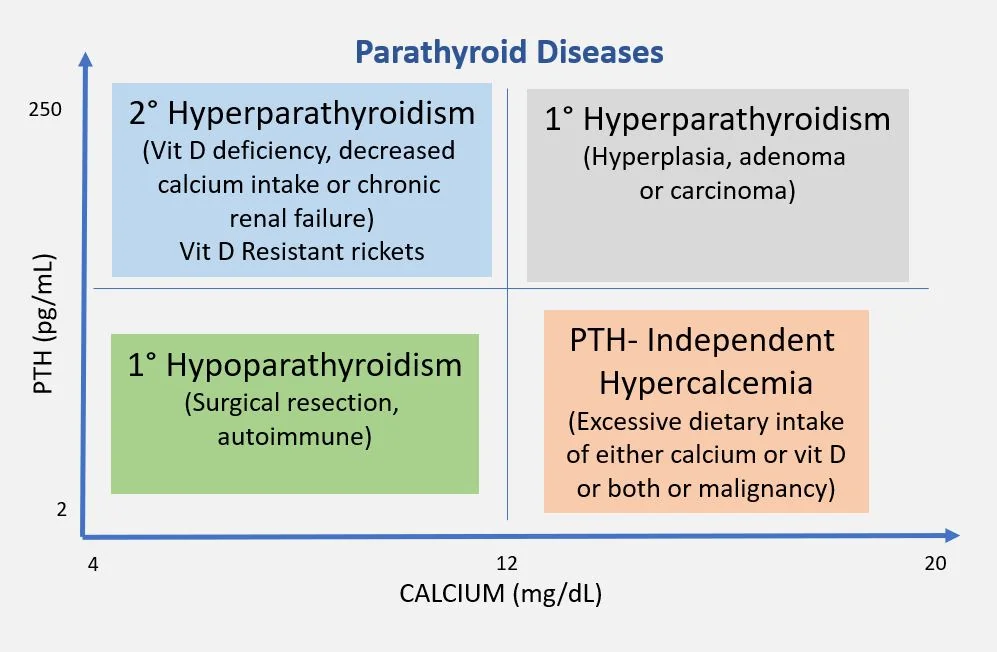
PTH-independent causes (PTH suppressed)
- Malignancy - the commonest cause in hospital, by four mechanisms: (1) PTH-related peptide (PTHrP) secretion, classically in squamous cell lung cancer, and in renal, breast, bladder and head and neck cancers; (2) osteolytic bone metastases - breast, lung, prostate, thyroid, kidney; (3) myeloma, through local osteoclast-activating cytokines; (4) tumour production of calcitriol, characteristically in lymphoma
- Granulomatous disease - sarcoidosis (the classic), tuberculosis, histoplasmosis, berylliosis. Macrophages within granulomas express 1-alpha-hydroxylase, producing unregulated calcitriol and increasing gut calcium absorption
- Drugs - thiazide diuretics (reduce renal calcium excretion), excessive vitamin D or calcium supplements, vitamin A / retinoids, calcium-containing antacids (milk-alkali syndrome), and teriparatide
- Endocrine - thyrotoxicosis (increased bone turnover), adrenal insufficiency, phaeochromocytoma, acromegaly
- Prolonged immobilisation - especially in those with high bone turnover such as adolescents or Paget disease
- Chronic kidney disease and its treatment, including calcium-based phosphate binders
- Rhabdomyolysis - during the recovery phase, as calcium deposited in damaged muscle is mobilised back
- Paget disease of bone - usually only when combined with immobilisation
Clinical features
The classic mnemonic is 'bones, stones, abdominal groans and psychiatric moans', to which should be added the frequently dominant symptoms of polyuria, polydipsia and dehydration. Mild hypercalcaemia is very often asymptomatic and found incidentally.
| System | Features |
|---|---|
| Renal ('stones') | Polyuria and polydipsia - hypercalcaemia causes a nephrogenic diabetes insipidus by impairing the response to ADH; dehydration; renal calculi; nephrocalcinosis; acute kidney injury and chronic kidney disease |
| Skeletal ('bones') | Bone pain, osteoporosis and fragility fractures; osteitis fibrosa cystica with brown tumours and 'pepper-pot skull' in severe long-standing hyperparathyroidism; subperiosteal resorption of the radial aspect of the phalanges |
| Gastrointestinal ('abdominal groans') | Constipation (very common), anorexia, nausea and vomiting, abdominal pain, peptic ulceration (calcium stimulates gastrin), and pancreatitis |
| Neuropsychiatric ('psychiatric moans') | Fatigue, lethargy and weakness; poor concentration, depression, anxiety and confusion; in severe cases stupor, coma and seizures. Hypercalcaemia is a genuinely reversible cause of delirium and of apparent depression in older people |
| Cardiovascular | Shortened QT interval, hypertension, bradycardia, bundle branch block and, rarely, arrhythmia or cardiac arrest. Hypercalcaemia also potentiates digoxin toxicity |
| Other | Corneal band keratopathy in chronic hypercalcaemia; pruritus; muscle weakness (typically proximal); metastatic calcification in soft tissues |
Investigations
- Corrected calcium - repeat to confirm, ideally on an uncuffed sample (prolonged tourniquet application falsely raises it)
- PTH - the key discriminating test, and it should be sent early. A raised or inappropriately normal PTH in the face of hypercalcaemia indicates a parathyroid cause; a suppressed PTH points to malignancy or another non-PTH cause
- Phosphate - low in primary hyperparathyroidism (PTH is phosphaturic); high in tertiary hyperparathyroidism with renal failure, and in vitamin D toxicity
- U&Es and creatinine - AKI is common, and renal function guides bisphosphonate dosing
- Alkaline phosphatase (ALP) - raised with bone metastases, Paget disease and osteitis fibrosa cystica; normal in myeloma (a classically examined point) and in FHH
- Magnesium - often disturbed alongside
- Vitamin D (25-hydroxyvitamin D), and 1,25-dihydroxyvitamin D if granulomatous disease or lymphoma is suspected
- ECG - looking for a short QT interval and conduction abnormalities
- Myeloma screen - serum and urine electrophoresis, serum free light chains, immunoglobulins, ESR
- Chest X-ray - lung cancer, sarcoidosis, tuberculosis
- Serum ACE - supportive in sarcoidosis
- TFTs and a short Synacthen test where thyrotoxicosis or adrenal insufficiency is possible
- 24-hour urinary calcium or the calcium:creatinine clearance ratio - essential to exclude FHH before considering parathyroid surgery
- Parathyroid imaging - sestamibi scan and neck ultrasound, used to localise an adenoma before surgery, not to make the diagnosis
- DEXA scan and renal tract imaging - to assess end-organ damage in primary hyperparathyroidism, which informs whether surgery is indicated
- Further imaging (CT, mammography, PSA, myeloma work-up) - to identify an underlying malignancy where PTH is suppressed
Management
Acute severe hypercalcaemia
Treat urgently if calcium is above 3.0-3.5 mmol/L or the patient is symptomatic - particularly with confusion, vomiting, dehydration or ECG changes.2
| Step | Treatment | Notes |
|---|---|---|
| 1. Rehydrate | IV 0.9% sodium chloride, typically 3-6 litres over 24 hours (often starting 1 litre over 2-4 hours) | The single most important intervention. Restores GFR and promotes calciuresis. Adjust for cardiac and renal comorbidity, and monitor for fluid overload with careful fluid balance |
| 2. Stop contributing drugs | Thiazides, calcium and vitamin D supplements, lithium, vitamin A; review digoxin | Frequently the whole problem in mild cases |
| 3. Bisphosphonate | IV zoledronic acid 4 mg (or pamidronate 30-90 mg) after adequate rehydration | Takes 2-4 days for full effect, lasting 2-4 weeks. Dose-adjust in renal impairment. Warn about a transient flu-like reaction and the small long-term risk of osteonecrosis of the jaw - check dental health |
| 4. Calcitonin | Subcutaneous or IM calcitonin | Rapid onset (4-6 hours), useful as a bridge while the bisphosphonate takes effect, but tachyphylaxis develops within 48 hours |
| 5. Corticosteroids | Prednisolone or hydrocortisone | Only for calcitriol-mediated hypercalcaemia - sarcoidosis and other granulomatous disease, lymphoma, and vitamin D toxicity. Ineffective in hyperparathyroidism and most solid tumours |
| 6. Denosumab | Subcutaneous denosumab | For bisphosphonate-refractory hypercalcaemia of malignancy, and usable in significant renal impairment where bisphosphonates are contraindicated. Watch for subsequent hypocalcaemia |
| 7. Dialysis | Haemodialysis with low-calcium dialysate | For life-threatening hypercalcaemia, especially with renal failure or heart failure limiting fluid administration |
Managing the underlying cause
- Primary hyperparathyroidism - parathyroidectomy is the only cure. Surgery is indicated for: symptomatic disease; corrected calcium more than 0.25 mmol/L above the upper limit of normal; age under 50; eGFR below 60; renal stones or nephrocalcinosis; or osteoporosis or fragility fracture. Otherwise, monitor calcium, renal function and bone density, ensure adequate hydration, and consider cinacalcet (a calcimimetic) where surgery is unsuitable
- Malignancy - treat the underlying tumour; hypercalcaemia often recurs and may need repeated bisphosphonates. Involve palliative care, as its onset frequently signals advanced disease
- Sarcoidosis and lymphoma - corticosteroids, plus advice to avoid sunlight and dietary vitamin D
- Familial hypocalciuric hypercalcaemia - no treatment required; the essential action is to recognise it and avoid unnecessary parathyroidectomy, and to reassure the patient and screen family members
- Drug-induced - stop the offending agent and recheck
- Immobilisation - mobilise where possible
- General advice - maintain good oral fluid intake, avoid thiazides and calcium supplements, and arrange monitoring
Complications
- Acute kidney injury - from volume depletion and direct renal vasoconstriction
- Nephrolithiasis and nephrocalcinosis, leading to chronic kidney disease
- Nephrogenic diabetes insipidus with polyuria and profound dehydration
- Cardiac arrhythmia - bradyarrhythmias, heart block and, rarely, arrest; potentiation of digoxin toxicity
- Coma and death in severe untreated hypercalcaemia
- Osteoporosis, fragility fractures and osteitis fibrosa cystica in chronic hyperparathyroidism
- Peptic ulceration and acute pancreatitis
- Delirium and depression - reversible, but frequently misattributed to dementia or primary psychiatric illness in older patients
- Corneal band keratopathy and metastatic soft tissue calcification
- Complications of treatment - fluid overload from rehydration, hypocalcaemia after bisphosphonates or denosumab, osteonecrosis of the jaw and atypical femoral fracture with prolonged bisphosphonate use, and the consequences of unnecessary parathyroidectomy in unrecognised FHH
Red flags
Prognosis
Prognosis diverges sharply according to the cause, and the two dominant causes could hardly be more different. Primary hyperparathyroidism generally has an excellent outlook: many patients have mild, stable, asymptomatic hypercalcaemia for years, and parathyroidectomy is curative in over 95%, with resolution of symptoms, improvement in bone density and reduced stone formation. Even those managed conservatively often remain stable, provided calcium, renal function and bone density are monitored.
Hypercalcaemia of malignancy carries a poor prognosis, with median survival historically measured in a few months from its onset. This is because it is a marker of advanced, usually widely disseminated disease rather than a direct cause of death in itself. Calcium can almost always be lowered effectively with fluids and bisphosphonates, and doing so produces genuine symptomatic benefit - relief of confusion, nausea, constipation and pain - but it does not alter the underlying trajectory. Its appearance should therefore prompt an honest conversation about goals of care and early palliative involvement alongside active treatment.
Acute severe hypercalcaemia is highly treatable, and rehydration alone frequently produces a substantial fall within 24-48 hours, with neuropsychiatric and gastrointestinal symptoms reversing completely. The important qualifications are that renal damage may not be fully reversible where nephrocalcinosis or prolonged AKI has occurred, and that recurrence is common in malignancy, often requiring repeated bisphosphonate infusions. Finally, it is worth remembering that hypercalcaemia is a genuinely reversible cause of delirium, depression and cognitive decline - a calcium level is a cheap test, and identifying it can transform an older patient who has been labelled with dementia or depression.
References
- NICE Clinical Knowledge Summaries. Hypercalcaemia. Available here
- Society for Endocrinology. Emergency Endocrine Guidance: Acute hypercalcaemia. Available here
- NICE NG132. Hyperparathyroidism (primary): diagnosis, assessment and initial management. 2019. Available here
- Minisola S, Pepe J, Piemonte S, Cipriani C. The diagnosis and management of hypercalcaemia. BMJ. 2015. Available here
- NICE NG12. Suspected cancer: recognition and referral (myeloma and malignancy). 2015, updated 2023. Available here
- BNF. Zoledronic acid, pamidronate, calcitonin and cinacalcet. Available here
- Dr. Vijaya Chandar, MBBS, CC BY-SA 4.0, via Wikimedia Commons. Available here
This article is written for revision and education. It is not clinical guidance and must not be used to make decisions about the care of a patient. Always check current NICE guidance and local protocols.