
Diabetic Nephropathy: Screening, Staging and Slowing Progression
Key points
- Diabetic nephropathy: progressive glomerular injury caused by chronic hyperglycaemia, and the single commonest cause of end-stage renal disease in the UK and worldwide.
- Screening: annual urine ACR on an early morning sample, plus creatinine and eGFR - from diagnosis in type 2 diabetes, and from 5 years after diagnosis (or age 12) in type 1.
- Natural history: hyperfiltration (raised GFR), then moderately increased albuminuria (ACR 3-30), then overt proteinuria (ACR above 30) with falling GFR, then end-stage renal disease.
- Albuminuria is the earliest marker: and is also an independent cardiovascular risk factor - these patients are more likely to die of cardiovascular disease than to reach dialysis.
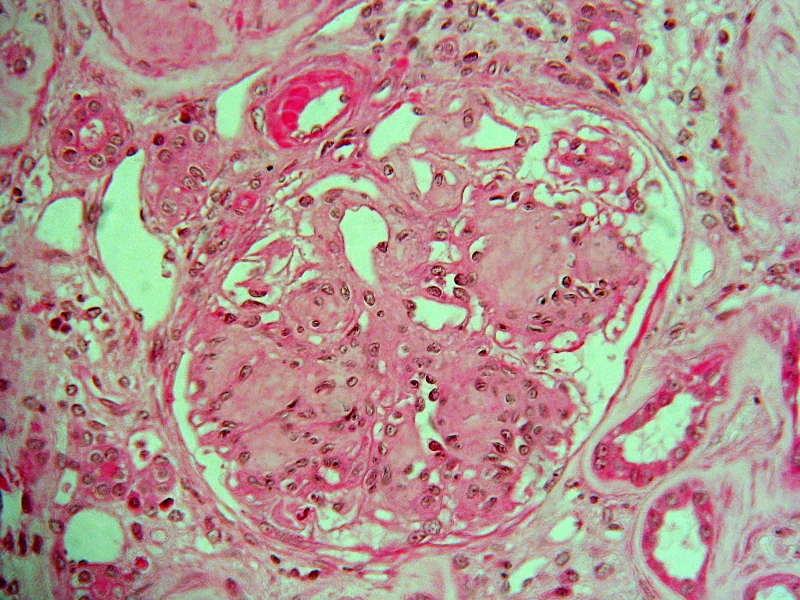
- Classic histology: mesangial expansion, basement membrane thickening and nodular glomerulosclerosis with Kimmelstiel-Wilson nodules, plus hyaline arteriolosclerosis.
- Four pillars of treatment: glycaemic control, blood pressure control, an ACE inhibitor or ARB, and an SGLT2 inhibitor - the last of which has transformed outcomes irrespective of glycaemic effect.
- Additional agents: finerenone (a non-steroidal mineralocorticoid receptor antagonist) reduces progression and cardiovascular events in diabetic CKD; a statin is given to essentially all patients.
- Suspect another diagnosis: if there is haematuria, absent retinopathy, rapid decline, a very short diabetes duration, or systemic features - then biopsy rather than assume.
Introduction
Diabetic nephropathy (diabetic kidney disease) is chronic progressive kidney damage caused by diabetes mellitus, and is the leading cause of end-stage renal disease in the UK, accounting for around a quarter to a third of patients starting renal replacement therapy.1
It affects roughly 30 to 40% of people with type 1 diabetes and a similar or slightly lower proportion with type 2 diabetes, though because type 2 is so much more prevalent, the great majority of diabetic nephropathy in absolute terms occurs in type 2. In type 1 diabetes the onset date is usually known, so the natural history is better characterised; in type 2 the disease may already be present at diagnosis, because hyperglycaemia has often been silent for years - which is why screening starts immediately in type 2 but is deferred in type 1.
Pathophysiology
Chronic hyperglycaemia damages the glomerulus through several interacting mechanisms, and the sequence explains both the early rise in GFR and the later relentless decline.
- Metabolic injury. Persistent hyperglycaemia leads to the formation of advanced glycation end-products (AGEs), activation of protein kinase C, and flux through the polyol (aldose reductase) pathway, generating oxidative stress and pro-inflammatory, pro-fibrotic signalling within the glomerulus.
- Haemodynamic injury. Hyperglycaemia causes afferent arteriolar vasodilation while the efferent arteriole remains relatively constricted, raising intraglomerular pressure and producing glomerular hyperfiltration - measurable as a supranormal GFR in early disease. Increased proximal sodium and glucose reabsorption reduces distal sodium delivery, blunting tubuloglomerular feedback and sustaining the hyperfiltration.
- Structural change. Sustained high pressure and metabolic injury cause mesangial matrix expansion, thickening of the glomerular basement membrane, and podocyte loss and effacement, which together degrade the filtration barrier and allow albumin to escape.
- Progressive sclerosis. Continued injury produces nodular glomerulosclerosis, with the accumulation of hyaline material into the Kimmelstiel-Wilson nodules that characterise advanced disease, alongside hyaline arteriolosclerosis affecting both afferent and efferent arterioles.
- Nephron loss and hyperfiltration of survivors. As glomeruli sclerose, the remaining nephrons hyperfilter to compensate, which accelerates their own destruction - a self-perpetuating cycle that continues even if glycaemia is later corrected, and the reason early intervention matters so much.
- Risk factors for developing nephropathy include poor glycaemic control, duration of diabetes, hypertension, smoking, obesity, dyslipidaemia, male sex, South Asian and Black African or African-Caribbean ethnicity, a family history of diabetic nephropathy, and the presence of other microvascular complications
Natural history and staging
| Stage | Timing (type 1) | GFR | Albuminuria | Notes |
|---|---|---|---|---|
| 1. Hyperfiltration | At or soon after diagnosis | Raised (supranormal) | Normal | Functional and reversible with glycaemic control; kidneys may be enlarged |
| 2. Silent / latent | First 5 years | Normal or high | Normal | Structural changes are accumulating (basement membrane thickening, mesangial expansion) despite normal tests |
| 3. Incipient nephropathy | Typically 5 to 15 years | Normal or beginning to fall | Moderately increased - ACR 3 to 30 mg/mmol (formerly 'microalbuminuria') | The critical window for intervention. Blood pressure begins to rise. Still potentially reversible. |
| 4. Overt nephropathy | Typically 15 to 25 years | Falling progressively | Severely increased - ACR above 30 mg/mmol; may reach nephrotic range | Hypertension is established; retinopathy is almost always present; decline in GFR is now largely relentless |
| 5. End-stage renal disease | Typically 20 to 30 years | Under 15 | Heavy | Requires renal replacement therapy or conservative management |
Screening and investigations
Screening
- Measure urine ACR and serum creatinine with eGFR at least annually in everyone with diabetes.2 Use an early morning urine sample, which minimises the effect of posture and exercise.
- Type 2 diabetes: start screening at diagnosis, because hyperglycaemia has usually been present for years beforehand
- Type 1 diabetes: start 5 years after diagnosis, or from age 12 in children, since the onset date is known and disease is very unlikely before then
- Confirm an abnormal ACR on a repeat early morning sample (typically 2 out of 3 samples over 3 to 6 months should be abnormal), because transient albuminuria is common
- Recognise the causes of a falsely raised ACR - urinary tract infection, vigorous exercise in the preceding 24 hours, menstruation, fever, acute hyperglycaemia, heart failure and marked hypertension. Exclude and treat infection before acting on a result.
Assessment once nephropathy is identified
- Quantify albuminuria with ACR, and stage using the combined G and A classification as for CKD generally
- Blood pressure, measured properly, with consideration of ambulatory monitoring
- HbA1c and review of glycaemic control and hypoglycaemia risk
- Retinal screening - dilated fundoscopy or retinal photography. The presence of retinopathy strongly supports a diabetic renal cause; its absence in type 1 diabetes argues strongly against it.
- Assessment for other complications - foot examination for neuropathy and peripheral vascular disease, and cardiovascular risk assessment
- Lipid profile
- Full blood count, bone profile, PTH and bicarbonate as eGFR falls, to detect anaemia, renal bone disease and acidosis
- Urine dipstick for blood - haematuria is not a feature of uncomplicated diabetic nephropathy and should prompt reconsideration
- Renal ultrasound where obstruction or another structural cause is possible
Management
Management aims to slow the decline in GFR, reduce albuminuria, and reduce cardiovascular risk - the last being at least as important as the first two, given where these patients' mortality actually comes from. Four interventions carry the strongest evidence.
1. Glycaemic control
- Tight glycaemic control reduces the incidence and progression of nephropathy, with the strongest evidence in early disease - the benefit of intervening before overt proteinuria is far greater than afterwards
- Individualise the HbA1c target, typically around 48 to 58 mmol/mol, relaxed in frailty, limited life expectancy, or a history of severe hypoglycaemia4
- Adjust glucose-lowering drugs as eGFR falls - metformin requires dose reduction below an eGFR of 45 and should be stopped below 306; sulfonylureas accumulate and cause hypoglycaemia; insulin requirements often fall as eGFR declines because the kidney degrades insulin, so doses may need reducing to avoid hypoglycaemia
- Note that HbA1c becomes less reliable in advanced CKD, because reduced red cell survival, anaemia and erythropoiesis-stimulating agents all lower it - so it may underestimate true glycaemia
2. Blood pressure control
- The most powerful modifiable determinant of progression. Target below 130/80 mmHg where ACR is 70 mg/mmol or above, and generally aim below 130/80 in diabetes with albuminuria; otherwise below 140/90.2
- Dietary sodium restriction amplifies the effect of every antihypertensive and of renin-angiotensin blockade
- Add further agents as needed - calcium channel blockers and thiazide-like diuretics are usual second and third agents (loop diuretics if eGFR is low or there is fluid overload)
3. Renin-angiotensin blockade
- An ACE inhibitor or ARB is indicated for anyone with diabetes and an ACR of 3 mg/mmol or above, regardless of blood pressure, and titrated to the maximum tolerated licensed dose2
- They reduce intraglomerular pressure by dilating the efferent arteriole, which lowers proteinuria and slows progression beyond their blood pressure-lowering effect
- Check U&Es 1 to 2 weeks after starting and after each dose increase. Accept a creatinine rise of up to 30% or an eGFR fall of up to 25%; investigate a greater change
- Never combine an ACE inhibitor with an ARB - the combination increases hyperkalaemia and AKI without additional benefit
- Counsel on sick day rules - withhold during intercurrent illness with dehydration
- Avoid in pregnancy - these drugs are teratogenic, and women of childbearing age need pre-conception counselling and a switch to a safe alternative
4. SGLT2 inhibitors
- The most significant advance in this field in decades. Dapagliflozin and empagliflozin reduce progression of CKD, the risk of end-stage renal disease and cardiovascular death, in diabetic and non-diabetic kidney disease alike3
- The mechanism is largely haemodynamic, not glycaemic - blocking proximal sodium-glucose reabsorption increases distal sodium delivery, restoring tubuloglomerular feedback and causing afferent arteriolar constriction, which relieves glomerular hyperfiltration. This is why the benefit persists at low eGFR where the glucose-lowering effect is negligible.
- Expect a small early dip in eGFR on starting, which is haemodynamic and expected - it should not prompt stopping the drug
- Adverse effects - genital mycotic infection and urinary tract infection, volume depletion, a small risk of necrotising fasciitis of the perineum (Fournier gangrene), and euglycaemic diabetic ketoacidosis, which is the most important to counsel about and requires temporary suspension during acute illness, fasting or surgery
Additional measures
| Intervention | Detail |
|---|---|
| Finerenone | A non-steroidal mineralocorticoid receptor antagonist that reduces CKD progression and cardiovascular events in diabetic kidney disease with albuminuria, added on top of an ACE inhibitor or ARB.5 Less hyperkalaemia and gynaecomastia than spironolactone, but potassium must still be monitored. |
| Statin | Atorvastatin 20 mg for essentially all patients with diabetes and CKD, given the dominant cardiovascular risk |
| GLP-1 receptor agonists | Useful for glycaemic control and weight, with emerging evidence of renal benefit, and safe at lower eGFR than many alternatives |
| Smoking cessation | Smoking accelerates progression of nephropathy independently - one of the highest-value interventions available |
| Weight management and exercise | Reduce albuminuria and cardiovascular risk |
| Dietary advice | Sodium restriction; avoid excessive protein intake; potassium and phosphate restriction as CKD advances - with renal dietitian input, since renal and diabetic dietary advice can appear to conflict |
| Avoid nephrotoxins | NSAIDs, unnecessary contrast, and dose-adjust all renally cleared drugs |
| Vaccination | Influenza, pneumococcal and hepatitis B (the last in anticipation of possible dialysis) |
| Nephrology referral and RRT planning | As for CKD generally - eGFR under 30, ACR 70 or above, rapid progression, or diagnostic uncertainty. Discuss transplantation early: simultaneous pancreas-kidney transplantation is an option for selected patients with type 1 diabetes. |
Complications
- Progressive CKD and end-stage renal disease requiring dialysis or transplantation
- Cardiovascular disease - myocardial infarction, heart failure and stroke; the leading cause of death, and the risk is multiplied by the combination of diabetes and albuminuria
- Nephrotic syndrome where proteinuria becomes heavy, with its own thrombotic and infective complications
- Resistant hypertension and fluid overload
- Hyperkalaemia - from CKD itself, compounded by ACE inhibitors, ARBs, finerenone and type 4 renal tubular acidosis which is common in diabetes
- Anaemia - occurring earlier and more severely in diabetic nephropathy than in other causes of CKD at equivalent eGFR
- CKD-mineral and bone disorder and vascular calcification
- Increased risk of AKI, urinary tract infection, pyelonephritis and renal papillary necrosis
- Type 4 renal tubular acidosis (hyperkalaemic, hyporeninaemic hypoaldosteronism)
- Neurogenic bladder from autonomic neuropathy, causing incomplete emptying, recurrent infection and obstructive uropathy
- Hypoglycaemia - because both insulin clearance and renal gluconeogenesis fall as eGFR declines, and many oral agents accumulate
- Coexisting retinopathy and neuropathy - the microvascular complications travel together, so finding one mandates screening for the others
Red flags
Prognosis
The outlook has improved markedly and is no longer the inevitable slide to dialysis it once was. Before renin-angiotensin blockade, patients with overt diabetic nephropathy lost around 10 to 12 mL/min/1.73 m2 of GFR each year; with modern therapy that rate can be reduced to a small fraction of it, and some patients remain stable for many years.
The stage at which treatment begins is the dominant determinant of outcome. At the stage of moderately increased albuminuria (ACR 3 to 30), aggressive glycaemic and blood pressure control with renin-angiotensin blockade can produce regression to normoalbuminuria in a meaningful proportion of patients. Once overt proteinuria and a falling GFR are established, the process can be slowed substantially but is rarely reversed - which is the entire justification for annual ACR screening in an asymptomatic population.
Cardiovascular death remains the commonest outcome, not dialysis. A patient with diabetes and albuminuria carries a cardiovascular risk several times that of a patient with diabetes and a normal ACR, and most will have a cardiovascular event before reaching end-stage renal disease. This is why statins, blood pressure control and smoking cessation belong in every management plan alongside the renal-specific drugs.
Where end-stage renal disease is reached, outcomes on dialysis are worse for patients with diabetes than for most other causes, reflecting the burden of concurrent cardiovascular disease, peripheral vascular disease and neuropathy. Transplantation offers a substantial survival advantage, and for selected patients with type 1 diabetes a simultaneous pancreas-kidney transplant can render them both dialysis-free and insulin-independent, with excellent long-term outcomes. The advent of SGLT2 inhibitors and finerenone means that current cohorts should be expected to do better still than these historical figures suggest.
References
- KDIGO 2022 Clinical Practice Guideline for Diabetes Management in Chronic Kidney Disease. Available here
- NICE NG203. Chronic kidney disease: assessment and management. 2021, updated 2023. Available here
- NICE TA775. Dapagliflozin for treating chronic kidney disease. 2022. Available here
- NICE NG28. Type 2 diabetes in adults: management. 2022. Available here
- NICE TA818. Finerenone for treating chronic kidney disease in type 2 diabetes. 2023. Available here
- BNF. Metformin, dapagliflozin and finerenone - use in renal impairment. Available here
- Doc.mari, CC BY-SA 3.0, via Wikimedia Commons. Available here
This article is written for revision and education. It is not clinical guidance and must not be used to make decisions about the care of a patient. Always check current NICE guidance and local protocols.