
Wernicke Encephalopathy and Korsakoff Syndrome: Diagnosis and Management
Key points
- Wernicke encephalopathy (WE): an acute, potentially reversible neuropsychiatric emergency caused by thiamine (vitamin B1) deficiency.
- Classic triad: confusion, ophthalmoplegia and ataxia - but all three are present in only around 10-20% of cases, so waiting for the full triad means missing the diagnosis.
- Korsakoff syndrome: the chronic, largely irreversible consequence of untreated or inadequately treated Wernicke encephalopathy - a profound anterograde and retrograde amnesia with confabulation.
- Commonest cause in the UK: chronic alcohol excess, through poor intake, impaired absorption and impaired hepatic storage of thiamine.
- Critical prescribing rule: always give thiamine BEFORE (or with) intravenous glucose in an at-risk patient - glucose given first consumes remaining thiamine and can precipitate Wernicke encephalopathy.
- Treatment: high-dose parenteral thiamine (Pabrinex) - oral thiamine is inadequate for treating acute Wernicke encephalopathy.
- Diagnosis is clinical: treatment should never be delayed for confirmatory tests; low threshold for treating anyone at risk.
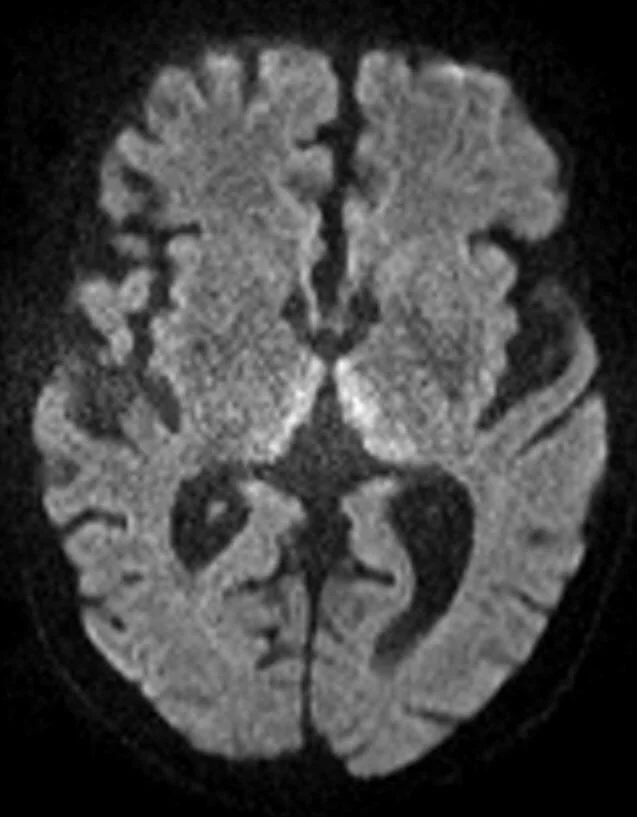
- MRI findings: symmetrical changes in the mammillary bodies, medial thalami and periaqueductal grey matter, though a normal MRI does not exclude the diagnosis.
Introduction
Wernicke encephalopathy is an acute neuropsychiatric emergency caused by deficiency of thiamine (vitamin B1). Thiamine is an essential cofactor for enzymes central to glucose metabolism, and the brain regions with the highest metabolic demand and thiamine turnover - the mammillary bodies, medial thalami, periaqueductal grey matter and cerebellar vermis - are the first to be damaged when it runs short.1
The condition matters enormously because it sits on a knife edge: Wernicke encephalopathy is largely reversible with prompt parenteral thiamine, but if untreated or undertreated it progresses to Korsakoff syndrome, a devastating and permanent amnestic disorder. The two are best understood as the acute and chronic phases of the same process, sometimes together termed the Wernicke-Korsakoff syndrome.
It is heavily examined because the diagnosis is easy to miss (the classic triad is usually incomplete), the treatment is simple and cheap, and the consequence of getting the glucose-before-thiamine sequence wrong is catastrophic and entirely iatrogenic.
Post-mortem studies consistently suggest that Wernicke encephalopathy is substantially underdiagnosed in life, with characteristic lesions found in a proportion of patients in whom the diagnosis was never made or suspected. That gap between pathological and clinical diagnosis rates is the single most compelling argument for treating on suspicion: the condition is far more common than the number of cases recognised at the bedside would suggest.
Aetiology
The body stores only a few weeks' worth of thiamine, so deficiency develops quickly whenever intake falls, losses rise, or demand increases.
- Chronic alcohol excess - by far the commonest cause in the UK, through a combination of poor dietary intake, impaired intestinal absorption, reduced hepatic storage and impaired conversion to the active form
- Malnutrition and starvation - including eating disorders (anorexia nervosa), homelessness, and food insecurity
- Persistent vomiting - hyperemesis gravidarum is a classic and important non-alcoholic cause
- Bariatric surgery - and other causes of malabsorption such as inflammatory bowel disease or short bowel syndrome
- Prolonged parenteral nutrition without adequate vitamin supplementation
- Dialysis - thiamine is water-soluble and readily lost
- Malignancy and chemotherapy - through increased metabolic demand and reduced intake
- Systemic illness with high metabolic demand - sepsis, thyrotoxicosis, refeeding
Clinical features
Wernicke encephalopathy - the classic triad
- Confusion - an acute confusional state, disorientation, inattention and apathy; the commonest of the three features
- Ophthalmoplegia and other eye signs - most characteristically bilateral lateral rectus (sixth nerve) palsy causing horizontal diplopia, plus nystagmus and conjugate gaze palsies
- Ataxia - a broad-based, unsteady gait, reflecting cerebellar vermis involvement; may be present when limb coordination is relatively preserved
- Other features: hypothermia, hypotension, tachycardia, peripheral neuropathy (frequently coexists), and reduced conscious level progressing to coma in severe untreated cases
Korsakoff syndrome
Korsakoff syndrome represents the chronic, largely irreversible sequel to untreated Wernicke encephalopathy, reflecting established damage to the mammillary bodies and medial thalamic nuclei - structures central to laying down new memories.
- Profound anterograde amnesia - a striking inability to form new memories, which is the dominant deficit
- Retrograde amnesia - typically with a temporal gradient, so remote memories are better preserved than recent ones
- Confabulation - the generation of fabricated or distorted accounts to fill gaps in memory, produced without any intention to deceive, and often delivered with complete conviction
- Relative preservation of other cognitive domains - language, attention and general intellect are often surprisingly intact, which is why the memory deficit can be missed on a superficial conversation
- Apathy and lack of insight into the memory impairment
Clinical examination
- Cognitive assessment - orientation, attention, and specifically short-term memory (name and address recall, three-item recall at 5 minutes)
- Eye examination - eye movements in all directions looking for gaze palsy or lateral rectus weakness, and nystagmus; pupillary responses
- Gait - assess if safe, looking for broad-based ataxia
- Cerebellar examination - coordination, though limb ataxia may be less prominent than gait ataxia
- Peripheral neuropathy - sensory testing and reflexes, since it frequently coexists
- Signs of chronic liver disease and alcohol excess - jaundice, spider naevi, palmar erythema, hepatomegaly, tremor
- Nutritional status - BMI, muscle wasting, other vitamin deficiency signs
- Observations - temperature (hypothermia), blood pressure, and capillary glucose
Differential diagnosis
- Alcohol intoxication or withdrawal (including delirium tremens) - frequently coexists with Wernicke encephalopathy in the same patient, which is precisely why it is missed; treating withdrawal does not treat thiamine deficiency
- Hepatic encephalopathy - asterixis, jaundice and other signs of liver failure, with a raised ammonia
- Hypoglycaemia - always check capillary glucose
- Head injury including subdural haematoma - common in this patient group after falls, and should be actively considered
- Meningitis or encephalitis - fever and meningism
- Other causes of delirium - sepsis, electrolyte disturbance, drugs
- Other amnestic syndromes - herpes simplex encephalitis (temporal lobe damage), hypoxic brain injury, or a thalamic stroke
- Vitamin B12 deficiency - can cause cognitive change and neuropathy
Investigations
Wernicke encephalopathy is a clinical diagnosis and treatment must never be delayed for investigation. Tests are used to exclude alternatives and support the diagnosis, not to license starting thiamine.
- Capillary blood glucose - immediately, to exclude hypoglycaemia (but remember the thiamine-before-glucose rule below)
- FBC, U&Es, LFTs, magnesium, clotting - assessing nutritional state, liver disease and electrolytes; magnesium is essential because it is a cofactor for thiamine-dependent enzymes and deficiency can render thiamine replacement ineffective until corrected
- Blood alcohol level and toxicology where relevant
- Red cell transketolase activity or serum thiamine levels - can confirm deficiency but are rarely available quickly enough to guide acute management, and are not required before treating
- CT head - to exclude a subdural haematoma or other structural cause in a confused patient with a history of falls
- MRI brain - may show symmetrical high signal in the mammillary bodies, medial thalami, periaqueductal grey matter and around the third ventricle; supportive when present but a normal MRI does not exclude the diagnosis
- Septic screen - if infection is a plausible contributor to the confusion
Management
Acute treatment
- High-dose parenteral thiamine (Pabrinex) - given intravenously or intramuscularly, typically two or three pairs of ampoules three times daily for several days in established Wernicke encephalopathy, then stepped down and converted to oral thiamine. Doses vary by local protocol, so check trust guidance
- Oral thiamine is inadequate for treating acute Wernicke encephalopathy, because absorption is limited and unreliable in exactly the patients who need it - it is used for prophylaxis and for continuation after parenteral treatment
- Correct magnesium - hypomagnesaemia impairs thiamine-dependent enzyme function and must be corrected for replacement to work
- Replace other vitamins - B-complex and folate, as deficiencies commonly coexist
- Manage alcohol withdrawal concurrently, usually with a benzodiazepine regimen, remembering that this is a separate problem requiring separate treatment
- Avoid or carefully manage refeeding - reintroduce nutrition cautiously in severely malnourished patients, monitoring phosphate, potassium and magnesium for refeeding syndrome
- Anaphylaxis risk with Pabrinex is very low but recognised - it should be given where resuscitation facilities are available, and this should not be used as a reason to withhold it
Prophylaxis
Prophylactic thiamine should be given to at-risk patients before they develop symptoms - for example, patients admitted with alcohol withdrawal, those undergoing detoxification, patients with hyperemesis gravidarum, and malnourished patients starting nutritional support. NICE recommends parenteral thiamine prophylaxis for people at high risk who are undergoing detoxification or are acutely unwell, and oral thiamine for lower-risk patients in the community.2
Managing established Korsakoff syndrome
- Continue long-term thiamine and address ongoing nutritional deficiency
- Abstinence from alcohol - essential to prevent further deterioration, with appropriate specialist alcohol service support
- Cognitive rehabilitation - memory aids, structured routines, environmental cues and errorless learning approaches
- Assessment of capacity and care needs - many patients with established Korsakoff syndrome require supported living or long-term residential care, and formal capacity assessment is often needed
- Support for family and carers, including explaining that confabulation is a symptom rather than deception
- Safeguarding considerations - patients are vulnerable to exploitation and self-neglect
Complications
- Progression to Korsakoff syndrome - the principal complication of untreated or undertreated Wernicke encephalopathy, and largely irreversible once established
- Permanent ataxia and nystagmus in some patients even after treatment
- Coma and death in severe untreated cases
- Loss of independence, requiring long-term supported care
- Coexisting complications of chronic alcohol use - liver disease, peripheral neuropathy, cardiomyopathy, seizures
- Refeeding syndrome during nutritional restoration
- Aspiration and falls related to ataxia and confusion
Red flags
The single most useful principle in this condition is that the threshold for giving thiamine should be far lower than the threshold for diagnosing Wernicke encephalopathy. Treatment is safe, inexpensive and immediate; the cost of withholding it is permanent.
Prognosis
Prognosis depends almost entirely on how quickly parenteral thiamine is given. Treated promptly, the ophthalmoplegia often improves within hours to days and is the most reliably reversible feature4; confusion improves over days to weeks; ataxia improves more slowly and may not fully resolve.
If treatment is delayed, a substantial proportion of patients progress to Korsakoff syndrome, in which the amnesia is largely permanent - roughly a quarter of patients with established Korsakoff syndrome recover substantially, a further proportion improve partially, and many are left requiring long-term supported care. Untreated Wernicke encephalopathy carries a significant mortality. Given that the treatment is cheap, safe and rapidly effective, and the untreated outcome is permanent brain injury, the threshold for giving thiamine should be extremely low.3
A recurring system-level failure is worth naming: thiamine is frequently prescribed but not actually given, or given orally when parenteral treatment was needed, or stopped after a single dose. Because the consequence of undertreatment is permanent amnesia rather than an obvious acute deterioration, the omission is rarely noticed at the time. Checking that prescribed doses have been administered, and that the route and duration match the indication, is a small intervention with a disproportionate effect on outcome.
References
- NICE CG100. Alcohol-use disorders: diagnosis and management of physical complications. 2010, updated 2017. Available here
- NICE CKS. Alcohol - problem drinking. Available here
- Galvin R, Bråthen G, Ivashynka A et al. EFNS guidelines for diagnosis, therapy and prevention of Wernicke encephalopathy. European Journal of Neurology. 2010. Available here
- Sechi G, Serra A. Wernicke's encephalopathy: new clinical settings and recent advances in diagnosis and management. The Lancet Neurology. 2007. Available here
This article is written for revision and education. It is not clinical guidance and must not be used to make decisions about the care of a patient. Always check current NICE guidance and local protocols.