
Eating Disorders
Key points
- Anorexia nervosa: deliberate weight loss or maintenance of a significantly low body weight, driven by an intense fear of weight gain and body image disturbance.
- Bulimia nervosa: recurrent binge eating followed by compensatory behaviour (vomiting, laxatives, excessive exercise, fasting), with weight typically in the normal range.
- Binge eating disorder: recurrent binge eating without regular compensatory behaviour, often associated with overweight or obesity.
- Screening: the SCOFF questionnaire - two or more positive answers should prompt further assessment.
- Low weight does not define severity alone: physiological compromise (bradycardia, hypotension, electrolyte derangement, low BMI or rapid weight loss) determines urgency, not BMI in isolation.
- Refeeding syndrome: a life-threatening shift in fluid and electrolytes (especially phosphate) when refeeding a severely malnourished patient - refeed slowly and correct electrolytes proactively under specialist guidance.
- First-line treatment: eating-disorder-focused psychological therapy - guided self-help CBT-ED or bulimia-nervosa-focused family therapy in bulimia; anorexia-focused family therapy for adolescents with anorexia nervosa, or adult-focused psychological therapy for adults.
- Medical emergency threshold: severe bradycardia, marked electrolyte derangement, syncope, or a very low or rapidly falling BMI need urgent medical (often inpatient) assessment - MARSIPAN guidance sets out the risk framework.
Introduction
Eating disorders are characterised by a persistent disturbance of eating behaviour or behaviour intended to control weight or shape, causing significant physical or psychosocial harm.1 The three principal disorders - anorexia nervosa, bulimia nervosa and binge eating disorder - share overlapping risk factors and a preoccupation with weight and shape, but differ in the balance of restriction, bingeing and compensatory behaviour, and in typical body weight.
Eating disorders carry the highest mortality of any psychiatric illness, driven both by the direct physical consequences of malnutrition and purging, and by a substantially elevated suicide risk. Anorexia nervosa in particular has a standardised mortality ratio several times that of the general population. They are most common in adolescent and young adult women, though they occur across all genders and ages, and under-recognition in men and in people who are not visibly underweight is a significant and increasingly recognised problem.
Early recognition matters enormously: outcomes are substantially better with prompt treatment, and physical risk can escalate quickly, particularly in anorexia nervosa.
Aetiology
Eating disorders arise from an interaction of genetic vulnerability, psychological factors and sociocultural pressure around weight and body image.
- Genetics: substantial heritability for anorexia and bulimia nervosa, with shared genetic risk also linking to anxiety disorders and, for anorexia, some metabolic traits
- Personality traits: perfectionism, high harm avoidance and obsessionality are common premorbid traits in anorexia nervosa; impulsivity is more characteristic of bulimia nervosa and binge eating disorder
- Psychological factors: low self-esteem, a need for control (particularly where other areas of life feel uncontrollable), and body image disturbance
- Sociocultural pressure: exposure to idealised body images and dieting culture, though this is a contributing rather than sufficient cause
- Family factors: high expressed emotion, over-involvement or conflict within the family can contribute to onset and maintenance, though families are not the 'cause' and are a key resource in treatment
- Neurobiology: altered serotonergic function and disrupted appetite-regulating pathways are described, and malnutrition itself produces secondary cognitive and mood changes that perpetuate the illness
Risk factors
- Female sex and adolescent or young adult age, though incidence in men and older adults is increasingly recognised
- Family history of an eating disorder, depression, or substance misuse
- Personal history of anxiety, obsessionality or perfectionistic traits
- Dieting behaviour and weight-based teasing or bullying
- Participation in activities emphasising weight or appearance - athletics, dance, modelling
- Type 1 diabetes - a recognised association with disordered eating and deliberate insulin omission for weight control
- Childhood adversity, including abuse
- Low self-esteem and difficulty regulating emotion
Clinical features
Anorexia nervosa
Deliberate restriction of energy intake leading to a significantly low body weight for the person's age, sex and developmental trajectory, driven by an intense fear of gaining weight or persistent behaviour that prevents weight gain, together with a disturbance in the way body weight or shape is experienced.
- Restrictive eating, food avoidance, ritualised eating behaviour, and preoccupation with calories
- Excessive exercise, sometimes covert
- Purging behaviours may coexist (binge-purge subtype) alongside restriction
- Amenorrhoea (where applicable) and other physical consequences of starvation
- Denial or minimisation of the severity of low weight; a sense of control or achievement from restriction
- Physical signs: lanugo hair, hypothermia, bradycardia, hypotension, dry skin, peripheral oedema, dental erosion if vomiting coexists
Bulimia nervosa
Recurrent episodes of binge eating (eating a large amount of food in a discrete period with a sense of loss of control), followed by recurrent inappropriate compensatory behaviour to prevent weight gain, occurring at least weekly for at least a month, in a person whose weight is typically within or above the normal range - which often means the disorder is far less visible than anorexia nervosa.
- Compensatory behaviours: self-induced vomiting, laxative or diuretic misuse, fasting, excessive exercise, or insulin omission in diabetes
- Marked shame and secrecy around bingeing and purging
- Self-evaluation unduly influenced by body shape and weight
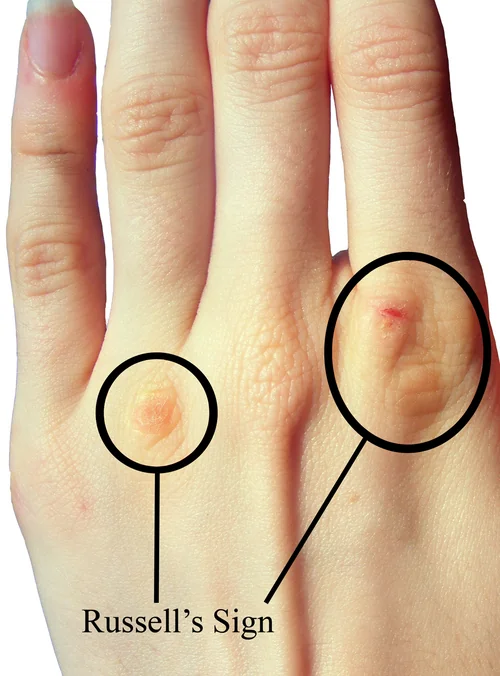
- Physical signs: Russell's sign (calluses on the knuckles from self-induced vomiting), dental erosion, parotid gland swelling, oesophagitis, electrolyte disturbance (particularly hypokalaemia from vomiting or laxative misuse)
Binge eating disorder
Recurrent binge eating, as above, occurring at least weekly for at least a month, without the regular compensatory behaviours seen in bulimia nervosa. It is commonly associated with overweight or obesity, and with significant distress and shame about eating.
Screening
The SCOFF questionnaire is a widely used case-finding tool; two or more 'yes' answers should prompt further assessment.
- Do you make yourself Sick because you feel uncomfortably full?
- Do you worry you have lost Control over how much you eat?
- Have you recently lost more than One stone (6.35 kg) in a 3-month period?
- Do you believe yourself to be Fat when others say you are too thin?
- Would you say that Food dominates your life?
Mental state examination
| Domain | Typical findings |
|---|---|
| Appearance and behaviour | May be underweight (anorexia) or normal/overweight (bulimia, BED); layered clothing to disguise weight loss or conserve heat; visible signs of purging |
| Speech | May be slowed if severely malnourished; otherwise unremarkable |
| Mood and affect | Anxious, low mood, irritability - often worsened directly by starvation itself |
| Thought content | Preoccupation with food, calories, weight and shape; overvalued ideas about body image; shame around bingeing/purging |
| Perception | Body image distortion - perceiving oneself as overweight despite objective evidence to the contrary; no true hallucinations |
| Cognition | Poor concentration, particularly with severe malnutrition |
| Insight | Often limited in anorexia nervosa, where restriction can feel ego-syntonic; usually better preserved in bulimia nervosa and binge eating disorder, where behaviour is experienced as distressing and unwanted |
Differential diagnosis
- Avoidant/restrictive food intake disorder (ARFID): restriction driven by sensory sensitivity, lack of interest in food, or fear of aversive consequences (choking, vomiting) rather than by weight or shape concerns
- Depression: appetite and weight change occur but without the specific body image disturbance and drive for thinness/control
- Malabsorption or gastrointestinal disease: coeliac disease, inflammatory bowel disease, and other causes of unintentional weight loss should be considered, particularly if body image and eating cognitions are not typical
- Hyperthyroidism: weight loss with preserved or increased appetite, and other thyrotoxic features
- Malignancy or chronic infection: as causes of unexplained weight loss in an atypical presentation
- Body dysmorphic disorder: preoccupation with a perceived defect in appearance not specifically centred on weight and shape/eating behaviour
- OCD: food-related rituals can occur, but without the core drive for weight loss or fear of fatness
Investigations
Investigations serve to assess physical risk and guide the urgency of intervention, not to make the diagnosis, which is clinical.
- Weight, height and BMI, and the rate of recent weight change - a rapid rate of loss is at least as important as the absolute figure
- Vital signs - bradycardia, hypotension, postural drop and hypothermia are all markers of physiological compromise
- ECG - bradycardia, and QTc prolongation particularly with electrolyte disturbance, hypokalaemia or certain medications
- U&Es - hypokalaemia, hyponatraemia (including from water-loading), and derangement from vomiting or laxative misuse
- Phosphate, magnesium, calcium - essential baseline before any refeeding, given the risk of refeeding syndrome
- FBC - anaemia, leucopenia and thrombocytopenia can occur with malnutrition
- LFTs, glucose, amylase - amylase can be raised with recurrent vomiting
- Bone profile and DEXA scan where amenorrhoea has been prolonged - osteoporosis risk
- Sick day rules / diabetes review where relevant, given the risk of insulin omission for weight control in type 1 diabetes
Physical signs and their causes
Many of the physical findings in eating disorders are directly explicable from the underlying behaviour, and being able to link the two is both good medicine and a reliable exam theme.
| Finding | Mechanism |
|---|---|
| Bradycardia and hypotension | Adaptive slowing of metabolism in starvation; a marker of physiological compromise |
| Lanugo hair, hypothermia | Insulation response to loss of subcutaneous fat |
| Amenorrhoea | Hypothalamic suppression of GnRH - hypogonadotrophic hypogonadism |
| Osteoporosis | Oestrogen deficiency plus low body weight and poor nutrition |
| Hypokalaemic metabolic alkalosis | Loss of hydrogen and potassium ions through self-induced vomiting |
| Hyperchloraemic metabolic acidosis | Bicarbonate loss through laxative-induced diarrhoea |
| Russell's sign | Repeated abrasion of the knuckles against the teeth during self-induced vomiting |
| Dental erosion (palatal surfaces) | Gastric acid exposure from vomiting |
| Parotid swelling, raised amylase | Salivary gland hypertrophy from repeated vomiting |
| Peripheral oedema | Hypoalbuminaemia and, on refeeding, fluid shifts and hyperaldosteronism |
Management
Treatment is delivered by specialist eating disorder services wherever possible, and referral should be made as soon as an eating disorder is suspected rather than after a period of monitoring - early intervention is one of the strongest determinants of outcome, and waiting for the BMI to fall further in order to meet a service threshold is not appropriate practice.
Psychological therapy
| Disorder | First-line therapy |
|---|---|
| Anorexia nervosa (adults) | An eating-disorder-focused individual psychological therapy - for example CBT-ED, MANTRA or SSCM |
| Anorexia nervosa (children/young people) | Anorexia-focused family therapy (FT-AN) |
| Bulimia nervosa (adults) | Guided self-help based on CBT principles first; if ineffective, individual CBT-ED |
| Bulimia nervosa (children/young people) | Bulimia-focused family therapy (FT-BN) |
| Binge eating disorder | Guided self-help based on CBT principles, or group CBT-ED |
The named therapies are worth recognising: CBT-ED addresses the overvaluation of weight and shape that maintains all three disorders; MANTRA (Maudsley Anorexia Nervosa Treatment for Adults) targets the obsessional, avoidant traits and beliefs about the value of anorexia to the person; and SSCM (Specialist Supportive Clinical Management) combines nutritional education with supportive therapy. Family therapy is first-line for children and young people in both anorexia and bulimia nervosa - an important point, since the adult and adolescent pathways differ.
Nutritional rehabilitation
Restoring weight and normalising eating patterns is central to treating anorexia nervosa, since cognitive symptoms and insight are difficult to address while the brain remains starved. This is done gradually and collaboratively, alongside psychological therapy, and can be managed in the community for most patients, with inpatient or day-patient care reserved for higher medical or psychiatric risk.2
Medication
- No medication is licensed or recommended as a primary treatment for anorexia nervosa - psychological therapy and nutritional rehabilitation are the mainstay
- Fluoxetine has a specific evidence base and licence for bulimia nervosa, used alongside psychological therapy, typically at a higher dose than for depression4
- Medication for comorbid depression or anxiety is considered on its own merits, but is not a substitute for eating-disorder-focused therapy
Assessing and managing physical risk
MARSIPAN (Management of Really Sick Patients with Anorexia Nervosa) provides the UK framework for grading physical risk and deciding on the need for urgent medical admission3, based on a combination of BMI/rate of weight loss, vital signs, and blood results, rather than any single cut-off in isolation.
Complications
Anorexia nervosa carries the highest mortality of any psychiatric disorder, from both direct physical complications of starvation (cardiac arrhythmia, electrolyte disturbance, infection) and suicide. Long-term physical complications include osteoporosis, infertility, and, in those with prolonged illness from a young age, impaired growth. Bulimia nervosa's compensatory behaviours cause electrolyte disturbance (with cardiac arrhythmia risk), oesophageal and dental damage, and gastrointestinal complications from laxative misuse. Binge eating disorder is strongly associated with the medical complications of obesity. Across all eating disorders, comorbid depression, anxiety and substance misuse are common, and social and occupational functioning are frequently significantly affected.
Red flags
Prognosis
Outcomes are significantly better with early treatment, particularly in anorexia nervosa presenting in adolescence, where family-based therapy achieves good rates of recovery. Roughly half of people with anorexia nervosa make a full recovery over the long term, with a further substantial proportion improving significantly, though a minority develop an enduring, severe and treatment-resistant course.
Bulimia nervosa and binge eating disorder generally carry a somewhat better prognosis than anorexia nervosa, with good response rates to CBT-based treatment, though relapse is common, particularly at times of stress. Poorer prognosis across all eating disorders is associated with a longer duration of untreated illness, more severe or fluctuating physical compromise, and significant psychiatric comorbidity, underscoring the importance of early recognition and referral.
References
- World Health Organization. ICD-11 for Mortality and Morbidity Statistics. Feeding or eating disorders. 2024. Available here
- NICE NG69. Eating disorders: recognition and treatment. 2017, updated 2020. Available here
- Royal College of Psychiatrists. MARSIPAN: Management of Really Sick Patients with Anorexia Nervosa. CR233. 2022. Available here
- NICE CKS. Eating disorders. Available here
This article is written for revision and education. It is not clinical guidance and must not be used to make decisions about the care of a patient. Always check current NICE guidance and local protocols.