
Liver Failure: Acute Liver Failure and Acute-on-Chronic Liver Failure
Key points
- Acute liver failure: the triad of jaundice, coagulopathy (INR above 1.5) and hepatic encephalopathy developing in a patient with no pre-existing liver disease.
- Commonest UK cause: paracetamol overdose, accounting for around half of cases; others include viral hepatitis, drug reactions, Wilson disease and Budd-Chiari syndrome.
- Classification: hyperacute (encephalopathy within 7 days of jaundice), acute (8-28 days) and subacute (29 days to 12 weeks); hyperacute has the best chance of spontaneous recovery.
- Acute-on-chronic liver failure: acute decompensation of established cirrhosis with organ failure, usually triggered by infection, GI bleeding or alcohol.
- Key early sign: a rising INR is the earliest and most sensitive marker of failing synthetic function - not the transaminases.
- N-acetylcysteine: the antidote for paracetamol toxicity, and beneficial in non-paracetamol acute liver failure too; give it early and do not delay for levels in staggered overdose.
- King's College criteria: identify patients requiring urgent liver transplantation; for paracetamol, arterial pH below 7.3, or the triad of INR above 6.5, creatinine above 300 and grade III-IV encephalopathy.
- Referral: discuss every case with a specialist liver unit early - before the patient meets transplant criteria, not after.
Introduction and definitions
Liver failure describes the loss of the liver's synthetic, metabolic and detoxifying functions to a degree that threatens life. It is important to distinguish two clinically distinct entities, since their causes, management and prognosis differ substantially.1
| Type | Definition | Key features |
|---|---|---|
| Acute liver failure (ALF) | Jaundice, coagulopathy (INR above 1.5) and hepatic encephalopathy in a patient with no pre-existing liver disease, developing within 26 weeks | Rapid onset, cerebral oedema is the major threat, potentially reversible with transplantation |
| Acute-on-chronic liver failure (ACLF) | Acute decompensation of established cirrhosis with associated extrahepatic organ failure | High short-term mortality, usually has an identifiable precipitant such as infection or GI bleeding |
| Chronic liver failure | Progressive decompensation of cirrhosis without a discrete acute insult | Gradual decline; see the cirrhosis article |
Classification of acute liver failure by speed of onset
The interval between the onset of jaundice and the development of encephalopathy is prognostically important, and counterintuitively, faster is better:
- Hyperacute: encephalopathy within 7 days of jaundice. Typically paracetamol or hepatitis A. Highest risk of cerebral oedema, but the best chance of spontaneous survival with supportive care
- Acute: encephalopathy at 8-28 days. Intermediate prognosis
- Subacute: encephalopathy at 29 days to 12 weeks. Often drug-induced or seronegative. Less cerebral oedema, but the worst prognosis and the least likely to recover without transplantation
Causes
Acute liver failure
| Category | Causes |
|---|---|
| Drugs and toxins | Paracetamol overdose - the commonest UK cause, around 50% of cases. Also idiosyncratic drug reactions (co-amoxiclav, flucloxacillin, isoniazid, anti-epileptics, statins, herbal remedies), ecstasy, and Amanita phalloides mushroom poisoning |
| Viral | Hepatitis A, B and E (hepatitis E especially in pregnancy); hepatitis D superinfection; rarely EBV, CMV, herpes simplex virus |
| Vascular | Budd-Chiari syndrome (hepatic vein thrombosis), ischaemic hepatitis ("shock liver") from prolonged hypotension, veno-occlusive disease |
| Metabolic and genetic | Wilson disease - always consider in patients under 40 |
| Pregnancy-related | Acute fatty liver of pregnancy, HELLP syndrome |
| Autoimmune | Severe autoimmune hepatitis presenting acutely |
| Malignant | Massive malignant infiltration, lymphoma |
| Other | Heat stroke, sepsis, and seronegative (indeterminate) hepatitis, which remains a substantial minority |
Precipitants of acute-on-chronic liver failure
- Infection, particularly spontaneous bacterial peritonitis - always exclude with a diagnostic ascitic tap
- Gastrointestinal bleeding, especially variceal haemorrhage
- Alcohol - a recent binge or severe alcoholic hepatitis
- Drugs: NSAIDs, opioids, sedatives, or hepatotoxic agents
- Dehydration, hypovolaemia and electrolyte disturbance
- Portal vein thrombosis
- Constipation, particularly as a trigger for encephalopathy
- Surgery, and superimposed viral hepatitis
Clinical features
The clinical picture reflects the loss of each hepatic function:
- Jaundice - failure of bilirubin conjugation and excretion
- Coagulopathy - failure to synthesise clotting factors, causing bruising, petechiae and bleeding. A rising INR is the earliest and most sensitive marker of deteriorating synthetic function
- Hepatic encephalopathy - failure to clear nitrogenous waste, with confusion, drowsiness, asterixis, and progression to coma
- Hypoglycaemia - failure of gluconeogenesis and glycogen storage; a critical, easily missed and rapidly fatal complication
- Fetor hepaticus - a sweet, musty breath
- Nausea, vomiting, malaise and right upper quadrant pain
- Ascites and peripheral oedema - more prominent in subacute and chronic failure
- Fever, tachycardia and hypotension - a systemic inflammatory response, often with a vasodilated, high-output circulation resembling sepsis
Grading hepatic encephalopathy
| Grade | Features |
|---|---|
| I | Mild confusion, altered mood, impaired attention, reversed sleep pattern |
| II | Drowsiness, lethargy, disorientation, obvious personality change, asterixis |
| III | Marked confusion, somnolent but rousable, incoherent speech |
| IV | Coma, unresponsive to pain |
Investigations
Assessing severity
- Prothrombin time and INR - the single most important test. Repeat at least daily; a rising INR indicates worsening synthetic function. Do not correct with vitamin K or fresh frozen plasma unless actively bleeding or before a procedure, as this removes the most reliable marker of progression and of transplant need
- Blood glucose - check frequently; hypoglycaemia is common, dangerous and easily missed
- Arterial blood gas and lactate - acidosis is a marker of severity and appears in the King's College criteria
- Urea, electrolytes and creatinine - renal failure is common and prognostically important
- Full blood count - anaemia, thrombocytopenia
- Liver enzymes and bilirubin - note that falling transaminases with a rising bilirubin and INR indicates hepatocyte exhaustion, not recovery
- Ammonia - an arterial ammonia above about 150-200 µmol/L predicts cerebral oedema and intracranial hypertension
- Phosphate, magnesium and calcium
Establishing the cause
- Paracetamol level and a careful timed overdose history, including staggered ingestion
- Viral hepatitis serology: hepatitis A IgM, hepatitis B surface antigen and core IgM, hepatitis E IgM and RNA, hepatitis C, plus EBV, CMV and HSV
- Autoantibodies and immunoglobulins for autoimmune hepatitis
- Caeruloplasmin, serum and 24-hour urinary copper, and slit-lamp examination for Wilson disease in anyone under 40
- Pregnancy test in women of childbearing age
- Toxicology screen and a full drug history including over-the-counter and herbal preparations
- Doppler ultrasound of the liver - assesses parenchyma, excludes biliary obstruction, and critically evaluates hepatic vein patency to exclude Budd-Chiari syndrome
- Blood, urine and ascitic cultures - infection is common and often occult
Paracetamol overdose
Paracetamol is the commonest cause of acute liver failure in the UK, and its management is a core competency.2
Mechanism
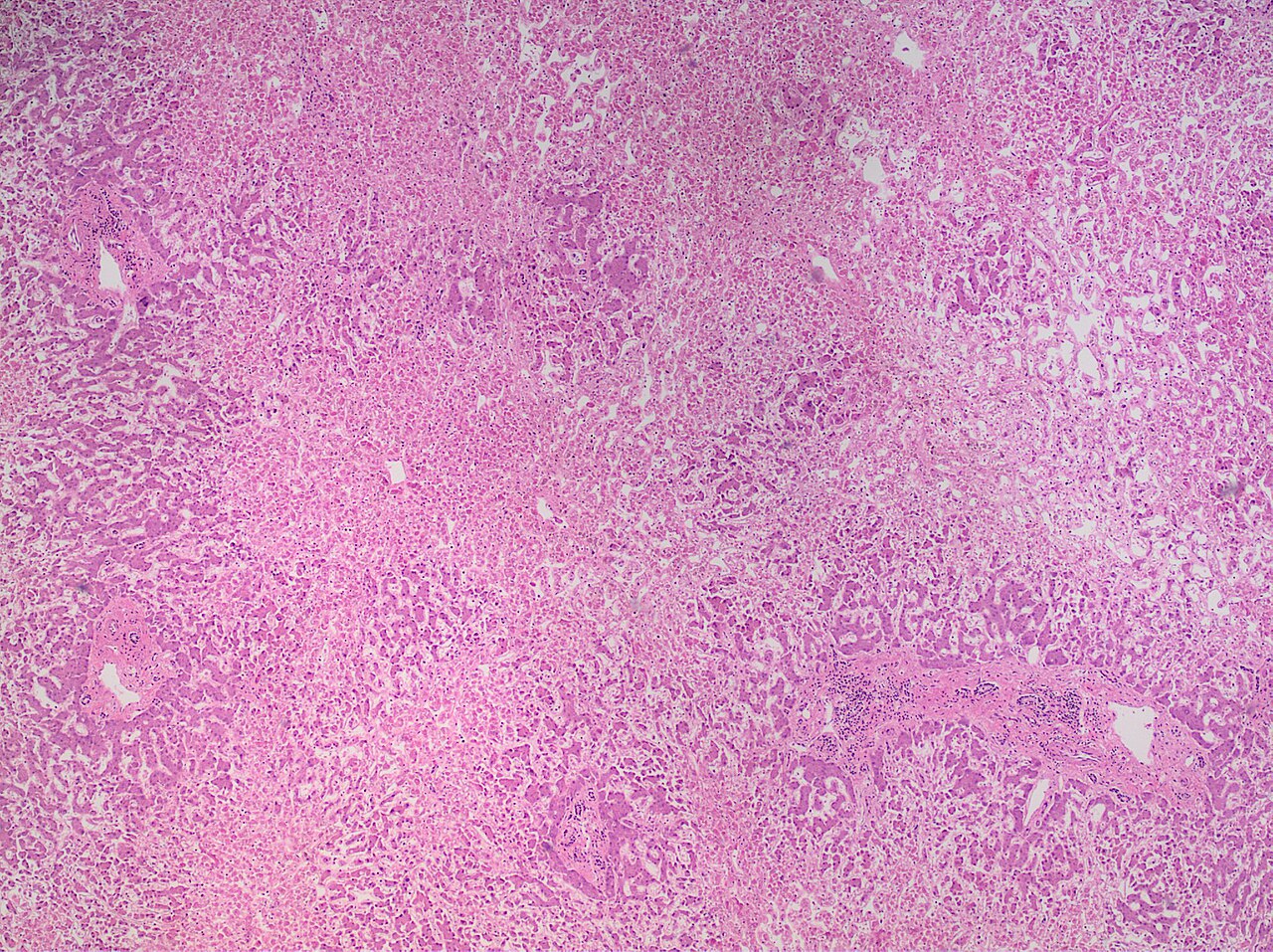
At therapeutic doses, paracetamol is mostly conjugated to harmless glucuronide and sulphate metabolites, with a small fraction oxidised by CYP2E1 to the toxic metabolite NAPQI, which is immediately detoxified by conjugation with glutathione. In overdose, conjugation pathways saturate, more NAPQI is produced, and glutathione stores are depleted. Free NAPQI then binds hepatocyte proteins, causing centrilobular (zone 3) necrosis. N-acetylcysteine works by replenishing glutathione, which is why it must be given before hepatocyte damage is established.
Risk factors for hepatotoxicity
- Enzyme-inducing drugs that upregulate CYP2E1: rifampicin, carbamazepine, phenytoin, phenobarbital, St John's wort, and chronic alcohol excess
- Glutathione depletion: malnutrition, anorexia nervosa, eating disorders, HIV, cystic fibrosis, and chronic alcohol use
- Note that acute alcohol intoxication is actually protective, as ethanol competes for CYP2E1
Management
- Activated charcoal if presentation is within 1 hour of a significant ingestion
- Paracetamol level at 4 hours post-ingestion (or immediately if later), plotted on the treatment nomogram. The UK uses a single treatment line at 100 mg/L at 4 hours for all patients, having abandoned separate high-risk lines
- N-acetylcysteine (NAC) if the level is above the treatment line. Give it immediately without waiting for levels in staggered overdoses, in presentations beyond 8 hours, where the timing is uncertain, or if the patient is already jaundiced or encephalopathic
- NAC is now commonly given by the SNAP regimen (a 12-hour, two-bag protocol), which reduces the anaphylactoid reactions common with the older 21-hour regimen. Anaphylactoid reactions are usually managed by slowing the infusion and giving an antihistamine rather than stopping treatment
- Continue NAC beyond the standard course if the INR remains raised, transaminases are still rising, or encephalopathy is present
- Assess and manage risk of further self-harm, with mental health review for every patient
Management of acute liver failure
Management is supportive and organ-directed, buying time for either hepatic regeneration or transplantation. Early discussion with a specialist liver unit is essential - refer before the patient fulfils transplant criteria, not after, because deterioration can be rapid and transfer becomes hazardous once encephalopathy is advanced.1
- Manage in a critical care setting with hourly neurological observations
- Treat the cause: NAC for paracetamol (and it also benefits non-paracetamol ALF), antivirals for hepatitis B, aciclovir for HSV, delivery for pregnancy-related liver failure, anticoagulation or TIPS for Budd-Chiari syndrome, chelation and transplantation for Wilson disease
- Glucose: monitor at least hourly and infuse 10% dextrose as needed - hypoglycaemia is common and can be fatal
- Encephalopathy and cerebral oedema: nurse head-up at 30°, avoid stimulation, intubate and ventilate for grade III-IV encephalopathy, treat raised ICP with mannitol or hypertonic saline. Lactulose is of limited value in ALF compared with its role in cirrhosis, and may cause bowel distension
- Coagulopathy: do not correct routinely - only give vitamin K, fresh frozen plasma or platelets if actively bleeding or before an invasive procedure. Give proton pump inhibitor prophylaxis against stress ulceration
- Infection: patients are functionally immunosuppressed; have a very low threshold for cultures and empirical broad-spectrum antibiotics and antifungals
- Renal: acute kidney injury is common; renal replacement therapy (continuous rather than intermittent) is often required and also helps clear ammonia
- Haemodynamics: fluid resuscitation and vasopressors (noradrenaline) for the vasodilated circulation
- Nutrition: enteral feeding with adequate protein - do not restrict protein
King's College criteria for liver transplantation
These criteria identify patients whose prognosis without transplantation is so poor that emergency listing is warranted.3
| Paracetamol-induced | Non-paracetamol |
|---|---|
| Arterial pH below 7.3 more than 24 hours after ingestion (after adequate fluid resuscitation) | INR above 6.5 (prothrombin time over 100 seconds) alone |
| OR all three of: INR above 6.5; creatinine above 300 µmol/L; grade III-IV encephalopathy | OR any three of: age under 10 or over 40; jaundice to encephalopathy interval over 7 days; INR above 3.5; bilirubin above 300 µmol/L; unfavourable cause (drug-induced or seronegative hepatitis) |
| Arterial lactate above 3.5 mmol/L early, or above 3.0 mmol/L after resuscitation, is also used |
Acute-on-chronic liver failure
ACLF is acute decompensation of established cirrhosis accompanied by failure of one or more extrahepatic organs - renal, cerebral, circulatory, respiratory or coagulation. It is distinguished from simple decompensation by the presence of organ failure and by a much higher short-term mortality, which rises steeply with the number of organs involved.4
Management centres on identifying and treating the precipitant, which is achievable in most cases:
- Screen aggressively for infection - blood, urine and ascitic cultures, chest radiograph. Perform a diagnostic ascitic tap in every patient with ascites, and treat SBP with antibiotics and albumin
- Control variceal bleeding with terlipressin, antibiotics and endoscopic band ligation
- Stop alcohol and manage withdrawal with lorazepam and thiamine
- Review and stop precipitating drugs: NSAIDs, opioids, sedatives and nephrotoxics
- Correct hypovolaemia and electrolytes, and treat constipation
- Treat encephalopathy with lactulose and rifaximin
- Organ support in critical care, and early transplant assessment for suitable candidates
Complications
- Cerebral oedema and intracranial hypertension - the leading cause of death in acute liver failure
- Sepsis and multi-organ failure - patients are functionally immunosuppressed
- Acute kidney injury and hepatorenal syndrome
- Hypoglycaemia, and metabolic acidosis with hyperlactataemia
- Coagulopathy and haemorrhage, including GI bleeding from stress ulceration
- Circulatory failure with profound vasodilatation resembling septic shock
- Respiratory failure, ARDS and aspiration pneumonia
- Electrolyte disturbance: hyponatraemia, hypokalaemia, hypophosphataemia and hypomagnesaemia
- Pancreatitis, particularly in paracetamol overdose
- Death, or the need for emergency transplantation
Red flags
Prognosis
Outcomes in acute liver failure have improved substantially, with overall survival now exceeding 60%, driven by better critical care, the widespread use of N-acetylcysteine, and emergency transplantation.3 Prognosis depends heavily on the cause and the speed of onset.
Paracetamol-induced and hepatitis A liver failure have the best spontaneous recovery rates - often exceeding 60-70% with supportive care alone - because they are hyperacute and the liver has substantial regenerative capacity if the patient survives the acute phase. Subacute presentations, idiosyncratic drug reactions, seronegative hepatitis and Wilson disease have the poorest spontaneous survival and most often require transplantation. Emergency liver transplantation achieves one-year survival of around 80%.
Acute-on-chronic liver failure carries a 28-day mortality that rises steeply with the number of failing organs, exceeding 75% with three or more organ failures. However, because a precipitant is identifiable in most cases, prompt treatment of infection, bleeding or alcohol can reverse the picture - which is why aggressive early search for a trigger is so worthwhile.
References
- European Association for the Study of the Liver. EASL Clinical Practical Guidelines on the management of acute (fulminant) liver failure. J Hepatol. 2017. Available here
- NICE Clinical Knowledge Summaries (CKS). Paracetamol poisoning. 2023. Available here
- O'Grady JG et al. Early indicators of prognosis in fulminant hepatic failure (King's College criteria). Gastroenterology. 1989. Available here
- Moreau R et al. Acute-on-chronic liver failure is a distinct syndrome that develops in patients with acute decompensation of cirrhosis. Gastroenterology. 2013. Available here
- TOXBASE. Paracetamol overdose management guidance. Available here
- Mikael Häggström, MD, CC0, via Wikimedia Commons. Available here
- NICE NG50. Cirrhosis in over 16s: assessment and management. 2016. Available here
- MHRA. Treating paracetamol overdose with intravenous acetylcysteine: new guidance. 2012. Available here
This article is written for revision and education. It is not clinical guidance and must not be used to make decisions about the care of a patient. Always check current NICE guidance and local protocols.