
Alcohol Withdrawal and Delirium Tremens
Key points
- Alcohol withdrawal: a physiological syndrome following reduction or cessation of alcohol in a dependent person, caused by unopposed glutamatergic excitation after chronic GABA suppression.
- Timeline: tremor and autonomic symptoms at 6-12 hours, seizures at 12-48 hours (peak ~24), alcoholic hallucinosis at 12-24 hours, and delirium tremens at 48-72 hours.
- Delirium tremens: a medical emergency with coarse tremor, marked confusion, vivid visual hallucinations and autonomic instability - mortality is up to 15% untreated, around 1-4% treated.
- First-line treatment: a reducing regimen of chlordiazepoxide, given either symptom-triggered (guided by CIWA-Ar) or as a fixed-dose reduction.
- Liver failure: use lorazepam or oxazepam instead of chlordiazepoxide - they are not subject to extensive hepatic oxidation and will not accumulate.
- Wernicke's encephalopathy: the triad of confusion, ataxia and ophthalmoplegia - but treat on any suspicion, since the full triad is present in a minority.
- Thiamine before glucose: always give parenteral thiamine (Pabrinex) before or with any glucose load, as glucose depletes remaining thiamine and can precipitate Wernicke's.
- Alcoholic hallucinosis vs DTs: hallucinosis features hallucinations with a clear sensorium and intact orientation; delirium tremens features clouded consciousness and disorientation.
Introduction
Alcohol withdrawal is the physiological syndrome that follows reduction or cessation of alcohol intake in someone who has become physically dependent. It ranges from mild tremor and anxiety through to withdrawal seizures and delirium tremens, which carries genuine mortality.1
It is one of the few psychiatric presentations that is a true medical emergency, and one of a small number of withdrawal states - alongside benzodiazepines - that can kill. Recognising it, predicting its severity and pre-empting it with adequate benzodiazepine cover and thiamine is core foundation-level practice, since a substantial proportion of patients admitted for entirely unrelated reasons will withdraw on the ward simply because their usual intake has stopped.
The clinical trap is that these patients frequently present for another reason entirely - a fracture, pneumonia, a surgical admission - and the alcohol history is not taken. Withdrawal then declares itself 48 hours later as unexplained confusion and agitation, at which point it is far harder to manage and easily misattributed to sepsis or postoperative delirium.
Pathophysiology
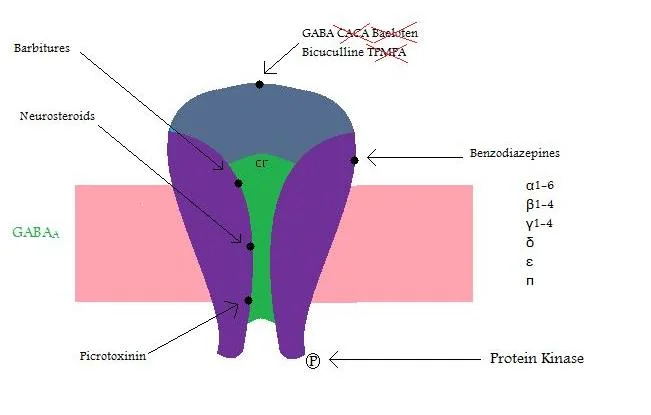
Alcohol acts as a GABA-A receptor agonist (enhancing inhibitory neurotransmission) and an NMDA receptor antagonist (suppressing excitatory glutamatergic transmission). It is, in net effect, a CNS depressant.
With chronic exposure, the brain adapts to maintain equilibrium: GABA-A receptors are downregulated and NMDA receptors are upregulated. The nervous system now requires the continued presence of alcohol simply to function normally - this is the neurobiological basis of tolerance.
When alcohol is abruptly withdrawn, that adaptation is suddenly unopposed. Reduced GABAergic inhibition combined with an excess of upregulated NMDA receptors produces a state of profound CNS hyperexcitability: tremor, tachycardia, hypertension, agitation, lowered seizure threshold and, at the extreme, delirium. Benzodiazepines work precisely because they are GABA-A agonists and therefore substitute for the missing inhibitory tone, allowing it to be tapered in a controlled way.
Risk factors for severe withdrawal
- Previous withdrawal seizures or delirium tremens - the strongest single predictor
- Multiple previous detoxifications (kindling)
- High daily alcohol intake and long duration of dependence
- High SADQ score or evidence of severe dependence such as morning drinking and relief drinking
- Concurrent acute medical illness, particularly infection, trauma, pancreatitis or gastrointestinal bleeding
- Electrolyte disturbance - hypokalaemia, hypomagnesaemia and hypophosphataemia all lower the seizure threshold
- Older age and cognitive impairment
- Concurrent benzodiazepine dependence
- Abnormal LFTs or established liver disease
Clinical features and timeline
The timeline is highly examinable and clinically useful, because it lets you anticipate what is coming rather than react to it. Times are from the last drink.
| Time from last drink | Feature | Description |
|---|---|---|
| 6-12 hours | Simple withdrawal | Tremor, sweating, anxiety, nausea, tachycardia, hypertension, insomnia, craving |
| 12-24 hours | Alcoholic hallucinosis | Visual, auditory or tactile hallucinations with a clear sensorium - the patient is orientated and knows the hallucinations are not real |
| 12-48 hours (peak ~24) | Withdrawal seizures | Generalised tonic-clonic, usually single or few; status epilepticus is uncommon but possible |
| 48-72 hours (up to 5 days) | Delirium tremens | Coarse tremor, clouded consciousness, disorientation, vivid hallucinations, agitation, marked autonomic instability, fever |
Delirium tremens
The most severe form of withdrawal, typically peaking at 48-72 hours and lasting up to 5 days. It is a medical emergency with mortality of up to 15% if untreated, falling to around 1-4% with appropriate treatment - deaths result from arrhythmia, hyperthermia, aspiration, seizures and the complications of the associated medical illness.
- Clouding of consciousness and disorientation - the defining difference from alcoholic hallucinosis
- Coarse tremor affecting the whole body
- Vivid visual hallucinations, classically of small animals or insects (Lilliputian hallucinations), often with tactile hallucinations of things crawling on the skin (formication)
- Marked agitation and fear, sometimes with persecutory delusions
- Autonomic instability - fever, profuse sweating, tachycardia, hypertension
- Fluctuating course, typically worse at night
Assessment scales
The CIWA-Ar (Clinical Institute Withdrawal Assessment for Alcohol, revised) scores ten domains including nausea, tremor, sweating, anxiety, agitation, sensory disturbance, headache and orientation. It is used to guide symptom-triggered dosing, giving benzodiazepine only when the score exceeds a threshold. It requires a patient who can communicate and cooperate, so it is unreliable in established delirium, in significant cognitive impairment, and where there is a language barrier.
Investigations
- Blood glucose - hypoglycaemia is common in alcohol dependence and can itself cause confusion and seizures
- FBC - raised MCV, and thrombocytopenia in liver disease
- U&Es, magnesium, phosphate, calcium - correct hypomagnesaemia and hypokalaemia, both of which lower the seizure threshold and impair response to treatment
- LFTs, albumin and clotting - to assess liver synthetic function, which directly determines benzodiazepine choice
- CRP, cultures and chest radiograph - infection is a common precipitant and a common comorbidity
- Breath or blood alcohol level - helps establish where in the timeline the patient is; a patient in withdrawal with a still-positive level is likely to deteriorate further
- CT head - if there is head injury, focal neurology, a first seizure, atypical features, or failure to improve as expected, since subdural haematoma is common in this group and easily missed
- ECG - arrhythmia, and QTc prolongation with electrolyte disturbance
Management
Benzodiazepine regimens
Chlordiazepoxide is the first-line agent in the UK - a long-acting benzodiazepine that substitutes for alcohol at the GABA-A receptor and is then tapered.2 Two approaches are used:
| Fixed-dose reducing regimen | Symptom-triggered regimen | |
|---|---|---|
| Method | A set starting dose reduced over 5-7 days regardless of symptoms | Dose given only when CIWA-Ar exceeds a threshold, reassessed regularly |
| Advantages | Simple; safe where monitoring is limited; suitable for community detoxification | Lower total dose and shorter duration; individually titrated |
| Requires | Little specialist input | Trained staff able to score reliably and frequently |
| Best suited to | Community settings, wards without experienced staff, patients unable to self-report | Inpatient units with experienced staff and cooperative, communicative patients |
Doses must be titrated to the individual - a severely dependent patient may need considerably more than a standard regimen, while an elderly or hepatically impaired patient may need considerably less.4 Withhold a dose if the patient is over-sedated, and reassess rather than continuing blindly.
Thiamine and Wernicke's encephalopathy
Thiamine (vitamin B1) deficiency is near-universal in alcohol dependence, through poor diet, impaired absorption and impaired hepatic storage. Untreated it causes Wernicke's encephalopathy, an acute, reversible neurological emergency, which if untreated progresses to the largely irreversible Korsakoff syndrome.
- Wernicke's triad: confusion, ataxia and ophthalmoplegia (classically nystagmus and lateral rectus palsy). The complete triad is present in only around 10-20% of cases, so treat on suspicion, not on completeness.
- Korsakoff syndrome: profound anterograde and retrograde amnesia with confabulation and relatively preserved other cognitive function - largely irreversible once established
- Treatment: high-dose parenteral thiamine (Pabrinex) for anyone with suspected Wernicke's or at high risk, given for a minimum of 5 days, followed by oral thiamine. Prophylactic oral thiamine alone is inadequate where absorption is impaired or risk is high.
- Also replace magnesium, which is a necessary cofactor - thiamine will not work properly in a magnesium-depleted patient
Managing delirium tremens
- Admit to an appropriate acute medical setting with adequate monitoring - this is not a community-manageable condition
- Oral lorazepam is first-line; if symptoms persist or oral administration is not possible, parenteral lorazepam or haloperidol may be used
- Antipsychotics should not be used alone - they do not treat the underlying GABA deficit and lower the seizure threshold, so they are adjuncts to adequate benzodiazepine cover, never a substitute
- Aggressive supportive care - fluid and electrolyte replacement, correction of magnesium and phosphate, treatment of any precipitating infection, and management of hyperthermia
- Parenteral thiamine throughout
- Nurse in a well-lit, quiet environment with frequent reorientation, as for any delirium
Withdrawal seizures
Managed with benzodiazepines, which both treat and prevent further seizures. Phenytoin is ineffective for alcohol withdrawal seizures specifically and should not be used for this indication. A first seizure, focal features, or failure to recover promptly warrants CT imaging to exclude an alternative cause such as a subdural haematoma. A patient who has had a withdrawal seizure requires adequate benzodiazepine cover, not simply observation.
After withdrawal
Detoxification alone is not treatment - it manages the physiology of withdrawal but does nothing to prevent relapse. Successful withdrawal should always be followed by relapse prevention: acamprosate or oral naltrexone, psychosocial support, and referral to community alcohol services.3 Continued oral thiamine and consideration of ongoing liver follow-up are also needed.
Complications
The acute complications are seizures (including status epilepticus), delirium tremens with its associated arrhythmia, hyperthermia and aspiration risk, and Wernicke's encephalopathy progressing to permanent Korsakoff syndrome. Over-sedation from benzodiazepines is a genuine iatrogenic risk, particularly in liver impairment or when combined with other depressants.
Longer term, patients who successfully complete withdrawal but receive no relapse prevention have very high rates of return to drinking, and each subsequent withdrawal is likely to be more severe through kindling. Aspiration pneumonia, falls, rhabdomyolysis and the decompensation of underlying liver disease all occur during severe withdrawal episodes.
Red flags
Prognosis
With prompt recognition and adequate benzodiazepine and thiamine treatment, uncomplicated alcohol withdrawal resolves over 5-7 days with a good outcome. Delirium tremens carries mortality of around 1-4% when properly treated, rising to as high as 15% when it is not recognised or is undertreated, with deaths driven by arrhythmia, hyperthermia, aspiration and untreated concurrent illness.
The longer-term outlook depends almost entirely on what follows detoxification. Withdrawal management in isolation has little effect on drinking outcomes; the addition of relapse prevention medication, psychosocial treatment and social support substantially improves abstinence rates. Established Korsakoff syndrome is largely irreversible and frequently necessitates long-term supported accommodation, which is why the threshold for giving parenteral thiamine should be extremely low.
References
- NICE CG100. Alcohol-use disorders: diagnosis and management of physical complications. 2010, updated 2017. Available here
- NICE CG115. Alcohol-use disorders: diagnosis, assessment and management of harmful drinking and alcohol dependence. 2011. Available here
- NICE CKS. Alcohol - problem drinking. Available here
- BNF. Chlordiazepoxide hydrochloride - alcohol withdrawal. Available here
This article is written for revision and education. It is not clinical guidance and must not be used to make decisions about the care of a patient. Always check current NICE guidance and local protocols.