
Wilson Disease: Diagnosis and Management
Key points
- Wilson disease: an autosomal recessive disorder of copper metabolism causing accumulation of copper in the liver, brain, cornea and kidneys.
- Genetics: mutations in the ATP7B gene on chromosome 13, encoding a copper-transporting ATPase needed for biliary copper excretion and caeruloplasmin loading.
- Who to suspect: any patient under 40 with unexplained liver disease, and any young person with new movement disorder or unexplained psychiatric symptoms.
- Presentation by age: hepatic disease predominates in children and adolescents; neuropsychiatric disease predominates in the twenties and thirties.
- Kayser-Fleischer rings: golden-brown copper deposits in Descemet membrane at the corneal limbus; present in nearly all patients with neurological disease, but only about half with hepatic disease.
- Screening tests: low serum caeruloplasmin and raised 24-hour urinary copper; serum copper is usually low, which is counterintuitive.
- Fulminant clue: acute liver failure with Coombs-negative haemolysis and a disproportionately low alkaline phosphatase with very high bilirubin (ALP:bilirubin ratio below 4).
- Treatment: lifelong copper chelation with penicillamine or trientine, or zinc for maintenance; transplantation for fulminant or decompensated disease.
Introduction
Wilson disease (hepatolenticular degeneration) is an autosomal recessive disorder of copper metabolism in which impaired biliary copper excretion causes progressive copper accumulation in the liver and, once hepatic storage capacity is exceeded, in the brain, cornea, kidneys and other tissues.1
It is rare, affecting around 1 in 30,000, but it is one of the most important diagnoses not to miss in hepatology for two reasons. First, it is treatable, and patients diagnosed before irreversible organ damage can expect a normal life expectancy. Second, it is uniformly fatal if untreated. Presentation is usually between the ages of 5 and 35, which is why the practical rule is to consider Wilson disease in any patient under 40 with unexplained liver disease or a new movement disorder.
Genetics and pathophysiology
Genetics
Wilson disease results from mutations in the ATP7B gene on chromosome 13, which encodes a copper-transporting P-type ATPase expressed principally in hepatocytes. Over 500 mutations have been described, and most patients are compound heterozygotes carrying two different mutations, which contributes to the wide variability in presentation. There is a poor genotype-phenotype correlation, so genetic testing is used for confirmation and family screening rather than to predict the clinical course.
Normal copper handling
Dietary copper is absorbed in the proximal small bowel and transported to the liver. Within the hepatocyte, the ATP7B protein has two essential functions: it loads copper onto apocaeruloplasmin to form functional caeruloplasmin for secretion into plasma, and it transports excess copper into the bile for excretion in the stool - the body's only meaningful route of copper elimination.
What goes wrong
Defective ATP7B impairs both functions.2 Biliary copper excretion fails, so copper accumulates progressively in hepatocytes, where it generates free radicals through Fenton chemistry, causing steatosis, hepatitis, fibrosis and eventually cirrhosis. Simultaneously, failure to incorporate copper into caeruloplasmin means apocaeruloplasmin is secreted instead, and being unstable it is rapidly degraded - producing the characteristically low serum caeruloplasmin.
Once hepatocyte storage capacity is exceeded, or when hepatocytes are damaged and release their contents, free (non-caeruloplasmin-bound) copper spills into the circulation. This is the toxic species: it deposits in the basal ganglia (particularly the putamen and lenticular nuclei, giving the name hepatolenticular degeneration), the cornea (Kayser-Fleischer rings), the renal tubules (causing a Fanconi-type tubulopathy) and the joints.
Clinical features
Presentation depends strongly on age. Hepatic disease predominates in children and adolescents (typically ages 5-20), whereas neuropsychiatric disease predominates in young adults (typically the twenties and thirties), by which time the liver is often already cirrhotic but compensated.
Hepatic features
- Asymptomatic abnormal liver blood tests, often found incidentally - the commonest early presentation
- Hepatic steatosis, which may be mistaken for MASLD in a young person
- Acute hepatitis, sometimes self-limiting and recurrent
- Chronic hepatitis mimicking autoimmune hepatitis, sometimes with positive autoantibodies and raised IgG, which is a well-recognised diagnostic trap
- Compensated or decompensated cirrhosis with ascites, varices and encephalopathy
- Fulminant hepatic failure - a distinctive and rapidly fatal presentation described below
Neurological features
Neurological disease reflects basal ganglia copper deposition and is essentially an extrapyramidal movement disorder:
- Tremor - classically a coarse, proximal "wing-beating" tremor of the outstretched arms, but resting, postural and intention tremors all occur
- Dysarthria and dysphagia, often early and prominent
- Dystonia, including the characteristic fixed dystonic smile (risus sardonicus)
- Parkinsonism - bradykinesia, rigidity and hypomimia in a young patient, which should always prompt consideration of Wilson disease
- Chorea and athetosis, ataxia and clumsiness
- Drooling, micrographia and deteriorating handwriting
- Cognition is typically preserved until late, and there is characteristically no sensory involvement and no true weakness
Psychiatric features
Psychiatric symptoms occur in up to a third and may precede other features by years, with patients not uncommonly treated for a primary psychiatric illness before the diagnosis is made. Features include personality change, disinhibition and impulsivity, depression (with a significant suicide risk), anxiety, psychosis, and a decline in school or work performance in a previously well-functioning young person.
Kayser-Fleischer rings and other signs
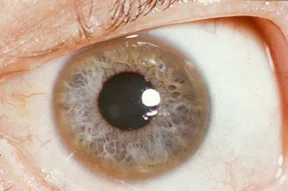
Kayser-Fleischer (KF) rings are golden-brown or greenish deposits of copper in Descemet membrane at the corneal limbus. They are best seen on slit-lamp examination and are often invisible to the naked eye. Their diagnostic value depends on the presentation: they are present in over 95% of patients with neurological disease, but in only about 50% of those with purely hepatic disease and are frequently absent in children. Their absence therefore never excludes Wilson disease.
- Sunflower cataracts - copper deposition in the lens, also seen on slit lamp; they do not usually impair vision
- Coombs-negative haemolytic anaemia, from sudden release of copper causing oxidative red cell damage
- Renal tubular acidosis and a Fanconi syndrome, with aminoaciduria, glycosuria, phosphaturia and nephrolithiasis
- Arthropathy and premature osteoarthritis, osteopenia
- Cardiomyopathy, arrhythmias, hypoparathyroidism, pancreatitis and amenorrhoea or recurrent miscarriage
Investigations
No single test is diagnostic; the diagnosis rests on combining biochemical, clinical and genetic findings, often using the Leipzig score.1
First-line tests
| Test | Typical finding | Caveats |
|---|---|---|
| Serum caeruloplasmin | Low (below 0.2 g/L) | An acute phase reactant - may be falsely normal in inflammation, acute hepatitis, pregnancy or oestrogen use. Also low in malnutrition and protein-losing states. Normal in up to 10% of patients |
| 24-hour urinary copper | Raised (above 0.64 µmol/24h, and often far higher) | The most useful biochemical test. Requires an accurate, complete collection in a copper-free container |
| Serum copper | Low or normal total copper, with a raised free (non-caeruloplasmin-bound) copper | Counterintuitive - a low total copper supports rather than refutes the diagnosis |
| Slit-lamp examination | Kayser-Fleischer rings | Must be performed by an ophthalmologist. Absent in around half of hepatic presentations and in most children |
| Liver biopsy with copper quantification | Hepatic copper above 250 µg/g dry weight | The gold standard where non-invasive tests are equivocal. Copper distribution can be patchy |
| ATP7B genetic testing | Two pathogenic mutations | Confirms the diagnosis and is essential for family screening. Many private mutations, so sequencing rather than targeted panels may be needed |
Supporting investigations
- Liver function tests, albumin and INR - to assess synthetic function and severity
- Full blood count and haemolysis screen - reticulocytes, LDH, haptoglobin and a direct antiglobulin (Coombs) test, which is characteristically negative
- Penicillamine challenge test - measuring urinary copper after a penicillamine dose, used chiefly in children where baseline urinary copper is equivocal
- MRI brain in patients with neuropsychiatric features - shows T2 hyperintensity in the basal ganglia, and may show the "face of the giant panda" sign in the midbrain, which is characteristic though not universal
- Urea, electrolytes and urinalysis for renal tubular dysfunction
- Non-invasive liver screen to exclude other causes, and transient elastography or biopsy to stage fibrosis
Differential diagnosis
- Autoimmune hepatitis - the most important mimic, since Wilson disease can present with raised IgG and positive autoantibodies. Always exclude Wilson disease before committing a young patient to lifelong immunosuppression
- MASLD - steatosis in a young person may be wrongly attributed to metabolic dysfunction
- Viral hepatitis and alcohol-related liver disease
- Alpha-1 antitrypsin deficiency and other inherited liver disorders
- Haemochromatosis - the other major inherited metal storage disorder, though it presents later and with raised iron indices
- Neurological differentials: juvenile Parkinson disease, Huntington disease, dystonia syndromes, multiple sclerosis, drug-induced parkinsonism, and other causes of tremor in the young
- Psychiatric differentials: first-episode psychosis, depression, bipolar disorder and substance misuse - Wilson disease should be considered where these are accompanied by any neurological sign or abnormal liver enzymes
- Aceruloplasminaemia and Menkes disease, rare related disorders of copper and iron handling
Management
Treatment is lifelong and consists of removing accumulated copper and then preventing re-accumulation. Treatment should never be stopped, even if the patient feels entirely well - discontinuation can precipitate fulminant hepatic failure.3
Chelation therapy
| Drug | Mechanism | Notes and adverse effects |
|---|---|---|
| Penicillamine | Chelates copper, promoting urinary excretion | Traditional first-line. Adverse effects are common: rash, proteinuria and nephrotic syndrome, bone marrow suppression, lupus-like syndrome, myasthenia, and pyridoxine (vitamin B6) deficiency - so pyridoxine is co-prescribed. May cause paradoxical initial neurological worsening |
| Trientine | Alternative chelator, also promoting urinary copper excretion | Better tolerated than penicillamine and increasingly used first-line, particularly in neurological disease. Fewer adverse effects; may cause sideroblastic anaemia |
| Zinc (acetate or sulphate) | Induces metallothionein in enterocytes, which binds dietary copper and sheds it in faeces, blocking absorption | Used for maintenance, in presymptomatic patients identified by screening, and in pregnancy. Slow-acting, so not suitable for initial decoppering of symptomatic disease. May cause gastric irritation |
| Ammonium tetrathiomolybdate | Blocks copper absorption and binds free copper in plasma | Used in some centres for neurological disease, where it may cause less initial worsening. Not widely available |
Treatment typically begins with a chelator for the decoppering phase, then transitions to maintenance with a lower-dose chelator or zinc once copper stores are depleted. If a chelator and zinc are given together, they must be taken several hours apart, as zinc binds the chelator and reduces its efficacy.
Monitoring
- 24-hour urinary copper - high initially during active chelation, then falling to a target maintenance range; a very low value may indicate over-treatment or non-adherence
- Serum free copper, liver function tests, albumin and INR
- Full blood count and urinalysis for proteinuria, particularly on penicillamine
- Clinical assessment of neurological and psychiatric status
- Surveillance for hepatocellular carcinoma if cirrhosis is present, though the risk is lower than in other cirrhoses
Diet and general measures
- Avoid copper-rich foods, particularly liver, shellfish, nuts, chocolate, mushrooms and dried fruit, especially in the first year of treatment
- Check drinking water copper content if supplied through copper piping from a private supply
- Avoid alcohol and other hepatotoxins
- Vaccinate against hepatitis A and B
- Emphasise lifelong adherence - non-adherence is the commonest cause of deterioration and can be fatal
Family screening and transplantation
Screen all first-degree relatives, particularly siblings, who have a 1 in 4 risk of being affected. Screening uses liver function tests, caeruloplasmin, 24-hour urinary copper, slit-lamp examination and, definitively, ATP7B genotyping. Presymptomatic siblings identified by screening should be treated, usually with zinc, since treatment before organ damage occurs gives a normal life expectancy.
Liver transplantation is indicated for fulminant Wilson disease and for decompensated cirrhosis unresponsive to chelation. Because the metabolic defect resides in the liver, transplantation is effectively curative of the copper handling disorder, with excellent long-term survival. Its role in purely neurological disease without liver failure remains controversial.
Complications
- Cirrhosis with portal hypertension, varices and ascites
- Fulminant hepatic failure, which is almost always fatal without emergency transplantation
- Irreversible neurological disability - dystonia, dysarthria, dysphagia and parkinsonism if treatment is delayed
- Psychiatric morbidity, including depression with a significant suicide risk
- Coombs-negative haemolytic anaemia, which can be acute and severe
- Renal tubular acidosis, Fanconi syndrome and nephrolithiasis
- Paradoxical neurological deterioration on starting chelation, particularly with penicillamine
- Hepatocellular carcinoma, although the risk is lower than in other causes of cirrhosis
- Osteoporosis, arthropathy, cardiomyopathy and infertility
Red flags
Prognosis
Wilson disease is one of the clearest examples in medicine of prognosis being determined by how early the diagnosis is made. Patients identified before symptoms develop - typically through family screening - and started on treatment can expect a completely normal life expectancy and quality of life.1
Patients with hepatic disease generally respond well to chelation, with biochemical improvement over 6-12 months and stabilisation or regression of fibrosis, provided cirrhosis is not already advanced. Neurological disease responds more slowly and less completely: many patients improve substantially over 1-3 years, but those with established severe dystonia or dysarthria may be left with permanent deficits, and around 10-20% deteriorate transiently when chelation is started.
Untreated Wilson disease is uniformly fatal, usually from hepatic failure or progressive neurological deterioration. Fulminant presentations have a mortality approaching 100% without emergency liver transplantation, but transplantation is effectively curative, correcting the underlying metabolic defect with long-term survival comparable to other transplant indications. The single greatest threat to a treated patient is non-adherence, which is why lifelong follow-up and education are integral to management.
References
- European Association for the Study of the Liver. EASL Clinical Practice Guidelines: Wilson's disease. J Hepatol. 2012. Available here
- Członkowska A et al. Wilson disease. Nat Rev Dis Primers. 2018. Available here
- Schilsky ML et al. AASLD practice guidance on Wilson disease. Hepatology. 2023. Available here
- Herbert L. Fred, MD and Hendrik A. van Dijk, CC BY 3.0, via Wikimedia Commons. Available here
- British Society of Gastroenterology. Guidelines on the management of abnormal liver blood tests. Gut. 2018. Available here
- BNF. Penicillamine. Available here
- British Liver Trust. Wilson's disease. Available here
This article is written for revision and education. It is not clinical guidance and must not be used to make decisions about the care of a patient. Always check current NICE guidance and local protocols.