
Panic Disorder
Key points
- Panic attack: a discrete episode of intense fear or discomfort that peaks within minutes, with physical and cognitive symptoms of autonomic arousal.
- Panic disorder: recurrent, unexpected panic attacks not restricted to a specific trigger, followed by at least a month of persistent worry about further attacks or their consequences.
- Key diagnostic feature: attacks are unexpected and not confined to a specific situation - if they only occur in one context, consider a specific phobia instead.
- First presentation: often to the emergency department with chest pain and breathlessness - ACS and PE must be excluded before attributing symptoms to panic.
- Hyperventilation: drives many of the physical symptoms via respiratory alkalosis - paraesthesiae, dizziness and carpopedal spasm.
- First-line management: CBT specifically adapted for panic disorder, or an SSRI - citalopram or sertraline.
- Avoid benzodiazepines: they relieve symptoms acutely but reinforce avoidance and carry a real risk of dependence; NICE advises against their use in panic disorder.
- Prognosis: good with treatment, but agoraphobia can develop if avoidance is not addressed early.
Introduction
A panic attack is a discrete episode of intense fear or discomfort, developing abruptly and reaching a peak within minutes, accompanied by physical symptoms of autonomic arousal and a sense of impending doom or loss of control.1 Panic attacks occur across many anxiety disorders and can occur in people with no psychiatric diagnosis at all - a single attack does not make a diagnosis.
Panic disorder is diagnosed when panic attacks are recurrent, unexpected (not consistently triggered by a specific situation), and followed by at least a month of persistent concern about having another attack, worry about the implications of an attack (for example, having a heart attack or 'going mad'), or a significant change in behaviour to avoid further attacks.1
It affects around 1-2% of the population and typically begins in late adolescence or early adulthood. It is clinically important well beyond psychiatry because it is a frequent cause of emergency presentations with chest pain and breathlessness, and a missed or delayed diagnosis leads to repeated, costly and unnecessary cardiac and respiratory investigation.
Aetiology
Panic disorder is thought to arise from a biological predisposition to a sensitive fear response, shaped by learning and cognitive interpretation.
- Genetics: moderate heritability, and a higher rate of anxiety disorders in first-degree relatives
- Neurobiology: heightened sensitivity of brainstem and limbic fear circuits (locus coeruleus, amygdala) to normal physiological fluctuations such as a rise in carbon dioxide or lactate
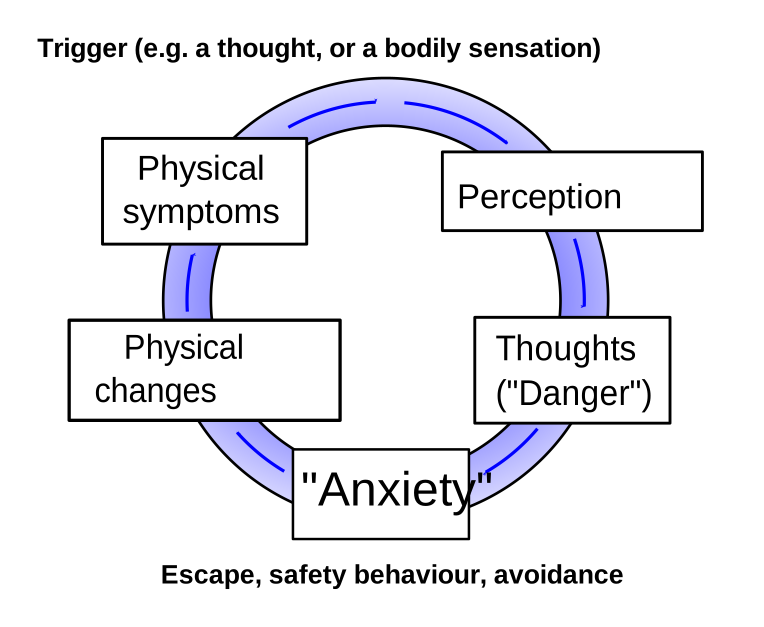
- Cognitive theory (Clark's model): a vicious cycle in which a normal bodily sensation (for example a slightly fast heartbeat) is catastrophically misinterpreted as a sign of imminent catastrophe, which drives further anxiety and more intense physical sensations
- Escape and safety behaviours terminate each attack, which the person attributes to the escape rather than to the attack being self-limiting - so the catastrophic belief is never disconfirmed and the cycle is preserved
- Hyperventilation: overbreathing during an attack causes respiratory alkalosis, producing paraesthesiae, dizziness and carpopedal spasm that reinforce the fear of a medical emergency
- Life stress and major life transitions: frequently identifiable as a precipitant for the first attack, even though later attacks feel unprovoked
- Substance use: stimulants, caffeine and cannabis can trigger attacks in susceptible individuals; alcohol withdrawal is another recognised trigger
Risk factors
- Female sex - roughly twice as common as in men
- Family history of panic disorder or other anxiety disorder
- Comorbid depression or another anxiety disorder
- Childhood adversity or separation anxiety
- Stimulant, caffeine or cannabis use
- Major life stress or transition preceding onset
- Behavioural inhibition and trait anxiety in childhood
Clinical features
A panic attack combines physical symptoms of autonomic arousal with catastrophic cognitions, and resolves spontaneously, typically within 20-30 minutes.
Physical symptoms
- Palpitations and tachycardia
- Chest pain or tightness
- Breathlessness or a sensation of choking
- Sweating and trembling
- Nausea or abdominal distress
- Dizziness, light-headedness or feeling faint
- Paraesthesiae, particularly perioral and in the fingers, from hyperventilation
- Hot flushes or chills
Cognitive symptoms
- Derealisation or depersonalisation - a sense of unreality or of being detached from oneself
- Fear of losing control or 'going mad'
- Fear of dying - often specifically fear of a heart attack
- An overwhelming urge to escape the situation
Between attacks
The diagnosis of panic disorder rests as much on what happens between attacks as on the attacks themselves: anticipatory anxiety about when the next attack will occur, and avoidance behaviour - avoiding places or situations where an attack has previously occurred, or where escape or help would be difficult. When avoidance becomes widespread (crowds, public transport, being far from home), it evolves into agoraphobia, which frequently coexists with panic disorder.
Mental state examination
| Domain | Typical findings |
|---|---|
| Appearance and behaviour | Between attacks often unremarkable; during an attack, visibly distressed, tachypnoeic, tremulous |
| Speech | Rapid, breathless during an attack; normal between episodes |
| Mood and affect | Anticipatory anxiety about further attacks; intense fear during an attack |
| Thought content | Catastrophic misinterpretation of bodily sensations; fear of dying, losing control or going mad; no fixed delusional beliefs |
| Perception | Derealisation/depersonalisation during attacks; no hallucinations |
| Cognition | Normal between attacks |
| Insight | Usually good - most patients recognise the attacks as excessive once they have passed, even if unable to control them in the moment |
Differential diagnosis
- Acute coronary syndrome: must be excluded first in anyone presenting acutely with chest pain, especially on a first episode or with cardiac risk factors
- Pulmonary embolism: pleuritic pain, tachycardia and breathlessness overlap closely with panic - consider risk factors and use a validated score
- Arrhythmia: paroxysmal SVT can mimic the palpitations of panic - a 24-hour ECG or event monitor may be needed if episodes are frequent
- Asthma: acute breathlessness and anxiety can be difficult to distinguish from an attack, particularly in a known asthmatic
- Thyrotoxicosis and phaeochromocytoma: episodic catecholamine surges producing similar autonomic symptoms
- Hypoglycaemia: in diabetic patients, can produce identical adrenergic symptoms
- Generalised anxiety disorder: worry is constant and free-floating rather than occurring in discrete attacks
- Specific phobia or social anxiety disorder: attacks are triggered consistently by a specific situation
- Substance intoxication or withdrawal: stimulants, cannabis, caffeine, or alcohol/benzodiazepine withdrawal
- Post-traumatic stress disorder: panic-like symptoms triggered specifically by trauma reminders
Investigations
The priority in a first presentation, particularly to the emergency department, is to exclude a dangerous organic cause before attributing symptoms to panic - this is a diagnosis that should be made with confidence, not by default exclusion alone.
- ECG - to exclude arrhythmia and cardiac ischaemia
- Troponin - if ACS is a realistic differential
- TFTs - to exclude thyrotoxicosis
- Capillary glucose - to exclude hypoglycaemia in diabetic patients
- FBC, U&Es - general screen
- Urine drug screen where stimulant use is suspected
- Arterial or venous blood gas if hyperventilation is severe, to demonstrate a respiratory alkalosis and support the diagnosis during an acute attack
Once organic causes have been reasonably excluded, the diagnosis is made clinically from the pattern of recurrent, unexpected attacks with inter-episode anticipatory anxiety and avoidance.
Management
During an acute attack
- Reassure and stay with the patient in a calm environment
- Encourage slow, controlled breathing to correct hyperventilation - breathing into cupped hands or through pursed lips can help
- Explain what is happening physiologically, which itself reduces catastrophic interpretation
- Avoid reflexively ordering repeat cardiac investigations once a genuine organic cause has already been excluded, as this reinforces the belief that something is physically wrong
Longer-term treatment
NICE recommends a choice of CBT specifically adapted for panic disorder or an SSRI, guided by patient preference.2
- CBT targets the catastrophic misinterpretation of bodily sensations, using psychoeducation, interoceptive exposure (deliberately inducing feared sensations in a safe context) and breathing retraining. It has strong, durable evidence in panic disorder.3
- SSRI - citalopram or sertraline are typically used first-line. Response can take several weeks, and anxiety can transiently worsen at initiation, so start at a low dose.
- If an SSRI is ineffective or not tolerated, an alternative SSRI, then a TCA (imipramine or clomipramine) can be considered under specialist guidance.
What CBT for panic actually involves
Panic-focused CBT is unusually specific and mechanistically elegant, and being able to describe it is useful both for exams and for persuading a sceptical patient to try it.
- Psychoeducation - explaining the fight-or-flight response and mapping each symptom onto a physiological cause: palpitations from adrenaline, dizziness and tingling from hyperventilation-induced hypocapnia, chest tightness from intercostal muscle tension
- Identifying the catastrophic misinterpretation - what the patient believes each sensation means ('my heart is about to stop')
- Interoceptive exposure - deliberately inducing the feared sensations in a safe setting, by hyperventilating for a minute, spinning to induce dizziness, or running on the spot to raise the heart rate, so the patient learns that the sensation occurs without the catastrophe
- Dropping safety behaviours - carrying an unused benzodiazepine, sitting near exits, always having a phone in hand. These prevent disconfirmation of the feared belief, because the patient attributes survival to the safety behaviour rather than to the harmlessness of the sensation.
- Graded in-vivo exposure to avoided situations, tackling agoraphobia directly
- Relapse prevention - identifying early warning signs and rehearsing the response
Where medication is used, continue an effective SSRI for at least 6 months after response, and withdraw gradually. Patients should be warned that discontinuation symptoms - dizziness, paraesthesiae, anxiety - can be mistaken for relapse, since misattributing them frequently leads to unnecessary long-term prescribing.
Complications
Untreated panic disorder commonly progresses to agoraphobia, which is the complication that causes most of the long-term disability. Avoidance typically spreads outwards from the situation where the first attack occurred - a supermarket, a motorway, a train - until the person's accessible world contracts substantially, and in severe cases they become housebound and dependent on others for shopping, childcare and appointments.
Comorbid depression develops in a substantial proportion, often as a secondary consequence of that restriction and of demoralisation at repeatedly failing to control the attacks, and it raises suicide risk - which is elevated in panic disorder even without agoraphobia. Self-medication with alcohol or benzodiazepines is a recognised path to dependence, since both reliably abort an attack in the short term.
There is also a considerable iatrogenic burden. Repeated emergency attendances, serial cardiac investigation, and occasionally invasive procedures such as coronary angiography all carry real risk and expense, and each normal result paradoxically entrenches the illness belief. Occupational consequences follow from both the attacks and the avoidance, with job loss, restricted driving and lost educational opportunity all common where the disorder goes untreated for years.
Red flags
Prognosis
Panic disorder responds well to treatment, with the majority of patients achieving significant improvement or remission with CBT, medication, or both. Early treatment before agoraphobic avoidance becomes established is associated with a better outcome and a shorter course of treatment.
Relapse can occur, particularly at times of stress or after stopping medication too soon, so continuation of an effective SSRI for at least 6-12 months after remission, alongside relapse-prevention strategies learned in CBT, is standard practice.
References
- World Health Organization. ICD-11 for Mortality and Morbidity Statistics. Panic disorder. 2024. Available here
- NICE CG113. Generalised anxiety disorder and panic disorder in adults: management. 2011, updated 2019. Available here
- NICE CKS. Panic disorder. Available here
This article is written for revision and education. It is not clinical guidance and must not be used to make decisions about the care of a patient. Always check current NICE guidance and local protocols.