
Benign Prostatic Hyperplasia
Key points
- Benign prostatic hyperplasia (BPH): non-malignant proliferation of the transitional zone of the prostate, causing bladder outlet obstruction and lower urinary tract symptoms. Extremely common - histological changes are present in the majority of men over 60.
- The zone matters: BPH arises in the transitional zone (surrounding the urethra, hence the obstruction), whereas prostate cancer arises in the peripheral zone (hence palpable on DRE and often asymptomatic early).
- Symptoms: voiding (obstructive) - hesitancy, poor stream, straining, terminal dribbling, incomplete emptying; and storage (irritative) - frequency, urgency, nocturia.
- Assessment: IPSS score, digital rectal examination, urine dipstick, U&Es, a bladder diary and a post-void residual. PSA only after counselling.
- Examination: a benign prostate is smooth, firm and symmetrical with a palpable median sulcus. Hard, craggy, nodular or an obliterated sulcus suggests cancer and needs urgent referral.
- First-line drug: alpha-blocker (tamsulosin) - relaxes prostatic smooth muscle and works within days. Causes postural hypotension, dizziness, retrograde ejaculation and intraoperative floppy iris syndrome.
- For larger prostates: 5-alpha reductase inhibitor (finasteride) - shrinks the prostate over 3-6 months, reduces the risk of retention and surgery, and halves the PSA.
- Surgery: transurethral resection of the prostate (TURP) for failed medical therapy or complications. Watch for TURP syndrome and retrograde ejaculation.
Introduction
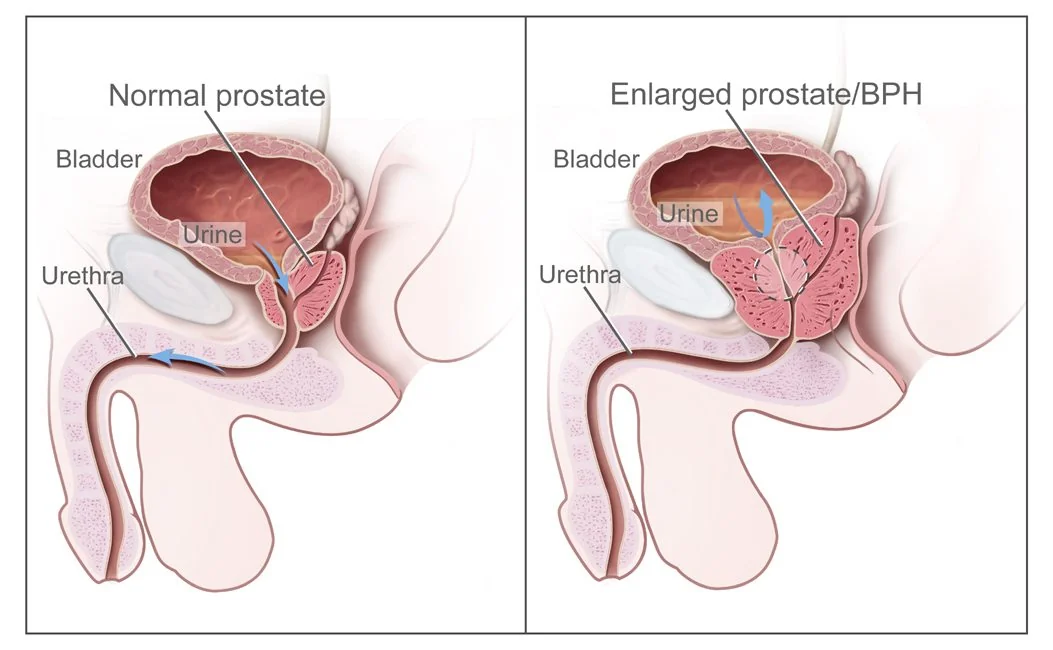
Benign prostatic hyperplasia is a non-malignant increase in the number of epithelial and stromal cells of the prostate, occurring specifically in the transitional zone that surrounds the prostatic urethra. As the gland enlarges it compresses the urethra, producing bladder outlet obstruction and the constellation of lower urinary tract symptoms (LUTS) that brings men to medical attention.1
It is one of the commonest conditions of ageing men: histological BPH is present in around 50% of men in their 60s and 80-90% of men over 80, though only a proportion have troublesome symptoms. The development of BPH requires both ageing and the presence of testosterone - men castrated before puberty do not develop it, which is the basis of hormonal treatment.
Pathophysiology and risk factors
Within the prostate, testosterone is converted by the enzyme 5-alpha reductase into dihydrotestosterone (DHT), which is considerably more potent and is the principal driver of prostatic growth. This is precisely the step blocked by finasteride and dutasteride.
Obstruction has two components, which is why two different drug classes are used:
- A static component - the physical bulk of the enlarged gland. Treated by 5-alpha reductase inhibitors, which reduce prostate volume by around 20-30% over months
- A dynamic component - smooth muscle tone in the prostate and bladder neck, mediated by alpha-1 adrenoceptors. Treated by alpha-blockers, which act within days
The bladder responds to chronic outflow obstruction with detrusor hypertrophy and trabeculation, producing detrusor overactivity and the storage symptoms of frequency, urgency and nocturia. If obstruction persists, the detrusor eventually decompensates, leading to incomplete emptying, chronic retention and, in high-pressure retention, hydronephrosis and renal impairment.
Risk factors
- Increasing age - the dominant factor
- Functioning testes and androgens - BPH does not occur without them
- Family history of BPH
- Obesity, metabolic syndrome and type 2 diabetes
- Ethnicity - higher rates reported in Black men and lower rates in men of East Asian origin
- Sedentary lifestyle; physical activity appears protective
Clinical features
Symptoms are conventionally divided into voiding (obstructive) and storage (irritative) groups. Most men have a mixture, and it is worth noting explicitly that LUTS is a syndrome, not a diagnosis - BPH is only one of its causes.
| Voiding (obstructive) symptoms | Storage (irritative) symptoms |
|---|---|
| Hesitancy - difficulty initiating the stream | Frequency - passing urine more often |
| Poor or weak stream | Urgency - a sudden compelling need to void |
| Straining to void | Nocturia - waking at night to pass urine; often the most bothersome symptom |
| Intermittency - stream starting and stopping | Urge incontinence |
| Terminal dribbling and post-micturition dribble | Dysuria (less typical - consider infection) |
| Sensation of incomplete emptying |
Scoring severity
The International Prostate Symptom Score (IPSS) is the standard tool. It comprises seven symptom questions scored 0-5 plus a quality-of-life question, giving a total out of 35:
- 0-7: mild - usually managed with watchful waiting and lifestyle advice
- 8-19: moderate
- 20-35: severe
- The quality-of-life question is arguably the most important, because the decision to treat is driven by bother rather than by the score alone - a man with moderate symptoms who is not troubled may need no treatment, while one with mild symptoms and severe nocturia may want it
Examination
- Abdominal examination - for a palpable bladder indicating retention
- Digital rectal examination - the key examination. A benign prostate is smooth, firm, symmetrical, with a palpable median sulcus and typically non-tender. Hard, craggy, nodular, asymmetrical, fixed, or with loss of the median sulcus suggests malignancy. A tender, boggy prostate suggests prostatitis
- External genitalia - phimosis, meatal stenosis
- Focused neurological examination - where a neurogenic bladder is a possibility
- Note that prostate size on DRE correlates poorly with symptom severity, though it does influence drug choice
Differential diagnosis
| Condition | Distinguishing features |
|---|---|
| Prostate cancer | Hard, craggy or nodular prostate, raised PSA, bone pain, weight loss, haematuria. Often asymptomatic early because it arises peripherally |
| Urinary tract infection | Dysuria, cloudy offensive urine, positive dipstick for nitrites and leucocytes, acute onset |
| Prostatitis | Perineal, pelvic or ejaculatory pain, fever in acute cases, tender boggy prostate; often in younger men |
| Overactive bladder | Predominantly storage symptoms with urgency, without significant voiding difficulty or a raised residual |
| Urethral stricture | History of instrumentation, catheterisation, trauma or STI; poor stream with spraying; may need urethrography |
| Bladder stone or tumour | Haematuria, pain at the end of voiding, recurrent infection; smoking history |
| Neurogenic bladder | Diabetes, multiple sclerosis, Parkinson's, stroke, spinal pathology; other neurological signs |
| Polyuria from another cause | Diabetes mellitus, diabetes insipidus, hypercalcaemia, diuretic therapy - the bladder is normal but urine volume is high, so check a bladder diary |
| Nocturnal polyuria | Large volumes at night specifically - consider heart failure, obstructive sleep apnoea, peripheral oedema and evening fluid or alcohol intake |
Investigations
- IPSS questionnaire - to quantify symptoms and bother at baseline and to monitor response
- Urine dipstick and culture - to exclude infection, haematuria and glycosuria
- Bladder diary (frequency-volume chart) for at least 3 days - distinguishes true LUTS from polyuria and from nocturnal polyuria, which are managed quite differently
- U&Es and creatinine - to detect obstructive renal impairment, particularly important if there is a large residual volume
- Post-void residual volume by bladder scan - identifies incomplete emptying and chronic retention
- PSA - see the caution below
- Urinary flow rate (uroflowmetry) - a maximum flow rate (Qmax) under 10 mL/s suggests obstruction; used in secondary care
- Renal tract ultrasound - if there is renal impairment, a large residual, haematuria, recurrent infection or suspected stones, to look for hydronephrosis
- Transrectal ultrasound and prostate volume measurement - to guide the choice of drug and surgical approach
- Multiparametric MRI and prostate biopsy - where prostate cancer is suspected
- Urodynamic studies - before surgery where the diagnosis is uncertain or a neurogenic cause is possible
- Flexible cystoscopy - for haematuria, suspected stricture, stone or bladder tumour
Management
Treatment is guided by how bothersome the symptoms are and by the presence of complications, following NICE CG97.1 Many men need no treatment at all.
Conservative management
Watchful waiting with lifestyle advice is appropriate for mild symptoms (IPSS 0-7) or symptoms that are not bothersome.
- Reduce evening fluid intake, and reduce caffeine and alcohol, both of which are diuretic and bladder irritants
- Double voiding - waiting and voiding a second time to improve emptying
- Bladder training for storage symptoms
- Treat constipation
- Review medications - diuretics, anticholinergics, opioids, antihistamines, tricyclics and decongestants all worsen symptoms
- Containment products and urinary sheaths as an adjunct where appropriate
Medical management
| Drug class | Example | Mechanism and use | Key adverse effects |
|---|---|---|---|
| Alpha-1 blocker | Tamsulosin, alfuzosin, doxazosin | Relaxes prostatic and bladder neck smooth muscle (dynamic component). First line for moderate to severe symptoms; works within days | Postural hypotension and dizziness, syncope on first dose, retrograde ejaculation, nasal congestion, intraoperative floppy iris syndrome - always tell the ophthalmologist before cataract surgery |
| 5-alpha reductase inhibitor | Finasteride, dutasteride | Blocks conversion of testosterone to DHT, shrinking the gland (static component). For prostates over about 30 g or a PSA above 1.4 ng/mL; reduces the risk of acute retention and the need for surgery. Takes 3-6 months to work | Reduced libido, erectile dysfunction, ejaculatory dysfunction, gynaecomastia; halves the PSA. Women of childbearing potential must not handle crushed tablets (teratogenic) |
| Combination therapy | Tamsulosin + finasteride | For men with bothersome moderate-to-severe symptoms and an enlarged prostate; more effective than either alone at preventing progression | Combined adverse effects of both |
| Antimuscarinic | Oxybutynin, tolterodine | Added for persistent storage symptoms (overactive bladder) despite alpha-blockade | Check the post-void residual first - risk of precipitating acute urinary retention; anticholinergic effects |
| PDE-5 inhibitor | Tadalafil | Used where there is coexisting erectile dysfunction | Headache, flushing; contraindicated with nitrates |
| Loop diuretic (late afternoon) or desmopressin | Furosemide; desmopressin | Occasionally used for nocturnal polyuria specifically | Desmopressin risks hyponatraemia - monitor sodium, and avoid in older patients |
Surgical management
Surgery is indicated for failure of or intolerance to medical therapy, and for complications: recurrent acute retention, high-pressure chronic retention with renal impairment, recurrent urinary tract infection, bladder stones, or recurrent haematuria from the prostate.
- Transurethral resection of the prostate (TURP) - the long-standing standard operation; endoscopic resection of transitional zone tissue
- Transurethral incision of the prostate (TUIP) - for smaller glands; lower risk of retrograde ejaculation
- Holmium laser enucleation (HoLEP) and photoselective vaporisation - increasingly used, with less bleeding and shorter catheter times, and suitable for larger glands
- Prostatic urethral lift (UroLift) and water vapour therapy (Rezum) - minimally invasive options that preserve ejaculatory function, suitable for selected men
- Open or robotic simple prostatectomy - for very large glands
- Prostatic artery embolisation - an option in selected patients unfit for surgery
Complications
- Acute urinary retention - painful, requiring catheterisation; a common presentation of undiagnosed BPH
- Chronic urinary retention, and in particular high-pressure chronic retention with bilateral hydronephrosis and renal impairment
- Obstructive uropathy, acute kidney injury and chronic kidney disease
- Recurrent urinary tract infections from incomplete emptying and stasis
- Bladder calculi - from chronic stasis
- Bladder diverticula and detrusor decompensation - a chronically obstructed bladder may never regain effective contraction
- Overflow incontinence and nocturnal enuresis
- Haematuria - from friable enlarged prostatic vessels
- Falls and sleep disturbance from nocturia, and considerable impairment of quality of life
- Complications of treatment - postural hypotension and falls from alpha-blockers, sexual dysfunction from 5-alpha reductase inhibitors, and the surgical complications above
Red flags
Prognosis
BPH is a chronic, slowly progressive condition, but its course is highly variable. A substantial proportion of men have symptoms that remain stable or even improve spontaneously over years, which is why watchful waiting is a legitimate and often successful strategy for mild or non-bothersome symptoms rather than a way of avoiding treatment.
Medical therapy is effective for most men who need it. Alpha-blockers improve symptom scores within days and are effective regardless of prostate size, while 5-alpha reductase inhibitors additionally alter the natural history - they reduce prostate volume and lower the long-term risk of acute urinary retention and the need for surgery by around half in men with enlarged glands. Combination therapy is more effective than either agent alone for preventing progression, at the cost of more adverse effects.
Surgery gives the greatest and most durable symptomatic improvement, with TURP producing substantial reductions in IPSS and improvements in flow rate that are maintained for years; around 10% require repeat surgery within a decade as tissue regrows. The important caveat is that outcomes are considerably worse where the detrusor has already decompensated after prolonged obstruction - such men may continue to empty poorly and remain dependent on catheterisation even after a technically successful operation. This is the strongest argument for identifying chronic retention and renal impairment early, and it is why a bladder scan and a creatinine matter as much as the symptom score.
References
- NICE CG97. Lower urinary tract symptoms in men: management. 2010, updated 2015. Available here
- NICE Clinical Knowledge Summaries. Lower urinary tract symptoms in men. Available here
- European Association of Urology. Guidelines on Management of Non-neurogenic Male LUTS. Available here
- NICE NG12. Suspected cancer: recognition and referral. 2015, updated 2023. Available here
- BNF. Tamsulosin and finasteride - indications, cautions and adverse effects. Available here
- McConnell JD, Roehrborn CG, Bautista OM et al. The long-term effect of doxazosin, finasteride, and combination therapy on the clinical progression of BPH (MTOPS). New England Journal of Medicine. 2003. Available here
- National Cancer Institute, public domain, via Wikimedia Commons. Available here
This article is written for revision and education. It is not clinical guidance and must not be used to make decisions about the care of a patient. Always check current NICE guidance and local protocols.