
Viral Exanthems of Childhood
Key points
- The classic six: measles, scarlet fever, rubella, an obsolete fourth disease, erythema infectiosum and roseola were historically numbered in order of description - hence fifth and sixth disease.
- The diagnostic method: match the prodrome, the rash morphology, where it started, how it spread, and the associated enanthem. The rash alone is rarely enough.
- Measles: the 3 Cs - cough, coryza and conjunctivitis - with a high fever, Koplik spots, and a rash starting behind the ears. Notifiable, and the most dangerous of the group.
- Rubella: mild in the child, devastating in the first trimester of pregnancy. Tender suboccipital and postauricular lymphadenopathy is the giveaway.
- Erythema infectiosum: parvovirus B19 - slapped cheeks then a lacy rash. The child is no longer infectious once the rash appears, so no exclusion is needed.
- Roseola: 3-5 days of high fever in an infant, then the fever breaks and a rose-pink trunk rash appears. A leading cause of febrile convulsions.
- Chickenpox: crops of lesions at different stages simultaneously. Avoid ibuprofen, and treat any new pain or fever after crusting as invasive group A streptococcal infection.
- The two questions to always ask: is the rash non-blanching, and has the child been near a pregnant or immunosuppressed person? Both change the management immediately.
Introduction
An exanthem is a widespread rash accompanying a systemic infection; the corresponding mucosal eruption is an enanthem. Most childhood exanthems are viral, self-limiting and require nothing more than fluids, antipyretics and reassurance. The clinical task is not usually treatment but identification - because a handful of them are notifiable, several are dangerous to particular contacts, and one or two mimics are not viral at all.
The historic numbering of the exanthems survives in exam questions and on ward rounds. First disease was measles, second scarlet fever, third rubella, fourth a poorly defined staphylococcal illness now discarded, fifth erythema infectiosum and sixth roseola infantum. The numbers convey no clinical information, but knowing that fifth disease means slapped cheek and sixth disease means roseola will save you in a viva.
Approach any rash in a febrile child in the same order: how ill is the child, is the rash blanching, what was the prodrome, where did the rash begin and how did it spread, what does the mouth show, and what is the immunisation status. That sequence identifies almost every exanthem and, more importantly, flags the child whose rash is not an exanthem at all.8
Measles
Measles is caused by a highly contagious morbillivirus with a basic reproduction number of 12-18 - one of the most transmissible human pathogens known. It requires approximately 95% population immunity to prevent circulation, and falling MMR uptake in the UK has already produced substantial outbreaks. It is a notifiable disease.1,3
Clinical course
- Incubation 10-14 days from exposure to the first symptom
- Prodrome (2-4 days): high fever, often 39-40°C, with the 3 Cs - cough, coryza and conjunctivitis. The child is miserable and photophobic, which is a useful discriminator from milder exanthems.
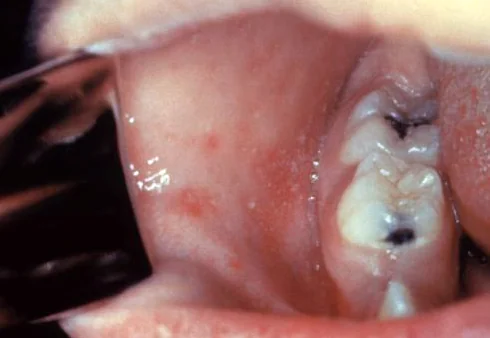
- Koplik spots: tiny white or bluish-white grains on an erythematous base on the buccal mucosa opposite the second molars, appearing 1-2 days before the rash and fading as it emerges. They are pathognomonic but transient and easily missed.
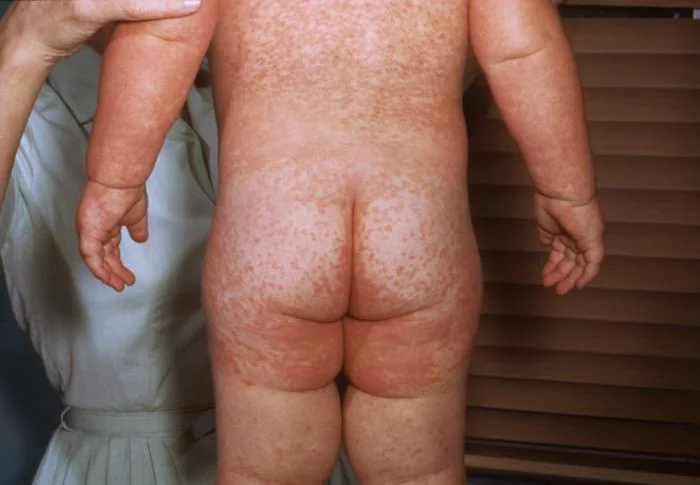
- Rash (day 3-5): an erythematous maculopapular eruption beginning behind the ears and at the hairline, spreading down over the face, trunk and limbs over about 3 days, and becoming confluent
- Resolution: the rash fades in the order it appeared, leaving a brownish staining and fine desquamation. Fever persisting beyond the third day of rash suggests a complication.
- Infectivity: from 4 days before until 4 days after the onset of the rash
Complications
- Otitis media - the commonest complication
- Pneumonia, either primary viral or secondary bacterial - the commonest cause of measles death
- Diarrhoea and dehydration
- Febrile convulsions
- Acute post-infectious encephalitis - around 1 in 1,000 cases, typically 7-10 days after the rash, with a high rate of permanent neurological sequelae
- Subacute sclerosing panencephalitis (SSPE) - a progressive and invariably fatal degenerative encephalopathy appearing 7-10 years after infection, with the highest risk in children infected under 2 years
- Keratoconjunctivitis and corneal ulceration, an important cause of blindness where vitamin A deficiency is prevalent
- Immune amnesia - measles depletes pre-existing memory lymphocytes, leaving increased susceptibility to other infections for months to years afterwards
- In pregnancy: miscarriage, preterm birth and low birth weight, though measles is not teratogenic
Management
- Notify the health protection team immediately on clinical suspicion, without waiting for confirmation
- Confirm with oral fluid measles IgM and RNA detection, arranged through the health protection team
- Supportive care: antipyretics, fluids, and treatment of any secondary bacterial infection
- Vitamin A is recommended for all children under 2 admitted to hospital with measles, and for any child with measles who is immunodeficient or malnourished2
- Exclude from school for 4 days after the rash appears, and keep the child away from healthcare waiting rooms - phone ahead so they can be seen in isolation
- Post-exposure prophylaxis: MMR within 72 hours of exposure for immunocompetent contacts aged 6 months and over; human normal immunoglobulin within 6 days for immunosuppressed contacts, pregnant women without immunity, and infants under 6 months1
Rubella
Rubella (German measles) is a mild togavirus infection that matters almost entirely because of what it does to a fetus. It is notifiable, and confirmed cases are now rare in the UK because of MMR.4
- Incubation 14-21 days
- Prodrome minimal or absent in children; adolescents and adults may have a few days of low-grade fever and malaise
- Lymphadenopathy - tender suboccipital and postauricular nodes, often preceding the rash and the most useful clinical sign
- Rash - a fine pink maculopapular eruption starting on the face and spreading to the trunk, non-confluent, fading by day 3
- Forchheimer spots - petechiae on the soft palate, suggestive but not specific
- Arthralgia and arthritis, particularly in adolescent girls and adult women
- Infectivity from 7 days before to 5 days after the onset of the rash; exclude from school for 5 days from rash onset
Erythema infectiosum (slapped cheek, fifth disease)
Caused by parvovirus B19, a small DNA virus with a specific tropism for erythroid progenitor cells in the bone marrow, which it enters using the P antigen as a receptor. That single fact explains all of its important complications.7
- Incubation 4-14 days, occasionally up to 21
- Prodrome mild - low-grade fever, headache and coryzal symptoms
- Slapped cheek: firm, bright red confluent erythema over both cheeks with circumoral pallor, appearing after the prodrome has settled
- Lacy reticular rash on the trunk and extensor surfaces of the limbs, 1-4 days later, which may fade and recur over several weeks when triggered by heat, exercise, sunlight or stress
- No exclusion is required - by the time the rash appears the child is no longer infectious, so keeping them off school achieves nothing
- Arthropathy, particularly a symmetrical small joint arthritis in adult women
Roseola infantum (exanthem subitum, sixth disease)
Caused by human herpesvirus 6, and less often HHV-7. It affects infants between about 6 months and 2 years and is extremely common - most children are seropositive by the age of 3.
- High fever for 3-5 days, often 39-40°C, in a child who is otherwise surprisingly well and continues to play
- Abrupt defervescence, followed within hours by the rash - the timing is the diagnostic feature and the reason it is called exanthem subitum, meaning sudden
- Rash: discrete rose-pink macules and papules, 2-5 mm, on the trunk spreading to the neck and proximal limbs, non-itchy, fading within 1-2 days
- Nagayama spots - erythematous papules on the soft palate and uvula
- Mild cervical and postauricular lymphadenopathy, and sometimes a bulging fontanelle or mild diarrhoea
- Febrile convulsions occur in around 10-15% of cases, and HHV-6 is one of the commonest identifiable causes of a first febrile seizure
Chickenpox (varicella)
Primary infection with varicella zoster virus. Around 90% of UK adults are seropositive, and infection is most common between 1 and 9 years of age. Reactivation of latent virus in the dorsal root ganglia later causes shingles.5,6
- Incubation 10-21 days
- Prodrome of 1-2 days of fever and malaise, more marked in adolescents and adults
- Rash: successive crops of intensely itchy lesions evolving from macule to papule to vesicle - the classic dewdrop on a rose petal - then to pustule and crust
- Lesions at different stages simultaneously, which is the single most useful diagnostic feature and distinguishes it from smallpox, in which lesions were synchronous
- Distribution is centripetal, densest on the trunk, head and face, with mucosal lesions in the mouth and sometimes the genitalia
- Infectious from 48 hours before the rash until all lesions have crusted, usually about 5 days after onset
Management
- Symptomatic treatment: paracetamol, calamine lotion, cool loose clothing, short nails, and a sedating antihistamine such as chlorphenamine for children over 1 year
- Avoid ibuprofen - NSAID use in chickenpox is associated with severe secondary group A streptococcal soft tissue infection including necrotising fasciitis
- Never give aspirin to a child under 16 - the association with Reye's syndrome is strongest in varicella and influenza
- Aciclovir is not routine in healthy children. It is indicated for neonates, the immunosuppressed, pregnant women, and adolescents and adults presenting within 24 hours of the rash, in whom disease is more severe.
- Exclusion from school until all lesions have crusted over
- Keep away from neonates, pregnant women without immunity, and anyone immunosuppressed
Hand, foot and mouth disease
Caused by enteroviruses, most often coxsackievirus A16, with enterovirus 71 responsible for more severe outbreaks in South East Asia. It occurs mainly in children under 10 and spreads by the faecal-oral and respiratory routes.9
- Incubation 3-5 days
- Prodrome: 1-2 days of fever, sore throat and reduced appetite
- Oral enanthem: painful shallow ulcers on the tongue, buccal mucosa and hard palate, which are the main reason children stop eating and drinking
- Exanthem: small greyish vesicles with a surrounding red halo on the palms, soles, and often the buttocks and perineum
- Self-limiting over 7-10 days; treatment is analgesia and attention to fluid intake
- Exclusion is not required if the child is well enough to attend, as the virus is shed in stool for weeks and exclusion does not control spread
- Onychomadesis - painless shedding of finger and toenails several weeks later, which alarms parents and needs only reassurance
Putting it together
| Illness | Organism | Prodrome | Rash | Key associated feature | School exclusion |
|---|---|---|---|---|---|
| Measles | Measles morbillivirus | 3-4 days, high fever, cough, coryza, conjunctivitis | Maculopapular, behind ears then downwards, confluent | Koplik spots | 4 days from rash onset |
| Scarlet fever | Group A streptococcus | 12-48 hours, fever, sore throat, vomiting | Fine sandpaper erythema, flexural, spares palms and soles | Strawberry tongue, circumoral pallor | 24 hours after starting antibiotics |
| Rubella | Rubella virus | Minimal in children | Fine pink macules, face then trunk, gone by day 3 | Tender suboccipital and postauricular nodes | 5 days from rash onset |
| Erythema infectiosum | Parvovirus B19 | Mild coryzal illness | Slapped cheeks, then lacy reticular rash on limbs | Aplastic crisis in haemolytic anaemia | None - not infectious once the rash appears |
| Roseola infantum | HHV-6 (or HHV-7) | 3-5 days of high fever in a well child | Rose-pink macules on trunk as fever breaks | Febrile convulsion, Nagayama spots | None |
| Chickenpox | Varicella zoster virus | 1-2 days of fever and malaise | Crops of vesicles at different stages, centripetal, itchy | Lesions of different ages together | Until all lesions have crusted |
| Hand, foot and mouth | Coxsackievirus A16 | 1-2 days of fever and sore throat | Vesicles on palms, soles and buttocks with oral ulcers | Onychomadesis weeks later | None if well enough to attend |
Red flags
Prognosis
Rubella, erythema infectiosum, roseola and hand, foot and mouth disease are almost always benign in an immunocompetent child and need no more than symptomatic care. Chickenpox is usually benign too, but is the exanthem most likely to produce a serious bacterial complication, and the one where a specific warning to parents - watch for new pain or a second fever - genuinely alters outcomes.
Measles is different in kind. It remains a significant cause of childhood death worldwide, roughly 1 in 5 UK cases is admitted to hospital, and its late complications, particularly SSPE, are untreatable. Because population immunity of about 95% is needed to interrupt transmission, and UK MMR coverage has fallen below that in many areas, measles is now a realistic diagnosis rather than a historical one.3
Two practical habits follow from all of this. Check and record the immunisation status of every child with a febrile rash, and offer catch-up MMR opportunistically - and, whenever an exanthem is diagnosed, ask specifically about contact with pregnant women, newborns and immunosuppressed people, because for those contacts the diagnosis you have just made may need acting on within days.
References
- UKHSA. Measles: the Green Book, chapter 21. Available here
- NICE Clinical Knowledge Summaries. Measles. Available here
- UKHSA. National measles guidelines. Available here
- UKHSA. Rubella: the Green Book, chapter 28. Available here
- NICE Clinical Knowledge Summaries. Chickenpox. Available here
- UKHSA. Varicella: the Green Book, chapter 34. Available here
- NICE Clinical Knowledge Summaries. Parvovirus B19 infection. Available here
- UKHSA. Health protection in children and young people settings, including education. Available here
- NICE Clinical Knowledge Summaries. Hand, foot and mouth disease. Available here
This article is written for revision and education. It is not clinical guidance and must not be used to make decisions about the care of a patient. Always check current NICE guidance and local protocols.