
Scleroderma and Mixed Connective Tissue Disease
Key points
- Systemic sclerosis: an autoimmune disease combining excess collagen deposition (fibrosis), small vessel vasculopathy, and autoantibody production, affecting the skin and, to varying degrees, internal organs.
- Limited cutaneous disease: skin change confined to the face and distal to the elbows/knees - remembered as CREST (Calcinosis, Raynaud's, oEsophageal dysmotility, Sclerodactyly, Telangiectasia). Anti-centromere antibody. Main visceral risk is pulmonary arterial hypertension.
- Diffuse cutaneous disease: skin change extends proximally and to the trunk, progresses faster, and carries a higher early risk of interstitial lung disease and scleroderma renal crisis. Anti-Scl-70 (anti-topoisomerase I) or anti-RNA polymerase III antibody.
- Raynaud phenomenon: often the first symptom, sometimes by years, in both limited and diffuse disease.
- Scleroderma renal crisis: malignant hypertension with acute kidney injury - a medical emergency treated with ACE inhibitors even in the presence of AKI, which is the exception to usual practice.
- Avoid high-dose steroids: corticosteroid doses above 15 mg prednisolone are a recognised trigger for scleroderma renal crisis and should be used cautiously in systemic sclerosis.
- Mixed connective tissue disease: an overlap syndrome combining features of SLE, systemic sclerosis and myositis, defined by high-titre anti-U1-RNP antibody.
- Screening: annual pulmonary function tests and echocardiography are used to catch interstitial lung disease and pulmonary arterial hypertension before they become symptomatic.
Introduction
Systemic sclerosis (scleroderma) is a chronic autoimmune disease characterised by three processes acting together: fibrosis from excess collagen deposition, vasculopathy affecting small blood vessels, and autoimmunity with characteristic autoantibodies. Its hallmark is skin thickening, but the disease ranges from a purely cutaneous, indolent condition to one with rapid, life-threatening internal organ involvement.1
Mixed connective tissue disease (MCTD) is closely related conceptually: an overlap syndrome combining features of SLE, systemic sclerosis and polymyositis in the same patient, unified by a single highly characteristic antibody. It is covered alongside systemic sclerosis here because Raynaud phenomenon, sclerodactyly and pulmonary involvement link the two conditions closely, and exam questions often test the ability to place a patient's antibody and clinical picture into the correct overlap category.
Systemic sclerosis: aetiology and classification
The trigger for systemic sclerosis is not fully understood, but endothelial injury is thought to be an early event, provoking immune activation and fibroblast stimulation that leads to unchecked collagen deposition. It is commoner in women (around 3-4:1) and typically presents between 30 and 50.
Systemic sclerosis is split into two clinically distinct subtypes based on the extent of skin involvement, and this classification matters because it predicts the pattern and timing of organ complications:
| Limited cutaneous (lcSSc) | Diffuse cutaneous (dcSSc) | |
|---|---|---|
| Skin distribution | Face and distal to elbows/knees only | Extends proximally and to the trunk |
| Progression | Slow | Rapid, often within the first few years |
| Antibody | Anti-centromere | Anti-Scl-70 (anti-topoisomerase I) or anti-RNA polymerase III |
| Main visceral risk | Pulmonary arterial hypertension (later in the disease) | Interstitial lung disease and scleroderma renal crisis (early) |
| Older name | CREST syndrome | - |
Systemic sclerosis: clinical features
Raynaud phenomenon is frequently the first manifestation, sometimes preceding other features by years, and is covered in detail in its own article.
Skin
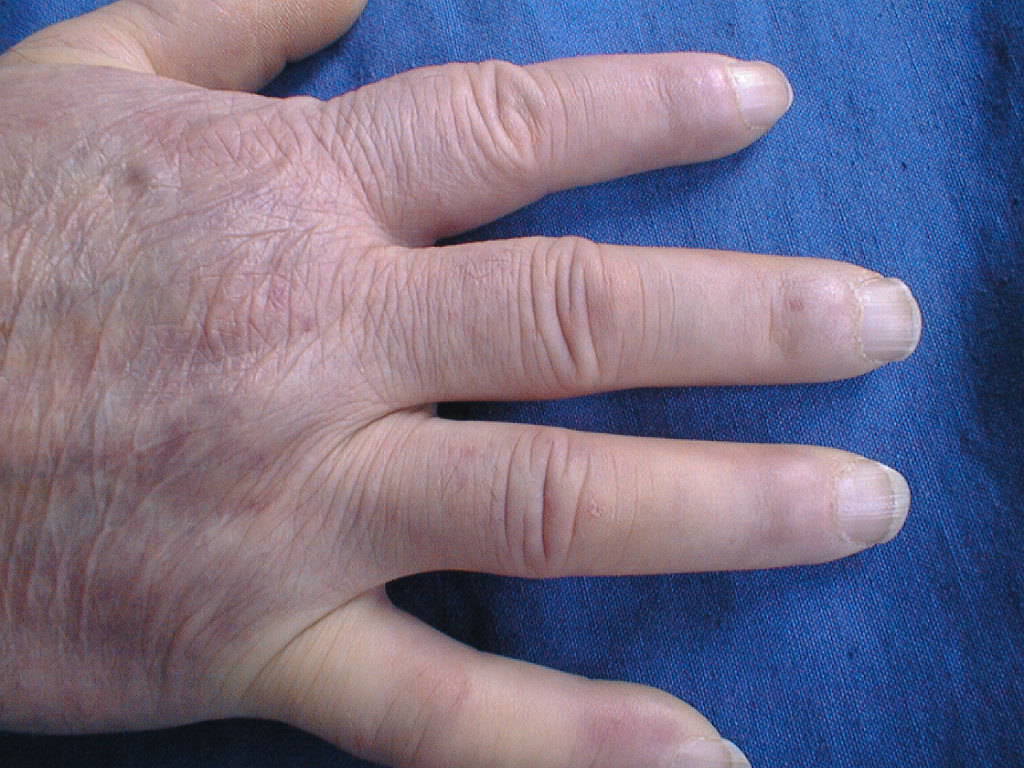
- Sclerodactyly - tight, thickened, shiny skin of the fingers, which can restrict movement and cause flexion contractures
- Microstomia - a small, tight-lipped mouth from perioral skin tightening, which can make dental care and even intubation difficult
- Calcinosis cutis - subcutaneous calcium deposits, often over pressure points, which can ulcerate
- Telangiectasia - dilated capillaries visible on the face, lips and hands
- Digital ulcers and pitting scars from chronic digital ischaemia
Gastrointestinal
The GI tract is the most commonly affected internal organ system. Oesophageal dysmotility causes dysphagia and severe reflux (from lower oesophageal sphincter involvement), small intestinal bacterial overgrowth causes bloating and malabsorption, and gastric antral vascular ectasia ('watermelon stomach') can cause chronic GI blood loss.
Pulmonary
Interstitial lung disease is the leading cause of death in systemic sclerosis overall, and is commoner and more aggressive in diffuse disease. Pulmonary arterial hypertension can occur independently of lung fibrosis, particularly in limited cutaneous disease, and is the leading cause of death in that subgroup.
Renal
Scleroderma renal crisis is an emergency: abrupt-onset malignant hypertension with acute kidney injury, occurring predominantly in early diffuse disease. It is discussed in detail below.
Cardiac
Myocardial fibrosis can cause arrhythmias, conduction disease and heart failure; pericardial effusion also occurs.
Investigations
- ANA - positive in the large majority of patients
- Anti-centromere antibody - associated with limited cutaneous disease and a higher long-term risk of pulmonary arterial hypertension
- Anti-Scl-70 (anti-topoisomerase I) - associated with diffuse disease and interstitial lung disease
- Anti-RNA polymerase III - associated with diffuse disease and a markedly increased risk of scleroderma renal crisis
- Nailfold capillaroscopy - shows capillary dilatation and dropout, useful in distinguishing primary Raynaud phenomenon from an underlying connective tissue disease
- High-resolution CT chest and pulmonary function tests - screen for and monitor interstitial lung disease (a restrictive pattern with reduced gas transfer)
- Echocardiography (+/- right heart catheterisation to confirm) - screens for pulmonary arterial hypertension
- U&Es and blood pressure monitoring - essential given the risk of renal crisis, particularly in early diffuse disease
Systemic sclerosis: management
There is no cure for systemic sclerosis; management is organ-directed, aiming to control symptoms and prevent irreversible damage.2
- Raynaud phenomenon - keep warm, avoid smoking, calcium channel blockers (nifedipine) first-line; intravenous prostacyclin analogues for severe digital ischaemia
- Skin disease - emollients; immunosuppression (methotrexate, mycophenolate mofetil) for progressive or diffuse skin involvement
- Gastro-oesophageal reflux - proton pump inhibitors, often at high dose; prokinetics for dysmotility; antibiotics for bacterial overgrowth
- Interstitial lung disease - immunosuppression (mycophenolate mofetil or cyclophosphamide), with the antifibrotic nintedanib now used for progressive fibrosing disease
- Pulmonary arterial hypertension - managed in a specialist pulmonary hypertension service with endothelin receptor antagonists, PDE5 inhibitors and prostacyclin pathway agents
- Digital ulcers - endothelin receptor antagonists (bosentan) reduce the occurrence of new digital ulcers
Mixed connective tissue disease
MCTD is an overlap syndrome combining clinical features of SLE, systemic sclerosis and polymyositis/dermatomyositis, unified by the presence of high-titre anti-U1 ribonucleoprotein (anti-U1-RNP) antibody, without which the diagnosis should not be made.3
- Raynaud phenomenon - very common, often the first feature, sometimes preceding other symptoms by years
- Puffy, swollen ('sausage') fingers, evolving in some patients toward sclerodactyly
- Arthralgia/arthritis, often resembling SLE or RA
- Myositis - proximal muscle weakness and raised creatine kinase, as in polymyositis
- Pulmonary involvement - interstitial lung disease and pulmonary arterial hypertension, which is the leading cause of death in MCTD
- Serositis, oesophageal dysmotility and mild renal disease can also occur, reflecting the overlap with both SLE and systemic sclerosis
Management follows the dominant organ pattern present in a given patient, drawing on the same drug classes used in SLE, systemic sclerosis and myositis - hydroxychloroquine and NSAIDs for milder disease, immunosuppression (methotrexate, mycophenolate, azathioprine) for more significant organ involvement, and pulmonary hypertension therapy where indicated. Regular screening for pulmonary arterial hypertension is a particular priority, given its outsized contribution to mortality in this condition.
Differential diagnosis
- Primary Raynaud phenomenon - no underlying connective tissue disease; normal nailfold capillaroscopy and negative autoantibodies
- Morphea (localised scleroderma) - skin fibrosis without systemic organ involvement or the characteristic serology
- Eosinophilic fasciitis - skin thickening but sparing the hands and face, with peripheral eosinophilia
- Nephrogenic systemic fibrosis - history of gadolinium exposure in renal impairment, mimicking skin thickening
- Other overlap and connective tissue diseases - SLE, Sjögren syndrome, dermatomyositis, each considered on their dominant clinical and serological pattern
Complications
Interstitial lung disease and pulmonary arterial hypertension together account for the majority of deaths in systemic sclerosis. Scleroderma renal crisis, if not treated immediately, can progress to end-stage renal failure. Chronic digital ischaemia can lead to critical digital ischaemia, ulceration and, in severe cases, auto-amputation. Malnutrition can result from severe GI dysmotility and malabsorption. In MCTD, pulmonary arterial hypertension carries the same outsized mortality risk.
Red flags
Prognosis
Limited cutaneous disease generally has a better prognosis than diffuse disease, though it is not benign, given the late risk of pulmonary arterial hypertension. Diffuse disease carries a higher early mortality risk from rapidly progressive skin and internal organ involvement, particularly in the first few years after diagnosis, but the rate of progression tends to slow after this early period. Regular organ-based screening and earlier use of targeted therapies for lung and pulmonary vascular disease have measurably improved survival over the past two decades. MCTD generally has a better prognosis than SLE alone, but pulmonary arterial hypertension remains its principal life-limiting complication.
References
- NICE Clinical Knowledge Summaries. Scleroderma (systemic sclerosis). Available here
- Denton CP, Khanna D. Systemic sclerosis. The Lancet. 2017. Available here
- Kowal-Bielecka O, Fransen J, Avouac J et al. Update of EULAR recommendations for the treatment of systemic sclerosis. Annals of the Rheumatic Diseases. 2017. Available here
- British Society for Rheumatology. Systemic sclerosis clinical guidance. Available here
- Gunnarsson R, Hetlevik SO, Lilleby V, Molberg O. Mixed connective tissue disease. Best Practice & Research Clinical Rheumatology. 2016. Available here
This article is written for revision and education. It is not clinical guidance and must not be used to make decisions about the care of a patient. Always check current NICE guidance and local protocols.