
Substance Use Disorder
Key points
- Harmful use: a pattern of substance use causing damage to physical or mental health, or to others, without meeting criteria for dependence.
- Dependence syndrome: requires several of: compulsion to use, impaired control, tolerance, withdrawal, primacy over other activities, and persistence despite clear harm.
- Tolerance and withdrawal are physiological, not moral: they reflect neuroadaptation and can occur with prescribed medication - dependence requires the behavioural features as well.
- Screening: AUDIT (or AUDIT-C) for alcohol, CAGE as a brief alternative, and always ask about all substances including prescribed and over-the-counter medicines.
- Alcohol units: UK guidance is no more than 14 units per week for all adults, spread over 3 or more days; units = volume (mL) x ABV / 1000.
- Alcohol relapse prevention: acamprosate or oral naltrexone after successful withdrawal, with disulfiram as a supervised alternative.
- Opioid substitution: methadone or buprenorphine maintenance markedly reduces mortality, injecting and criminality - retention in treatment matters more than achieving abstinence quickly.
- Harm reduction is a legitimate goal: needle exchange, take-home naloxone, vaccination and safer-use advice save lives even when the person is not ready to stop.
Introduction
Substance use disorders describe patterns of psychoactive substance use that cause significant harm to physical or mental health, to social functioning, or that result in a dependence syndrome.1 They span alcohol, opioids, stimulants, cannabis, benzodiazepines, novel psychoactive substances and nicotine, and increasingly include prescribed and over-the-counter medicines.
The scale is substantial: alcohol alone accounts for a large share of emergency attendances, liver disease and premature mortality in the UK, and opioid-related deaths have risen steadily. Substance use is also the single most important comorbidity across the rest of psychiatry - it worsens the course of almost every mental illness, complicates diagnosis, reduces treatment adherence and raises suicide risk substantially.
Modern practice treats these as chronic, relapsing conditions with an identifiable neurobiology, not as failures of willpower. That framing matters clinically as well as ethically: relapse is an expected part of the course rather than evidence of treatment failure, and the goal of treatment is frequently harm reduction and retention rather than immediate abstinence.
Aetiology and pathophysiology
The common pathway across all substances of dependence is the mesolimbic dopamine reward system, projecting from the ventral tegmental area to the nucleus accumbens. All addictive substances, by different receptor mechanisms, ultimately increase dopamine release in this pathway, producing reinforcement far more powerful and reliable than natural rewards.
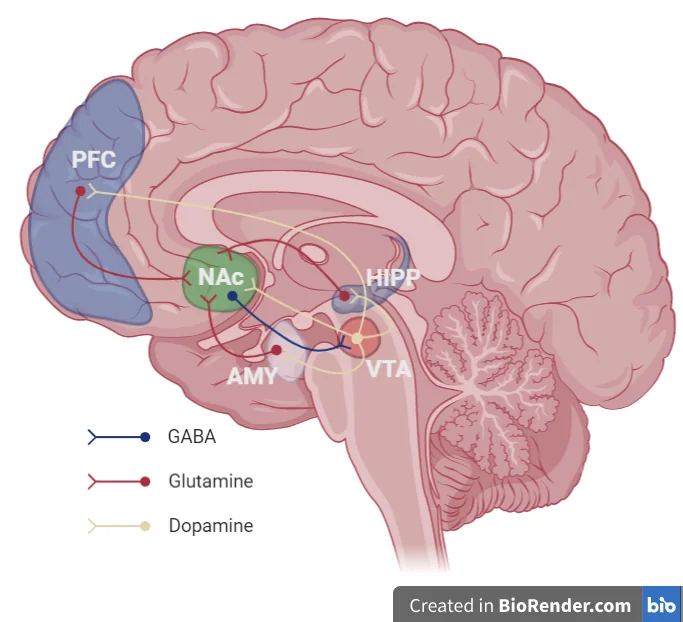
- Positive reinforcement - the substance produces euphoria or relief, which drives repeat use. This dominates early in the course of use.
- Neuroadaptation and tolerance - repeated exposure downregulates receptors and upregulates opposing systems, so escalating doses are needed for the same effect
- Negative reinforcement - as neuroadaptation progresses, use is increasingly driven by the need to avoid withdrawal rather than to obtain pleasure. This shift explains why dependence persists long after the substance has stopped being enjoyable.
- Cue conditioning - people, places, paraphernalia and emotional states become powerfully associated with use, triggering craving long after abstinence and accounting for much relapse
- Prefrontal impairment - chronic use impairs the executive control regions that would otherwise inhibit drug-seeking, so the decision-making capacity that recovery depends on is itself degraded by the disorder
- Genetics - heritability is substantial, around 50% for alcohol dependence, involving variation in metabolising enzymes and in reward pathway genes
| Substance | Primary mechanism | Withdrawal risk |
|---|---|---|
| Alcohol | GABA-A agonist and NMDA antagonist | Potentially fatal - seizures, delirium tremens |
| Opioids | Mu-opioid receptor agonist | Very unpleasant but rarely fatal in itself |
| Benzodiazepines | GABA-A positive allosteric modulator | Potentially fatal - seizures |
| Stimulants (cocaine, amphetamine) | Block reuptake / promote release of dopamine and noradrenaline | Not fatal - a 'crash' with depression, hypersomnia and craving |
| Cannabis | CB1 receptor agonist | Mild - irritability, sleep disturbance, appetite change |
| Nicotine | Nicotinic acetylcholine receptor agonist | Mild - irritability, craving, poor concentration |
Risk factors
- Family history of substance dependence
- Early age of first use - a strong predictor of later dependence5
- Comorbid mental illness, particularly depression, PTSD, ADHD, bipolar disorder and psychosis
- Childhood adversity, including abuse, neglect and parental substance use
- Social deprivation, unemployment, homelessness and criminal justice involvement
- Chronic pain, particularly where opioids have been prescribed long-term
- Peer group use and easy availability
- Occupations with high availability or high stress, including healthcare and hospitality
- Impulsivity and sensation-seeking personality traits
Clinical features
The dependence syndrome
The classical description requires three or more of the following features, present together at some point in the previous year:1
- A strong desire or compulsion to take the substance (craving)
- Impaired control over starting, stopping, or the amount used
- A physiological withdrawal state on stopping or reducing, or use of the substance to relieve or avoid withdrawal
- Tolerance - increasing doses required to achieve the original effect
- Primacy - progressive neglect of other pleasures and interests, with increasing time spent obtaining, using or recovering from the substance
- Persistence despite clear evidence of harm - continuing to drink with established liver disease, for example
Features suggesting a problem
- Physical - unexplained injuries, seizures, hepatomegaly and stigmata of chronic liver disease, injection sites and venous damage, nasal septum perforation with cocaine, poor dentition, unexplained weight loss
- Psychological - depression, anxiety, insomnia, cognitive impairment, drug-induced psychosis, escalating self-harm
- Social - relationship breakdown, unemployment, housing instability, debt, criminal justice contact, safeguarding concerns for children
- Healthcare-related - frequent missed appointments, early prescription requests, reported lost prescriptions, requesting specific drugs by name, or attending multiple prescribers
Screening tools
- AUDIT - a 10-item validated alcohol screening tool; a score of 8 or more indicates hazardous drinking, 16 or more suggests harmful drinking warranting brief intervention, and 20 or more suggests possible dependence requiring specialist assessment2
- AUDIT-C - the first three consumption questions, widely used as a rapid screen in primary care and emergency departments
- CAGE - four questions on Cutting down, Annoyance at criticism, Guilt, and needing an Eye-opener; two or more positive answers is a positive screen. Quick but less sensitive than AUDIT for hazardous drinking.
- SADQ - the Severity of Alcohol Dependence Questionnaire, used to grade dependence severity and guide detoxification medication dosing
Investigations
Investigations quantify harm, identify complications and support - but never replace - a careful history.
- FBC - a raised MCV is a classic marker of chronic alcohol use; thrombocytopenia occurs in liver disease and with direct marrow suppression
- LFTs - a raised gamma-GT is the most sensitive marker of recent heavy alcohol use, and an AST:ALT ratio above 2:1 favours alcoholic over non-alcoholic liver disease
- U&Es, magnesium, phosphate - electrolyte disturbance is common, and hypomagnesaemia lowers the seizure threshold in withdrawal
- Clotting and albumin - to assess synthetic liver function
- Urine drug screen - to confirm the substances involved, remembering that many novel psychoactive substances are not detected on standard panels
- Blood-borne virus screen - hepatitis B, hepatitis C and HIV for anyone who injects or has ever injected
- Vitamin status and thiamine - deficiency is near-universal in alcohol dependence
- Pregnancy test where relevant, which materially changes management for both alcohol and opioids
- Liver imaging and fibrosis assessment - ultrasound and transient elastography where chronic liver disease is suspected
Management
Management combines treating intoxication and withdrawal safely, supporting relapse prevention, and - crucially - reducing harm for those not ready or able to stop. NICE and the UK clinical guidelines ('the Orange Book') frame this as a long-term, relapsing condition requiring sustained engagement.3
Brief intervention
For hazardous or harmful use without dependence, structured brief advice in primary care is effective and evidence-based.4 The FRAMES model summarises the components: Feedback on risk, emphasising personal Responsibility for change, clear Advice to cut down, a Menu of options, delivered with Empathy, and supporting Self-efficacy. Motivational interviewing techniques - exploring ambivalence rather than confronting denial - underpin this and are more effective than warning or lecturing.
Alcohol
- Assisted withdrawal with a reducing regimen of chlordiazepoxide (or diazepam), either community-based or inpatient depending on severity, seizure history and social circumstances - covered in detail in the article on alcohol withdrawal
- Pabrinex (parenteral thiamine) during withdrawal to prevent Wernicke's encephalopathy, followed by oral thiamine
- Acamprosate - reduces craving by modulating glutamatergic transmission; started as soon as possible after withdrawal and continued for around 6 months
- Oral naltrexone - an opioid antagonist that blunts the rewarding effect of alcohol; contraindicated in those taking opioids and requires LFT monitoring
- Disulfiram - causes a severely unpleasant reaction (flushing, vomiting, tachycardia) if alcohol is consumed, through acetaldehyde accumulation. Requires full informed consent, supervision, and warning about alcohol in foods, mouthwashes and perfumes.
- Psychosocial interventions - CBT, behavioural couples therapy, and mutual aid such as Alcoholics Anonymous, which has good evidence when engagement is genuine
Opioids
- Opioid substitution treatment (OST) with methadone (a full agonist, oral solution, supervised consumption initially) or buprenorphine (a partial agonist, sublingual, with a ceiling effect that makes it safer in overdose but which precipitates withdrawal if given too early)
- Retention in treatment is the primary goal. OST substantially reduces mortality, injecting behaviour, blood-borne virus transmission and offending, even where illicit use continues intermittently.
- Take-home naloxone should be offered to anyone using opioids and to their family or carers, with training in its use
- Detoxification is offered where the person wishes it, but carries an important caveat below
- Naltrexone for relapse prevention after successful detoxification in motivated, abstinent patients
Stimulants, cannabis and benzodiazepines
- Stimulants - no established substitute pharmacotherapy; management is psychosocial, with contingency management having the best evidence base. Treat comorbid depression and stimulant-induced psychosis.
- Cannabis - psychosocial interventions; assess and treat associated psychosis and address the strong association with worsening psychotic illness
- Benzodiazepines - never stop abruptly. Convert to an equivalent dose of long-acting diazepam and reduce very gradually, typically over months, with slower steps at lower doses.
Harm reduction
- Needle and syringe exchange to reduce blood-borne virus transmission and injection-site infection
- Hepatitis B vaccination, and hepatitis C testing and treatment - modern direct-acting antivirals are curative and should be offered irrespective of ongoing use
- Take-home naloxone and overdose recognition training
- Safer injecting and safer using advice, including not using alone and avoiding mixing depressants
- Contraception and preconception advice, and prompt engagement of pregnant women with specialist services
Complications
| Substance | Complications |
|---|---|
| Alcohol | Liver disease (steatosis, hepatitis, cirrhosis), pancreatitis, cardiomyopathy, hypertension, Wernicke-Korsakoff syndrome, peripheral neuropathy, oesophageal varices, malignancy (oropharyngeal, oesophageal, liver, breast), foetal alcohol spectrum disorder |
| Opioids | Fatal respiratory depression, blood-borne viruses, injection-site abscess and cellulitis, infective endocarditis, DVT, constipation, hypogonadism, neonatal abstinence syndrome |
| Stimulants | Myocardial infarction, stroke, arrhythmia, aortic dissection, hyperthermia, psychosis, nasal septum perforation, seizures |
| Cannabis | Psychosis and precipitation of schizophrenia in vulnerable individuals, cognitive impairment, cannabinoid hyperemesis syndrome, respiratory disease |
| Benzodiazepines | Falls and fracture, cognitive impairment, withdrawal seizures, respiratory depression when combined with opioids or alcohol |
Across all substances, suicide risk is markedly elevated, social consequences are severe, and safeguarding concerns for dependent children are common and must be actively considered at every assessment.
Red flags
Prognosis
Substance use disorders are chronic and relapsing, and outcomes are best understood over years rather than weeks. Relapse rates after treatment are comparable to those of other chronic conditions such as asthma and hypertension, which is a useful reframing: a return to use signals a need to adjust treatment, not that treatment has failed.
The strongest predictors of good outcome are retention in treatment, a stable social environment - particularly housing and employment - treatment of comorbid mental illness, and social support. Poorer outcomes are associated with homelessness, injecting use, polysubstance use, untreated psychiatric comorbidity and criminal justice involvement. Even where abstinence is not achieved, engagement with services and harm reduction measurably reduce mortality, which is why maintaining contact is itself a legitimate and valuable clinical goal.
References
- World Health Organization. ICD-11 for Mortality and Morbidity Statistics. Disorders due to substance use. 2024. Available here
- NICE CG115. Alcohol-use disorders: diagnosis, assessment and management of harmful drinking and alcohol dependence. 2011. Available here
- Department of Health. Drug misuse and dependence: UK guidelines on clinical management (the Orange Book). 2017. Available here
- NICE CKS. Alcohol - problem drinking. Available here
- NICE NG64. Drug misuse prevention: targeted interventions. 2017. Available here
This article is written for revision and education. It is not clinical guidance and must not be used to make decisions about the care of a patient. Always check current NICE guidance and local protocols.