
Neonatal Jaundice
Key points
- How common: around 60% of term and 80% of preterm babies become visibly jaundiced in the first week. Most need nothing more than observation.
- Timing is the framework: under 24 hours is always pathological; 24 hours to 14 days is usually physiological; beyond 14 days is prolonged and needs a split bilirubin.
- Under 24 hours: measure serum bilirubin within 2 hours and think haemolysis or sepsis. This is never physiological.
- Prolonged jaundice: beyond 14 days at term, or 21 days if preterm. The single question is whether the bilirubin is conjugated.
- Conjugated jaundice: with pale stools and dark urine is biliary atresia until proven otherwise, and the Kasai operation works best before 60 days of age.
- Never estimate by eye: visual assessment is unreliable. Use a transcutaneous bilirubinometer or serum bilirubin and plot it on the gestation-specific threshold chart.
- Phototherapy: blue-green light at 460-490 nm converts unconjugated bilirubin in the skin into water-soluble isomers that are excreted without needing hepatic conjugation.
- Kernicterus: unconjugated bilirubin crossing the blood-brain barrier and depositing in the basal ganglia. Rare, preventable, and permanent once established.
Introduction
Jaundice is the yellow discolouration of skin and sclerae caused by raised serum bilirubin, and it becomes visible in a newborn at around 80-100 micromol/L. It is the commonest condition needing medical attention in the first week of life, and in most babies it is a normal physiological transition rather than a disease.1
The clinical problem is separating that large benign majority from three groups who need action: babies with haemolysis or sepsis presenting in the first 24 hours, babies whose unconjugated bilirubin is heading towards a level that could injure the brain, and babies whose prolonged jaundice is the first sign of biliary atresia or another liver disease.
The organising principle for this whole topic is when the jaundice appeared. Get that right and the differential, the investigations and the urgency all follow from it. Get it wrong and you will either investigate a normal baby unnecessarily or reassure a baby with biliary atresia past the point at which surgery works.
Why newborns get jaundiced
Physiological jaundice results from three concurrent features of newborn physiology, and understanding them explains both the timing and the treatments.
- Increased bilirubin production. Newborns have a high haematocrit and a red cell mass built largely of fetal haemoglobin, and fetal red cells survive only 70-90 days rather than the adult 120. Haem breakdown therefore produces roughly twice as much bilirubin per kilogram as in an adult.
- Immature conjugation. Hepatic uridine diphosphate glucuronosyltransferase (UGT1A1) activity is only a fraction of adult levels at birth and takes some weeks to mature, so the liver cannot keep up with the load.
- Increased enterohepatic circulation. The newborn gut is sterile and rich in beta-glucuronidase, which deconjugates bilirubin in the bowel so that it is reabsorbed rather than excreted. Delayed feeding and delayed passage of meconium make this worse - which is why establishing feeding is itself a treatment.
The result is a rise in unconjugated bilirubin that appears after the first 24 hours, peaks around days 3-5 in a term baby and days 5-7 in a preterm one, and resolves by around 14 days. Anything that deviates from that pattern - too early, too high, too fast or too long - warrants investigation.
Preterm babies are more vulnerable at every step: lower UGT activity, lower albumin so less bilirubin binding capacity, a more permeable blood-brain barrier, and a greater likelihood of the acidosis and sepsis that displace bilirubin from albumin. Their treatment thresholds are correspondingly lower.
Causes by timing
| Onset | Interpretation | Causes |
|---|---|---|
| Under 24 hours | Always pathological | Haemolysis - rhesus disease, ABO incompatibility, G6PD deficiency, hereditary spherocytosis, pyruvate kinase deficiency; congenital infection (TORCH); sepsis |
| 24 hours to 14 days | Usually physiological or feeding-related | Physiological jaundice; suboptimal intake (breastfeeding) jaundice; sepsis; haemolysis; polycythaemia; extravasated blood from bruising or cephalhaematoma; Crigler-Najjar and Gilbert syndromes |
| More than 14 days (21 days if preterm) | Prolonged jaundice - always needs a split bilirubin | Unconjugated: breast milk jaundice, hypothyroidism, urinary tract infection, ongoing haemolysis, Gilbert and Crigler-Najjar syndromes, pyloric stenosis. Conjugated: biliary atresia, choledochal cyst, neonatal hepatitis, alpha-1 antitrypsin deficiency, cystic fibrosis, galactosaemia, Alagille syndrome, parenteral nutrition, sepsis |
Two breast-related patterns often confused
| Suboptimal intake (breastfeeding) jaundice | Breast milk jaundice | |
|---|---|---|
| Timing | First week, typically days 2-5 | Starts days 4-7, peaks around 2 weeks, may persist to 12 weeks |
| Mechanism | Inadequate milk intake, dehydration, delayed stooling and increased enterohepatic circulation | Not fully understood; factors in breast milk are thought to inhibit conjugation and increase enterohepatic reabsorption |
| The baby | May be losing excess weight, with few wet nappies and delayed meconium clearance | Thriving, gaining weight normally, otherwise entirely well |
| Management | Feeding support - this is a feeding problem, not a milk problem. Assess latch, increase frequency, involve an infant feeding specialist. | Continue breastfeeding. Diagnosis of exclusion, so a prolonged jaundice screen is still needed. |
Assessment
Clinical assessment
- Examine in bright, preferably natural light, with the baby undressed, blanching the skin to reveal the underlying colour. Check the sclerae, gums and the blanched skin - jaundice progresses cephalocaudally, so involvement of the legs and feet suggests a higher level.
- Never estimate the bilirubin by eye. Visual assessment consistently underestimates the level, and is particularly unreliable in babies with darker skin tones - a well-documented source of missed severe jaundice.
- Feeding and weight - assess latch, frequency and volume, and compare weight with birth weight. Loss of more than 10% is significant.
- Urine and stool - dark urine that stains the nappy and pale, chalky or putty-coloured stools indicate conjugated jaundice
- Look for a cause: bruising, cephalhaematoma, plethora suggesting polycythaemia, hepatosplenomegaly, and features of sepsis such as temperature instability, poor feeding, apnoea or lethargy
- Risk factors: gestational age under 38 weeks, a sibling who required phototherapy, visible jaundice in the first 24 hours, and exclusive breastfeeding
Measuring the bilirubin
- Transcutaneous bilirubinometer may be used in babies of 35 weeks or more gestation who are over 24 hours old. If the reading is above 250 micromol/L, confirm with a serum bilirubin.
- Serum bilirubin must be used in babies under 35 weeks, in babies under 24 hours old, and in any baby with jaundice appearing in the first 24 hours, and whenever the transcutaneous reading is high or treatment is being considered
- Measure within 2 hours in any baby with suspected or visible jaundice in the first 24 hours, and within 6 hours in other babies with suspected jaundice
- Plot the result on the gestational-age-specific treatment threshold graph, which gives the phototherapy and exchange transfusion lines against the baby's age in hours. Repeat measurements allow the rate of rise to be plotted, and a rise of more than 8.5 micromol/L per hour is significant.1
Investigations
- Serum bilirubin, and a conjugated (split) fraction in any baby with prolonged jaundice, pale stools or dark urine
- Mother's and baby's blood group and direct antiglobulin test to identify rhesus or ABO haemolytic disease. Note that a DAT is often only weakly positive in ABO incompatibility.
- FBC, blood film and reticulocyte count for haemolysis, spherocytes and polycythaemia
- G6PD activity, particularly in boys and in families of African, Mediterranean, Middle Eastern or South East Asian ancestry
- Blood culture, urine culture, CRP if sepsis is suspected, with antibiotics per the neonatal infection pathway5
- Thyroid function - check the newborn blood spot result, since congenital hypothyroidism causes prolonged unconjugated jaundice6
- Urine for reducing substances to screen for galactosaemia, and urine culture, in prolonged jaundice
Management
Phototherapy
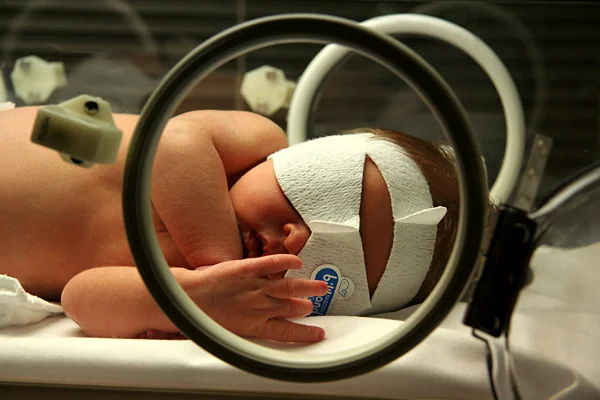
Phototherapy uses blue-green light of wavelength 460-490 nm to convert unconjugated bilirubin in the skin into water-soluble photoisomers, principally lumirubin, which can be excreted in bile and urine without requiring hepatic conjugation. It bypasses the immature enzyme rather than accelerating it.
- Start when the bilirubin crosses the phototherapy line on the gestation-specific chart for the baby's age in hours
- Undress the baby to maximise exposed surface area, apply eye protection, and monitor temperature
- Continue feeding - do not interrupt breastfeeding for phototherapy, and encourage short feeding breaks with the lights off in conventional single phototherapy
- Do not give routine additional intravenous fluids. Give them only if the baby is dehydrated or is on continuous multiple phototherapy and unable to feed.
- Repeat the bilirubin 4-6 hours after starting, then every 6-12 hours once it is stable or falling
- Continuous multiple phototherapy is used if the bilirubin is rising rapidly, is not responding, or is approaching the exchange transfusion threshold
- Stop when the level is at least 50 micromol/L below the treatment threshold, and check a rebound bilirubin 12-18 hours later
Exchange transfusion
- Indicated when the bilirubin is at or above the exchange threshold line, or where there are clinical signs of acute bilirubin encephalopathy at any level
- A double-volume exchange removes bilirubin and, in haemolytic disease, also removes antibody-coated red cells and maternal antibody
- Continuous multiple phototherapy is continued during preparation and throughout
- Performed on a neonatal unit with continuous monitoring; complications include electrolyte disturbance, thrombocytopenia, necrotising enterocolitis, infection, and cardiovascular instability
Intravenous immunoglobulin
IVIG 500 mg/kg over 4 hours is used as an adjunct to continuous multiple phototherapy in rhesus or ABO haemolytic disease when the bilirubin continues to rise by more than 8.5 micromol/L per hour despite maximal phototherapy. It blocks Fc receptors on reticuloendothelial cells and so reduces haemolysis, and may avoid the need for exchange transfusion.3
Prolonged jaundice
Jaundice persisting beyond 14 days in a term baby or 21 days in a preterm baby requires a formal prolonged jaundice screen. The single most important result is the conjugated (direct) bilirubin.
- Conjugated bilirubin above 25 micromol/L, or more than 20% of the total, defines conjugated hyperbilirubinaemia and is always pathological
- The screen includes: split bilirubin, FBC and blood film, blood group and DAT, LFTs, U&Es, thyroid function (or the blood spot result), urine culture, urine for reducing substances, and G6PD activity
- Ask about stool colour and inspect a dirty nappy yourself. Persistently pale, chalky stools with dark urine is the classic picture of biliary obstruction.4
- Arrange an abdominal ultrasound and refer urgently to a specialist paediatric hepatology centre if the bilirubin is conjugated
Kernicterus and acute bilirubin encephalopathy
Unconjugated bilirubin is lipid-soluble. When it exceeds the binding capacity of albumin, free bilirubin crosses the blood-brain barrier and is deposited preferentially in the basal ganglia - particularly the globus pallidus and subthalamic nuclei - the hippocampus and the brainstem nuclei, where it is directly neurotoxic.
Factors that increase the risk at any given bilirubin level
- Prematurity - lower albumin, more permeable blood-brain barrier
- Sepsis and acidosis, which reduce bilirubin binding and increase barrier permeability
- Hypoalbuminaemia
- Haemolysis, which produces a rapidly rising rather than a slowly accumulating level
- Drugs that displace bilirubin from albumin, notably ceftriaxone and sulphonamides - which is why cefotaxime rather than ceftriaxone is used in neonates
- Hypoxia, hypothermia and hypoglycaemia
| Phase | Features |
|---|---|
| Acute, early | Lethargy, poor feeding, hypotonia - easily mistaken for sepsis or simply a sleepy baby |
| Acute, intermediate | Irritability, a high-pitched cry, hypertonia with retrocollis and opisthotonus (arching of the neck and back), and fever |
| Acute, advanced | Apnoea, seizures, coma and death |
| Chronic (kernicterus) | Choreoathetoid cerebral palsy, sensorineural hearing loss from auditory neuropathy, upward gaze palsy, dental enamel dysplasia, and variable intellectual impairment |
Prognosis
For the great majority of babies, jaundice resolves without intervention and has no consequences whatsoever. Phototherapy is safe, well tolerated and required by around 5-10% of newborns; the commonest problems it causes are transient rashes, loose stools, temperature instability and, more significantly, separation of mother and baby, which can undermine breastfeeding if not managed thoughtfully.
Kernicterus is now rare in the UK - of the order of a handful of cases a year - and essentially every case represents a failure of a system designed to prevent it: jaundice not measured, a threshold chart not plotted, a rising trend not rechecked, or a baby discharged without a plan to review. Once established, the neurological damage is permanent.2
Prolonged jaundice carries a similar message. Most babies still yellow at 3 weeks have breast milk jaundice and are entirely well, but the whole purpose of the prolonged jaundice screen is to find the small number with biliary atresia while the Kasai procedure can still work. Checking a split bilirubin and looking at a nappy is a very small amount of effort for a diagnosis that is otherwise made too late.
References
- NICE CG98. Jaundice in newborn babies under 28 days. 2010, updated 2023. Available here
- NICE Clinical Knowledge Summaries. Jaundice in the newborn. Available here
- BNF for Children. Normal immunoglobulin. Available here
- Children's Liver Disease Foundation. Yellow Alert: jaundice in newborn babies and the stool colour chart. Available here
- NICE NG195. Neonatal infection: antibiotics for prevention and treatment. 2021. Available here
- GOV.UK. Newborn blood spot screening programme overview. Available here
This article is written for revision and education. It is not clinical guidance and must not be used to make decisions about the care of a patient. Always check current NICE guidance and local protocols.