
Malaria
Key points
- Malaria: infection with a Plasmodium species, transmitted by the bite of a female Anopheles mosquito - always consider it in a febrile patient who has travelled to an endemic area, however mild the symptoms seem.
- Plasmodium falciparum: the commonest and most dangerous species, predominant in sub-Saharan Africa, responsible for almost all severe and fatal malaria.
- P. vivax and P. ovale: form dormant liver hypnozoites that can cause relapse months to years after the original infection unless specifically eradicated.
- Diagnosis: thick and thin blood films - thick for sensitivity, thin for species identification and parasitaemia - repeated three times over 24-48 hours before malaria can be excluded.
- Severe falciparum malaria: defined by impaired consciousness, seizures, respiratory distress, hypoglycaemia, severe anaemia, renal impairment, acidosis, shock, spontaneous bleeding or a parasitaemia above 2%.
- Treatment: IV artesunate for severe or complicated falciparum malaria; oral artemisinin combination therapy for uncomplicated disease; add primaquine after chloroquine in vivax/ovale to clear hypnozoites, but only after checking G6PD status.
- Prevention: the ABCD approach - Awareness of risk, Bite prevention, Chemoprophylaxis, prompt Diagnosis of any fever after travel.
Introduction
Malaria is caused by protozoan parasites of the genus Plasmodium, transmitted by the bite of an infected female Anopheles mosquito. It is the most important cause of severe imported febrile illness in UK travellers, and the single most important rule in managing a returning traveller with fever is simple: exclude malaria before assuming anything else, because a missed diagnosis of falciparum malaria can be fatal within days.1
| Species | Key features |
|---|---|
| P. falciparum | Commonest and most dangerous species; predominant in sub-Saharan Africa; responsible for almost all severe malaria and malaria deaths |
| P. vivax | Common in South Asia and Latin America; forms dormant liver hypnozoites causing relapse months to years later |
| P. ovale | Mainly West Africa; also forms hypnozoites and can relapse |
| P. malariae | Chronic, low-grade infection; associated with nephrotic syndrome from immune-complex glomerulonephritis |
| P. knowlesi | A zoonotic species from Southeast Asia (macaques are the reservoir), which can cause severe disease and is increasingly recognised |
Life cycle
A mosquito bite injects sporozoites, which travel to the liver and multiply within hepatocytes (the exo-erythrocytic cycle) before releasing merozoites into the bloodstream. Merozoites invade red blood cells, developing through ring forms and trophozoites to schizonts, which rupture the cell and release further merozoites to infect new red cells - it is this synchronised rupture that produces the classic cyclical fever pattern. Some parasites differentiate into gametocytes, which are taken up by a feeding mosquito to complete the cycle.
P. vivax and P. ovale form dormant liver-stage hypnozoites that can reactivate weeks, months or even years after the original infection, causing relapse - the reason these two species need specific additional treatment to eradicate the liver stage, not just the blood stage.
Clinical features
The presentation is often deceptively non-specific, which is exactly why the travel history is the single most important piece of information in the assessment.
- Fever, classically cyclical - every 48 hours (tertian) in P. falciparum, P. vivax and P. ovale, or every 72 hours (quartan) in P. malariae - though in practice, especially early in falciparum infection, fever is often irregular or continuous rather than neatly periodic
- Rigors, headache, myalgia and malaise
- Nausea, vomiting and diarrhoea - can mimic gastroenteritis and mislead the initial assessment
- Splenomegaly
- Mild jaundice, from haemolysis
- Anaemia and thrombocytopenia are common laboratory findings and a useful diagnostic clue even before a film result is available
Severe (complicated) falciparum malaria
Any one of the following features in confirmed or suspected P. falciparum infection defines severe malaria and mandates emergency management, typically with high-dependency or intensive care input.2
- Impaired consciousness or cerebral malaria - can present with seizures, confusion or coma
- Seizures (more than one episode)
- Respiratory distress or ARDS
- Hypoglycaemia - can also be worsened by quinine treatment itself, via insulin secretion
- Severe anaemia
- Renal impairment - including "blackwater fever", haemoglobinuria from severe intravascular haemolysis
- Acidosis
- Shock
- Spontaneous bleeding or disseminated intravascular coagulation
- Pulmonary oedema
- Hyperparasitaemia - a parasitaemia above 2% is generally used as a severity threshold, with a substantially worse prognosis above 10%
- Jaundice in combination with any other organ dysfunction
Differential diagnosis
- Typhoid (enteric fever) - another major cause of fever in a returning traveller, covered in its own article
- Dengue fever - fever, myalgia ("breakbone fever"), thrombocytopenia and a rash, from a different geographic distribution overlap
- Viral hepatitis - jaundice with malaise, though the acute febrile pattern differs
- Amoebic liver abscess - fever with right upper quadrant pain, often without diarrhoea at presentation
- Rickettsial disease - fever with a rash and often an eschar at the site of a tick bite
- Viral haemorrhagic fever - rare, but must be actively considered and isolation precautions applied where the travel and exposure history and clinical picture fit, given the public health implications
Investigations
Blood film
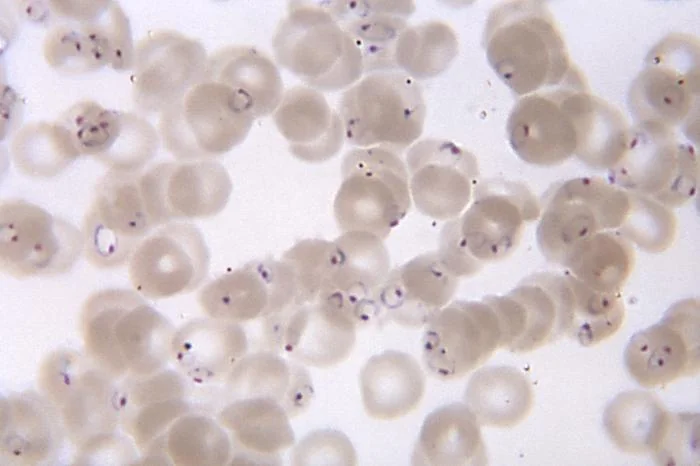
Thick and thin Giemsa-stained blood films remain the diagnostic standard. The thick film is more sensitive and used to detect the presence of parasites; the thin film allows species identification and quantification of the percentage parasitaemia, which is central to grading severity.
Other tests
- Rapid diagnostic tests (RDTs) - antigen-based tests (for example detecting HRP-2, specific to P. falciparum) used alongside microscopy, useful where film expertise is not immediately available, but not a substitute for it
- PCR - available through reference laboratories, useful for species confirmation and low-level parasitaemia
- FBC - thrombocytopenia is common and a useful supporting clue even before the film is reported
- U&Es, LFTs, glucose, lactate and clotting screen - to assess for the organ dysfunction that defines severe disease
- Blood cultures - to help exclude co-existing or alternative bacterial infection in an unwell returning traveller
Management
Uncomplicated falciparum malaria
Oral artemisinin combination therapy (ACT), most often artemether-lumefantrine, is first-line in the UK. Atovaquone-proguanil, or quinine combined with doxycycline or clindamycin, are alternatives.
Severe or complicated falciparum malaria
IV artesunate is first-line, having been shown in major trials to reduce mortality compared with IV quinine, and is now the standard of care for severe disease.3 Management runs alongside intensive supportive care: careful fluid balance (given the risk of pulmonary oedema), monitoring and correction of hypoglycaemia, seizure management, and renal replacement therapy if acute kidney injury develops.
Non-falciparum malaria
Chloroquine remains effective for most non-falciparum species where resistance is not established, though ACT is also used. For P. vivax and P. ovale, primaquine (or tafenoquine) is added after the blood-stage treatment to eradicate liver hypnozoites and prevent relapse.
Malaria is a notifiable disease in the UK, and should be reported to UKHSA on diagnosis.
Prevention
Prevention is usually summarised as the ABCD approach, and is a standard travel medicine counselling point.
- Awareness of the risk in the specific destination and season
- Bite prevention - insect repellent (DEET), long sleeves and trousers particularly at dusk and night, and insecticide-treated bed nets
- Chemoprophylaxis - chosen according to the destination's resistance patterns and the traveller's individual risk factors; common options include atovaquone-proguanil, doxycycline and mefloquine, each with a different side effect and contraindication profile (mefloquine is avoided with a history of depression, anxiety or seizures because of neuropsychiatric side effects; doxycycline causes photosensitivity and is avoided in pregnancy and young children)
- Diagnosis promptly sought for any fever occurring during travel or after return, rather than assuming a self-limiting viral illness
Complications
- Cerebral malaria, with a risk of lasting neurological sequelae in survivors
- Acute kidney injury ("blackwater fever")
- ARDS
- Disseminated intravascular coagulation and spontaneous bleeding
- Splenic rupture (rare, but recognised, particularly with a markedly enlarged spleen)
- Severe hypoglycaemia, compounded by quinine treatment
- Relapse (P. vivax/ovale) if hypnozoites are not eradicated
- Death - overwhelmingly from delayed diagnosis or inadequately treated severe falciparum malaria
Prognosis
Uncomplicated malaria treated promptly with appropriate antimalarials has an excellent prognosis. Severe falciparum malaria carries a significant mortality risk even with modern treatment, and outcome is strongly time-dependent - the interval between symptom onset and starting effective treatment is the single most modifiable determinant of survival, which is the underlying reason malaria is treated as a diagnosis to actively exclude rather than one to wait and see about in any returning traveller with fever.
References
- UK Health Security Agency. Guidelines for malaria prevention in travellers from the UK. Available here
- World Health Organization. Guidelines for the treatment of malaria. Available here
- Dondorp AM, Fanello CI, Hendriksen IC et al. Artesunate versus quinine in the treatment of severe falciparum malaria in African children (AQUAMAT). The Lancet. 2010. Available here
- NICE Clinical Knowledge Summaries. Malaria. Available here
- Public Health England / UKHSA. Guidelines for the treatment of malaria in the UK. Available here
This article is written for revision and education. It is not clinical guidance and must not be used to make decisions about the care of a patient. Always check current NICE guidance and local protocols.