
Childhood Asthma: Diagnosis and Management
Key points
- Definition: a chronic inflammatory airway disorder producing variable, reversible airflow obstruction with wheeze, cough, breathlessness and chest tightness.
- Scale: the commonest chronic disease of childhood in the UK, affecting roughly 1 in 11 children, and the UK has among the worst asthma death rates in Europe.
- Diagnosis (5-16 years): objective testing is now required. Measure FeNO first; if 35 ppb or more the diagnosis is made. Otherwise use spirometry with bronchodilator reversibility, then peak flow variability.
- Under 5s: cannot perform the tests reliably. Treat on clinical grounds with a monitored trial of inhaled corticosteroid and re-test at 5.
- The 2024 shift: SABA-only treatment is no longer acceptable. Every child with asthma should be on an inhaled corticosteroid, and MART regimens have moved up the ladder.
- Acute severity: graded as moderate, acute severe or life-threatening using saturations, peak flow, ability to talk, heart rate and respiratory rate.
- Acute treatment: oxygen to 94-98%, inhaled salbutamol - by spacer if moderate, nebulised if severe - ipratropium if severe, and oral prednisolone in every case.
- Before discharge: inhaler technique checked, a written personalised asthma action plan issued, and follow-up arranged. The National Review of Asthma Deaths found these omissions again and again.
Introduction
Asthma is a chronic inflammatory disorder of the airways characterised by variable and reversible airflow obstruction, bronchial hyper-responsiveness and, in most children, eosinophilic airway inflammation. It affects around 1 in 11 UK children and accounts for a large volume of emergency attendances every autumn.
Two things have changed the way this topic is taught. The first is the National Review of Asthma Deaths, which examined every asthma death in the UK over a year and found that most were preventable: excessive reliance on reliever inhalers, under-prescription of preventers, absent personalised action plans, and no follow-up after an attack.5 The second is the joint BTS, NICE and SIGN guideline published in 2024 (NG245), which rewrote both the diagnostic pathway and the treatment ladder.1
The headline change is worth stating plainly: treating asthma with a short-acting beta-2 agonist alone is no longer acceptable at any age. Every child with a diagnosis of asthma should be on an inhaled corticosteroid, because reliever-only treatment leaves the underlying inflammation untreated while masking deterioration.
Pathophysiology
Asthma is not one disease. In most children it is a type 2 inflammatory process: an inhaled allergen is processed by dendritic cells, drives a Th2 lymphocyte response, and generates IL-4, IL-5 and IL-13. These cytokines produce IgE class switching, eosinophil recruitment and survival, goblet cell hyperplasia and mucus production.
Airflow obstruction results from three processes acting together, and this is worth having straight because it explains the treatments:
- Bronchoconstriction - smooth muscle contraction, rapid in onset and rapidly reversed by a beta-2 agonist
- Airway inflammation and oedema - slower, and reversed only by corticosteroids, which is why a child who feels better after salbutamol is not necessarily better
- Mucus plugging - contributes heavily to severe attacks and to the silent chest of life-threatening asthma
Chronic uncontrolled inflammation causes airway remodelling: subepithelial fibrosis, smooth muscle hypertrophy and angiogenesis. This is partially irreversible and is the reason under-treated childhood asthma can leave a permanent deficit in lung function in adult life - the strongest argument for treating the inflammation properly rather than chasing symptoms with a reliever.
A minority of children have non-eosinophilic or neutrophilic asthma, which responds less well to inhaled corticosteroids. In practice, a child who genuinely fails to improve on an adequate ICS dose taken correctly needs specialist assessment rather than a further step up.
Risk factors and triggers
Predisposing factors
- Personal or family history of atopy - eczema, allergic rhinitis, food allergy. The atopic march from infantile eczema to asthma is well recognised.
- Male sex in childhood, though the ratio reverses after puberty
- Prematurity and low birth weight
- Maternal smoking in pregnancy, and household smoke exposure
- Bronchiolitis in infancy, particularly severe RSV disease
- Obesity, which both increases incidence and worsens control
- Air pollution and damp or mouldy housing - now recognised as a serious and remediable determinant of childhood respiratory disease
Triggers to ask about
- Viral upper respiratory tract infections - much the commonest trigger of an attack in children, and the reason for the September spike in admissions after schools return
- Exercise and cold air
- Aeroallergens - house dust mite, pets, pollen and moulds
- Tobacco smoke, vaping aerosol, and air pollution
- Drugs - NSAIDs and beta-blockers
- Emotion, laughter and stress
- Gastro-oesophageal reflux, which both triggers and mimics asthma
Clinical features
The four cardinal symptoms are wheeze, cough, breathlessness and chest tightness. What makes them asthmatic rather than simply respiratory is their pattern:
- Variable - better on some days than others, and often normal between episodes
- Worse at night and in the early morning
- Provoked by identifiable triggers, especially exercise, cold air and viral infections
- Responsive to bronchodilators
- Accompanied by a personal or family history of atopy
Ask specifically about nocturnal cough waking the child, exercise limitation compared with peers, school absence, and how many reliever inhalers have been used in the past year. Ask what the child does in PE, not whether they can run - children normalise their limitation and parents often do not realise how much has been given up.
Examination
- Frequently normal between episodes, which does not argue against the diagnosis
- Polyphonic expiratory wheeze with a prolonged expiratory phase during an episode
- Hyperinflation with a barrel chest in chronic poorly controlled disease
- Harrison's sulci - horizontal grooves at the diaphragmatic insertion, indicating long-standing increased work of breathing
- Growth - plot height and weight, since both poor control and high-dose corticosteroids can affect growth
- Signs of atopy - eczema, allergic rhinitis, a transverse nasal crease
- Inhaler technique, which should be observed at every review rather than asked about
Diagnosis
The 2024 guideline made objective testing mandatory where the child can perform it, in response to evidence that a large proportion of children labelled asthmatic do not have it - and that some children with genuine asthma are never diagnosed.1
Children and young people aged 5-16
- Measure FeNO. A fractional exhaled nitric oxide of 35 ppb or more confirms the diagnosis of asthma in a symptomatic child.
- If FeNO is unavailable or below 35 ppb, perform spirometry with bronchodilator reversibility. Diagnose asthma if FEV1 improves by 12% or more, or by 10% or more of the predicted value.
- If spirometry is unavailable or delayed, measure peak expiratory flow twice daily for 2 weeks. Diagnose asthma if PEF variability is 20% or more.
- If the diagnosis remains uncertain, refer for specialist assessment, which may include skin prick testing, total or specific IgE, blood eosinophil count or bronchial challenge testing.
Children under 5
Preschool children cannot perform spirometry or FeNO reliably. Treat on the basis of clinical judgement and observation, review regularly, and repeat the objective testing once the child reaches 5. If symptoms are frequent enough to need treatment, a monitored trial of an inhaled corticosteroid is used, with a clear plan for what constitutes a response and what happens if there is none.
Chronic management
The 2024 ladder differs from what many textbooks still show. The central concepts are AIR (anti-inflammatory reliever - an as-needed ICS/formoterol combination inhaler) and MART (maintenance and reliever therapy - the same combination inhaler taken both regularly and as needed).1
| Step | Children aged 5-11 | Young people aged 12 and over |
|---|---|---|
| 1 | Twice-daily paediatric low-dose ICS with a SABA as needed | As-needed low-dose ICS/formoterol (AIR therapy) for infrequent symptoms; start at low-dose MART if already highly symptomatic or presenting with an exacerbation |
| 2 | Paediatric low-dose MART (ICS/formoterol used as both preventer and reliever) | Low-dose MART |
| 3 | Paediatric moderate-dose MART | Moderate-dose MART |
| 4 | Check FeNO and spirometry, then refer to a specialist | Check FeNO and blood eosinophils; consider adding an LTRA or a LAMA, then refer to a specialist |
| Alternative | Where MART is not feasible, twice-daily paediatric low-dose ICS plus an LTRA, with a SABA as needed | Where MART is not feasible, regular ICS/LABA with a SABA as needed |
Non-pharmacological management, which carries equal weight
- A written personalised asthma action plan for every child, setting out daily treatment, how to recognise deterioration, what to do about it, and when to call for help
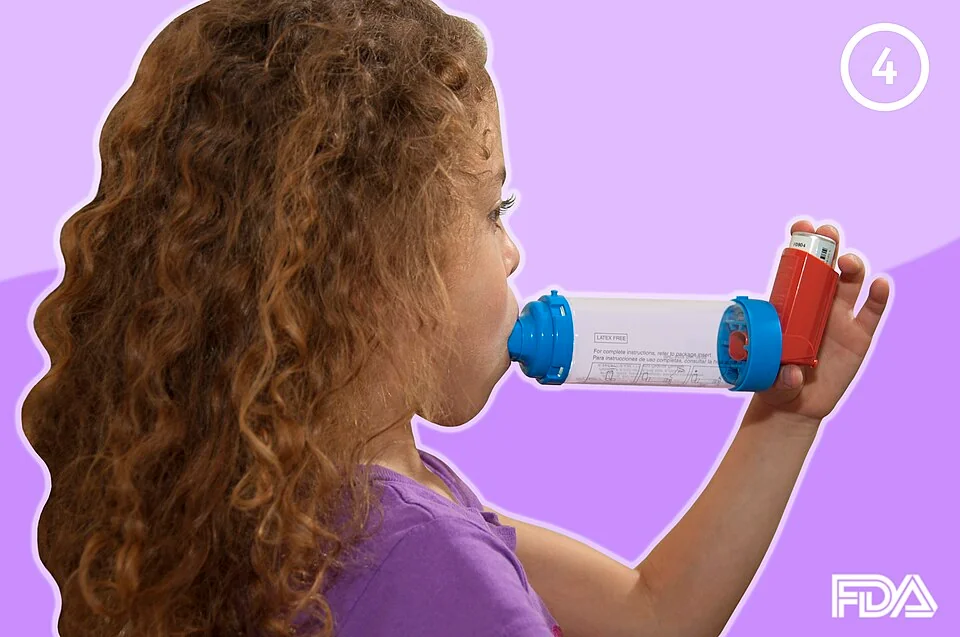
- Inhaler technique checked and demonstrated at every contact, with a spacer for all pressurised metered-dose inhalers, and a mask for children under about 3
- Adherence review - checking prescription collection data is more informative than asking
- Trigger reduction: smoke-free home and car, house dust mite measures where there is proven sensitisation, and addressing damp and mould in the home
- Annual influenza vaccination
- Weight management where relevant, and encouragement of exercise rather than avoidance
- Annual asthma review, including growth, control assessment and school liaison
- Assessment and treatment of comorbid allergic rhinitis, which materially worsens control if untreated
Acute asthma attack
Acute asthma in children is graded and treated according to BTS/SIGN criteria, which remain the reference standard for exacerbations alongside the NICE chronic management pathway.2
Grading severity
| Moderate | Acute severe | Life-threatening | |
|---|---|---|---|
| Oxygen saturation | 92% or above | Below 92% | Below 92% |
| Peak flow (if able) | 50% or more of best or predicted | 33-50% | Below 33% |
| Speech and feeding | Able to talk in sentences | Too breathless to talk or feed | Unable to talk |
| Heart rate | Not raised | Above 140 if aged 2-5; above 125 if over 5 | Bradycardia is pre-terminal |
| Respiratory rate | Not raised | Above 40 if aged 2-5; above 30 if over 5 | Poor respiratory effort |
| Other | No features of severe asthma | Use of accessory neck muscles | Silent chest, cyanosis, exhaustion, confusion, hypotension, altered consciousness |
Immediate treatment
- Oxygen by face mask or nasal cannulae to maintain saturations of 94-98%
- Salbutamol - for moderate attacks, 10 puffs via a pressurised metered-dose inhaler and spacer, one puff at a time with 5 tidal breaths each, repeated every 20-30 minutes. For severe or life-threatening attacks, nebulised salbutamol driven by oxygen - 2.5 mg under 5 years, 5 mg over 5 years - given back to back if needed.6
- Ipratropium bromide 250 micrograms nebulised, mixed with the salbutamol and given every 20-30 minutes for the first 2 hours, in severe or life-threatening attacks or where the response to salbutamol is poor
- Oral prednisolone in every child with an acute attack: 10 mg under 2 years, 20 mg for 2-5 years, 30-40 mg for over 5 years, for at least 3 days. Give intravenous hydrocortisone instead if the child is vomiting or unable to swallow.
- Reassess after each treatment, and escalate early if there is no improvement
If there is no response
- Call for senior and intensive care support early, and obtain intravenous access
- Intravenous magnesium sulfate 40 mg/kg (maximum 2 g) over 20 minutes - the usual first intravenous agent
- Intravenous salbutamol - a bolus of 15 micrograms/kg over 10 minutes followed by an infusion, with monitoring of potassium and lactate
- Intravenous aminophylline - a loading dose of 5 mg/kg over 20 minutes, omitted if the child already takes oral theophylline, followed by an infusion
- Correct hypokalaemia, which is caused by high-dose beta-2 agonists and can precipitate arrhythmia
- Intubation and ventilation is a last resort, is high risk in asthma, and should be performed by the most experienced clinician available
Investigations in an acute attack
- Pulse oximetry in every child; peak flow if the child is over 5 and able to perform it
- Blood gas only in life-threatening asthma or where there is no response to treatment
- Chest radiograph only if there is suspected pneumothorax, lobar collapse, consolidation, or failure to respond to treatment - it is not routine
- U&Es where high-dose or intravenous beta-2 agonists are used, to detect hypokalaemia
Discharge and follow-up
This is where preventable deaths are made, and it is heavily examined.
- Stable on 3-4 hourly inhaled bronchodilators that can be continued at home, with saturations above 94% in air and peak flow above 75% of best or predicted
- Inhaler technique checked and corrected, with a spacer supplied
- A written personalised asthma action plan issued or updated before leaving
- Preventer treatment started or stepped up - an attack is by definition a failure of current control
- Primary care follow-up within 2 working days, and paediatric respiratory review within 1-2 months after a severe attack
- Trigger and adherence review, including smoking in the household
- Complete the course of oral steroid, and give clear instructions on what to do if symptoms return
Complications
- Life-threatening attack and death - asthma still kills UK children every year, and most such deaths are judged preventable5
- Fixed airflow obstruction from airway remodelling in chronically under-treated disease
- Growth impairment - from poorly controlled disease itself as much as from corticosteroids
- Adrenal suppression with high-dose inhaled or repeated oral corticosteroids
- Oral candidiasis and dysphonia from inhaled steroid deposition
- Pneumothorax and pneumomediastinum during a severe attack
- Hypokalaemia and lactic acidosis from high-dose beta-2 agonists
- School absence, exercise avoidance and reduced quality of life, plus anxiety in both child and parents
Prognosis
Prognosis is generally good. Many children with mild episodic symptoms become symptom-free in adolescence, though airway hyper-responsiveness often persists and symptoms may return in adult life. Persistence into adulthood is more likely with early onset, severe or frequent symptoms, marked atopy, a strong family history and impaired lung function at diagnosis.
The determinants of a poor outcome are largely modifiable: poor adherence to preventer treatment, over-reliance on reliever inhalers, continued smoke exposure, and the absence of a written action plan and structured follow-up. Each of these is something a clinician can address in a ten-minute consultation.
That is the message to take from the National Review of Asthma Deaths and the reason the 2024 guideline pushed inhaled corticosteroids to the very first step. When you are asked how to manage a child with asthma, the marks are not only in naming the drugs - they are in checking the inhaler technique, issuing the action plan, and arranging the follow-up.3,4
References
- NICE NG245. Asthma: diagnosis, monitoring and chronic asthma management (BTS, NICE, SIGN). 2024. Available here
- British Thoracic Society and SIGN. British guideline on the management of asthma. Available here
- NICE Clinical Knowledge Summaries. Asthma. Available here
- NICE Clinical Knowledge Summaries. Asthma - acute exacerbation. Available here
- Royal College of Physicians. Why asthma still kills: the National Review of Asthma Deaths. 2014. Available here
- BNF for Children. Salbutamol. Available here
This article is written for revision and education. It is not clinical guidance and must not be used to make decisions about the care of a patient. Always check current NICE guidance and local protocols.