
Polycystic Ovary Syndrome (PCOS)
Key points
- PCOS: a common endocrine disorder defined by two of three Rotterdam criteria: oligo/anovulation, clinical or biochemical hyperandrogenism, and polycystic ovarian morphology on ultrasound.
- Prevalence: affects around 1 in 10 women of reproductive age, making it the most common cause of anovulatory infertility.
- Pathophysiology: insulin resistance and raised LH drive excess ovarian androgen production, which in turn impairs normal follicle development.
- Presentation: oligomenorrhoea/amenorrhoea, hirsutism, acne, and subfertility; often alongside obesity and features of metabolic syndrome.
- Diagnosis of exclusion: thyroid disease, hyperprolactinaemia and, if hyperandrogenism is severe or rapid-onset, androgen-secreting tumours and congenital adrenal hyperplasia must be excluded first.
- Long-term risks: type 2 diabetes, endometrial hyperplasia/cancer from unopposed oestrogen, and cardiovascular disease.
- Management: weight management, the combined pill for cycle control and hirsutism, metformin for insulin resistance, and letrozole/clomifene for ovulation induction when fertility is desired.
- Endometrial protection: women with amenorrhoea for longer than 3-4 months need induced withdrawal bleeds to prevent endometrial hyperplasia from unopposed oestrogen.
Introduction
Polycystic ovary syndrome (PCOS) is a common endocrine and metabolic disorder affecting around one in ten women of reproductive age, making it the leading cause of anovulatory infertility.1 Despite the name, the ovarian cysts are not true cysts but numerous small, arrested antral follicles - the syndrome is fundamentally a disorder of hormonal and metabolic regulation rather than a structural ovarian disease.
PCOS is diagnosed using the Rotterdam criteria, which require at least two of the following three features, with other causes of the same picture excluded:2
- Oligo-ovulation or anovulation (typically manifesting as oligomenorrhoea or amenorrhoea)
- Clinical and/or biochemical signs of hyperandrogenism (hirsutism, acne, alopecia, or raised testosterone)
- Polycystic ovarian morphology on ultrasound (see the threshold note below), or a raised anti-Mullerian hormone (AMH) level as an accepted alternative in adults
Pathophysiology
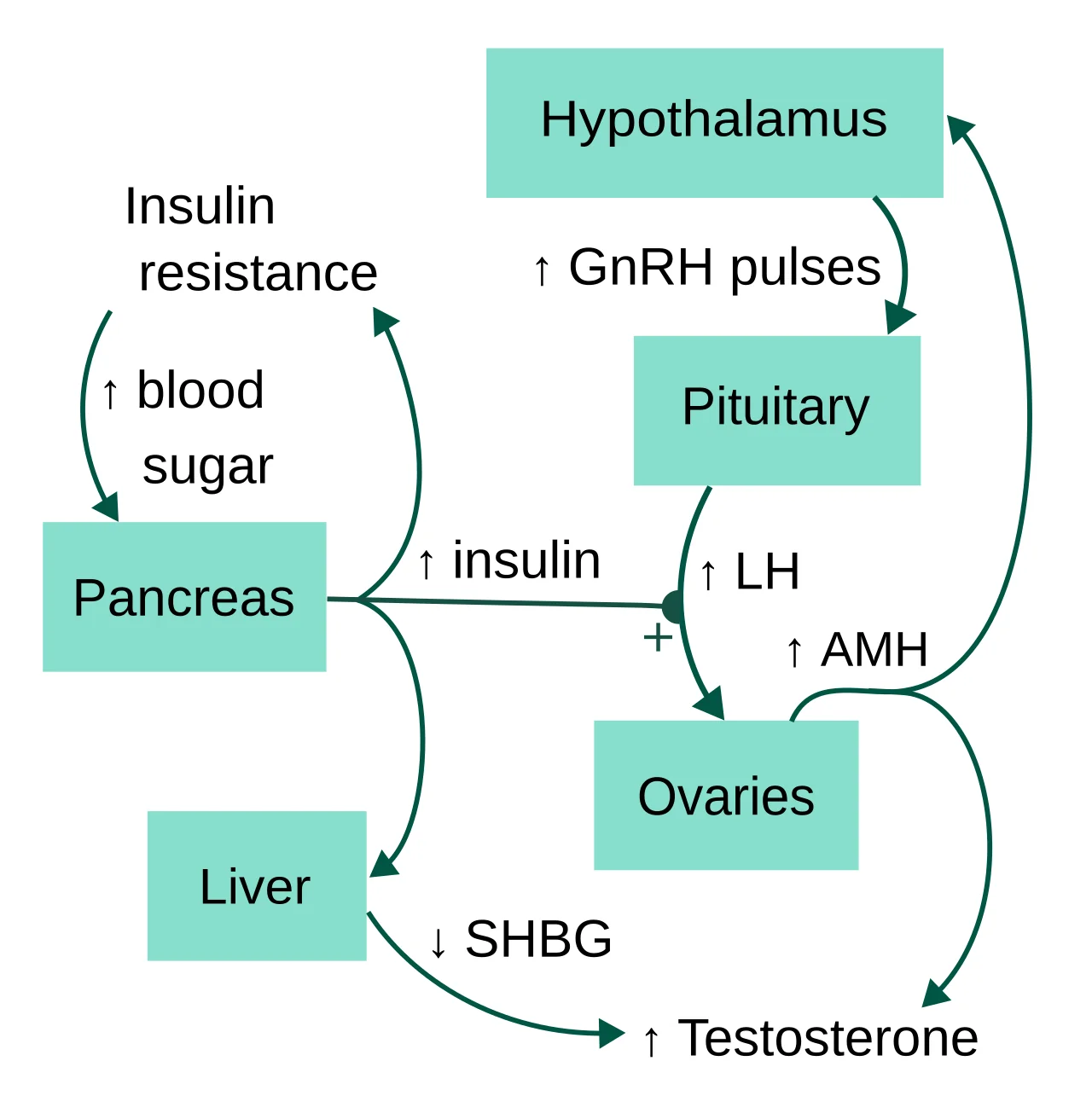
The precise cause is not fully understood, but the central mechanism is a vicious cycle linking insulin resistance, raised luteinising hormone (LH), and excess ovarian androgen production.3
Increased GnRH pulse frequency from the hypothalamus favours LH over FSH release from the pituitary. Raised LH stimulates the ovarian theca cells to produce excess androgens, while relatively low FSH impairs normal follicular maturation, so follicles arrest at an early antral stage rather than progressing to ovulation - these arrested follicles are the 'polycystic' appearance seen on ultrasound. Insulin resistance, present in the majority of women with PCOS regardless of body weight, compounds this: high circulating insulin directly stimulates theca cell androgen production, reduces hepatic production of sex hormone-binding globulin (SHBG) so more testosterone circulates unbound and biologically active, and enhances the ovarian response to LH.
Risk factors
- Family history of PCOS
- Obesity (both a risk factor and a consequence, as insulin resistance is self-perpetuating)
- Type 2 diabetes or a strong family history of it
- Reflects a genetic and environmental interplay rather than any single cause
Clinical features
Symptoms typically begin around puberty and can be difficult to distinguish from normal adolescent cycle irregularity at first, which contributes to diagnostic delay.1
Reproductive features
- Oligomenorrhoea or amenorrhoea (irregular or absent periods from anovulation)
- Subfertility
- Hirsutism (male-pattern hair growth - upper lip, chin, chest)
- Acne
- Androgenic alopecia (male-pattern scalp hair thinning)
Metabolic features
- Obesity, particularly central adiposity
- Acanthosis nigricans (velvety hyperpigmentation of skin folds - neck, axillae) reflecting significant insulin resistance
- Features of metabolic syndrome (hypertension, dyslipidaemia)
Psychological
Anxiety, depression and body image concerns are common and should be actively asked about, as they are frequently under-recognised and undertreated in women with PCOS.
Differential diagnosis and investigations
PCOS is a diagnosis of exclusion - other causes of oligomenorrhoea and hyperandrogenism must be considered and excluded before confirming the diagnosis, particularly if the presentation is atypical, severe, or rapid in onset.2
| Test | Purpose |
|---|---|
| LH, FSH | May show a raised LH:FSH ratio, though this is not required for diagnosis |
| Total and free testosterone, SHBG | Confirms biochemical hyperandrogenism; markedly elevated testosterone should prompt investigation for an androgen-secreting tumour |
| Thyroid function tests | Excludes thyroid dysfunction as a cause of menstrual irregularity |
| Prolactin | Excludes hyperprolactinaemia, another cause of oligo/amenorrhoea |
| 17-hydroxyprogesterone | Excludes late-onset (non-classic) congenital adrenal hyperplasia if hyperandrogenism is prominent |
| Pelvic ultrasound (transvaginal preferred) | Assesses ovarian morphology and follicle count/volume; not used for diagnosis within 8 years of menarche |
| Anti-Mullerian hormone (AMH) | Raised in PCOS, reflecting the increased pool of small antral follicles; accepted in current international guidance as an alternative to ultrasound for defining polycystic ovarian morphology in adults, but not for adolescents |
| Oral glucose tolerance test / HbA1c | Screens for impaired glucose tolerance or type 2 diabetes, given the strong link with insulin resistance |
| Lipid profile | Screens for dyslipidaemia as part of cardiovascular risk assessment |
Management
Management is individualised according to the woman's main concern - cycle control, hirsutism/acne, fertility, or metabolic risk - and lifestyle measures underpin all of these.2
Lifestyle
Weight loss of even 5-10% in women who are overweight can restore ovulation, improve insulin sensitivity, and reduce androgen levels, and is first-line advice regardless of which symptom is most troubling. Regular exercise and a balanced diet support this.
Menstrual irregularity and endometrial protection
The combined oral contraceptive pill regulates cycles and provides endometrial protection. Where the COCP is contraindicated or not wanted, cyclical progestogens or an LNG-IUS achieve the same protective effect. Unopposed oestrogen from chronic anovulation increases the long-term risk of endometrial hyperplasia and cancer, so women with amenorrhoea persisting beyond 3-4 months who are not on a method that protects the endometrium should be induced to have a withdrawal bleed.
Hirsutism and acne
The COCP (particularly formulations containing an anti-androgenic progestogen such as co-cyprindiol) improves both. Topical eflornithine can slow facial hair growth, and cosmetic measures (laser therapy, electrolysis) are options for persistent hirsutism. Topical or oral treatments for acne follow standard dermatological practice.
Fertility
Weight loss alone restores ovulation in some women. Letrozole is now first-line pharmacological ovulation induction (off-label but favoured over clomifene in current guidance due to better live birth rates), with clomifene citrate an alternative. Metformin improves insulin sensitivity and can be used alone or alongside letrozole/clomifene, particularly in women who are overweight. Gonadotrophin injections or laparoscopic ovarian drilling are options if oral treatments fail, and IVF is considered if these are unsuccessful.4
Long-term complications
PCOS is not confined to reproductive years - it carries significant long-term metabolic and oncological risk that should be discussed with every woman at diagnosis.1
- Type 2 diabetes mellitus: from chronic insulin resistance; regular screening is recommended, particularly in those who are overweight
- Endometrial hyperplasia and cancer: from chronic unopposed oestrogen exposure due to anovulation
- Cardiovascular disease: related to dyslipidaemia, hypertension and obesity clustering with PCOS
- Obstructive sleep apnoea: more common in women with PCOS, independent of BMI
- Subfertility and adverse pregnancy outcomes: including gestational diabetes and pre-eclampsia if pregnancy is achieved
- Psychological morbidity: anxiety, depression, and reduced quality of life related to body image
Prognosis
PCOS is a lifelong condition, though its clinical impact shifts across a woman's life - reproductive and cosmetic concerns dominate in the 20s and 30s, while metabolic and cardiovascular risk become more prominent with age. With sustained lifestyle management and appropriate screening for diabetes and endometrial protection, most long-term complications are preventable or manageable, and the majority of women with PCOS who wish to conceive are ultimately able to do so with fertility treatment.
References
- NICE Clinical Knowledge Summaries (CKS). Polycystic ovary syndrome. Available here
- International evidence-based guideline for the assessment and management of polycystic ovary syndrome. 2023. Available here
- Stener-Victorin E, Teede H, Norman RJ et al. Polycystic ovary syndrome. Nature Reviews Disease Primers. 2024. Available here
- NICE Clinical Knowledge Summaries (CKS). Infertility - ovulation induction. Available here
This article is written for revision and education. It is not clinical guidance and must not be used to make decisions about the care of a patient. Always check current NICE guidance and local protocols.