
Lichen Sclerosus
Key points
- Lichen sclerosus: a chronic inflammatory skin condition, thought to be autoimmune, causing itchy, white, atrophic plaques most often affecting the anogenital skin.
- Typical patient: bimodal distribution - prepubertal girls and postmenopausal women, though it can occur at any age and in men (usually the glans/foreskin).
- Presentation: vulval itch (often severe, worse at night), soreness, dyspareunia, and skin changes described as ivory-white, thin, crinkled ('cigarette paper').
- Diagnosis: usually clinical; biopsy is reserved for diagnostic uncertainty, failure to respond to treatment, or any suspicious area to exclude malignancy.
- Management: potent topical corticosteroid (e.g. clobetasol propionate) is first-line, used to induce remission then taper to a maintenance regimen.
- Malignancy risk: around 4-5% lifetime risk of vulval squamous cell carcinoma, which is why lifelong follow-up and self-examination advice are part of standard care.
- Complications: scarring can cause fusion of the labia, narrowing of the introitus, and clitoral hood adhesions, sometimes requiring surgical intervention.
- Not sexually transmitted: lichen sclerosus is not infectious or sexually transmitted, an important point to reassure patients on at diagnosis.
Introduction
Lichen sclerosus is a chronic, inflammatory skin condition that most commonly affects the anogenital region, causing thinning, whitening and scarring of the affected skin. Although it can occur anywhere on the body, anogenital involvement accounts for the great majority of cases and is what most commonly presents to gynaecology, dermatology and general practice.1
The condition has a bimodal age distribution, most commonly affecting prepubertal girls and postmenopausal women, though it can present at any age. In men, it typically affects the glans penis and foreskin, where it is sometimes called balanitis xerotica obliterans.
Lichen sclerosus is not infectious and not sexually transmitted - an important early reassurance for patients, who may otherwise worry about transmission to a partner or, in the case of a parent of an affected child, about abuse having occurred (vulval changes can occasionally be mistaken for, or coexist with, signs of abuse, so a careful and sensitive history is important).
Aetiology and pathophysiology
The exact cause is not fully understood, but lichen sclerosus is thought to be an autoimmune-mediated condition, supported by its association with other autoimmune diseases (autoimmune thyroid disease, vitiligo, alopecia areata, pernicious anaemia) and the finding of circulating autoantibodies (e.g. to extracellular matrix protein 1) in a proportion of affected women.1
Chronic inflammation in the affected skin leads to thinning of the epidermis, homogenisation and sclerosis of the underlying dermal collagen, and loss of normal skin architecture - this is what produces the characteristic pale, thin, 'cigarette-paper' texture and, over time, progressive scarring.
Risk factors
- Female sex (more commonly affected than men)
- Postmenopausal status or prepubertal age (bimodal distribution)
- Personal or family history of autoimmune disease (thyroid disease, vitiligo, alopecia areata, type 1 diabetes)
- Family history of lichen sclerosus
- Koebner phenomenon: lesions can develop at sites of skin trauma or friction
Clinical features
The dominant symptom is vulval itch, often intense and characteristically worse at night, which can significantly disrupt sleep and quality of life. Soreness, burning, and pain or splitting of the skin (fissuring) are also common, and dyspareunia or discomfort with urination can occur if the introitus or perineum is affected.2
On examination, the skin appears ivory-white, thin, and atrophic, often described as having a 'cigarette-paper' or crinkled texture. Lesions classically affect the labia minora, labia majora, clitoral hood and perineum in a figure-of-eight distribution around the vulva and anus, typically sparing the vagina itself.
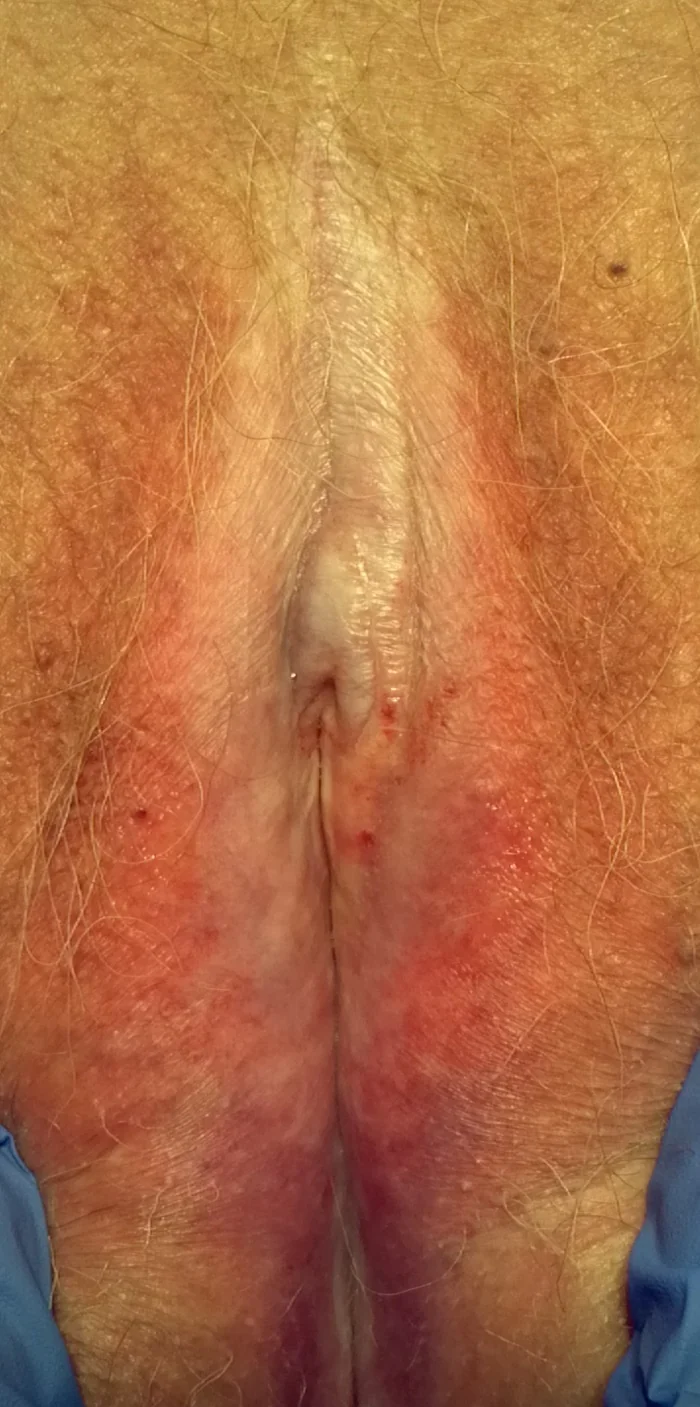
Other features include purpura or ecchymoses within affected skin (from fragile, thinned tissue - not to be mistaken for trauma or abuse), fissuring, and, in longstanding disease, architectural change: fusion or resorption of the labia minora, narrowing of the introitus, and adhesions over the clitoris (clitoral phimosis).
Differential diagnosis
- Lichen planus: violaceous, flat-topped papules; can also affect the vulva and cause scarring, and can coexist with lichen sclerosus
- Lichen simplex chronicus: thickened, lichenified skin from chronic scratching, usually without the ivory-white atrophy
- Vitiligo: depigmentation without the textural skin change
- Vulval intraepithelial neoplasia (VIN) or squamous cell carcinoma: any raised, ulcerated, or non-healing area within lichen sclerosus needs biopsy to exclude this
- Candidiasis or other vulvovaginitis: itch without the characteristic skin changes
Investigations
Lichen sclerosus is usually a clinical diagnosis based on the characteristic appearance and distribution.2 Biopsy is reserved for:
- Diagnostic uncertainty
- Atypical features or failure to respond to appropriately used first-line treatment
- Any area suspicious for vulval intraepithelial neoplasia or squamous cell carcinoma (ulceration, a persistent lump, or a rapidly changing area)
- Suspected coexisting lichen planus
Management
The mainstay of treatment is a potent topical corticosteroid, which controls inflammation, relieves symptoms, and - importantly - reduces the long-term risk of scarring and, likely, of malignant transformation, which is why early and adequate treatment matters even in mild cases.1
Topical corticosteroids
Clobetasol propionate 0.05% (a potent/very potent steroid) is typically used once daily for around 4 weeks to induce remission, then gradually reduced in frequency to a maintenance regimen (e.g. twice weekly), tailored to symptom control. Patients are counselled on correct application (a thin layer to affected skin only) and reassured that potent steroid use in this context, under specialist guidance, is safe and does not cause significant skin thinning at the doses and duration typically used - a common source of patient (and sometimes clinician) hesitancy.
General measures
- Emollients as a soap substitute and for regular skin care
- Avoiding irritants (scented soaps, wipes, tight synthetic underwear)
- Topical anaesthetic (e.g. lidocaine gel) for symptomatic relief of severe soreness if needed
Surgical management
Reserved for complications rather than the disease itself: division of labial adhesions or introital narrowing causing dyspareunia or urinary obstruction, or excision of any biopsy-confirmed malignant or premalignant change. Surgery does not treat the underlying inflammatory process, so topical corticosteroid therapy continues alongside it.
Malignancy risk and follow-up
Lichen sclerosus carries an increased lifetime risk of vulval squamous cell carcinoma, estimated at around 4-5%, thought to arise via a differentiated VIN pathway distinct from the HPV-driven pathway seen in younger women (see the vulval cancer article).3 This risk underlies the emphasis on long-term follow-up.
Women with lichen sclerosus should be advised on regular self-examination and offered longer-term follow-up (frequency guided by symptom control and risk factors), and encouraged to seek prompt review of any new or changing lesion rather than waiting for a routine appointment.
Lichen sclerosus in children
In prepubertal girls, lichen sclerosus can be mistaken for signs of sexual abuse because of vulval soreness, bruising-like purpura, and skin fragility - clinicians should be aware of this overlap and take a careful, sensitive history, while remaining alert to the fact that the two are not mutually exclusive and safeguarding concerns should still be considered where clinically indicated. Childhood lichen sclerosus is managed with topical corticosteroids in the same way as in adults, and a proportion of cases improve or resolve around puberty, though some persist into adulthood.
Prognosis
Lichen sclerosus is a chronic condition with no cure, but symptoms are usually well controlled with appropriate topical corticosteroid therapy, and early, adequate treatment reduces the risk of long-term scarring. Because the condition can wax and wane and carries a lasting malignancy risk, most women continue some form of maintenance treatment and follow-up indefinitely rather than being discharged after initial symptom control.
References
- British Association of Dermatologists. Guidelines for the management of lichen sclerosus. 2018. Available here
- NICE Clinical Knowledge Summaries (CKS). Lichen sclerosus. Available here
- Royal College of Obstetricians and Gynaecologists. Vulval conditions - lichen sclerosus, patient information. Available here
This article is written for revision and education. It is not clinical guidance and must not be used to make decisions about the care of a patient. Always check current NICE guidance and local protocols.