
Cervical Ectropion
Key points
- Cervical ectropion: eversion of the endocervical columnar epithelium onto the ectocervix, exposing it beyond the normal squamocolumnar junction; a normal variant, not a disease.
- Cause: driven by oestrogen - common in adolescence, pregnancy, and with combined hormonal contraceptive use; regresses as oestrogen levels fall.
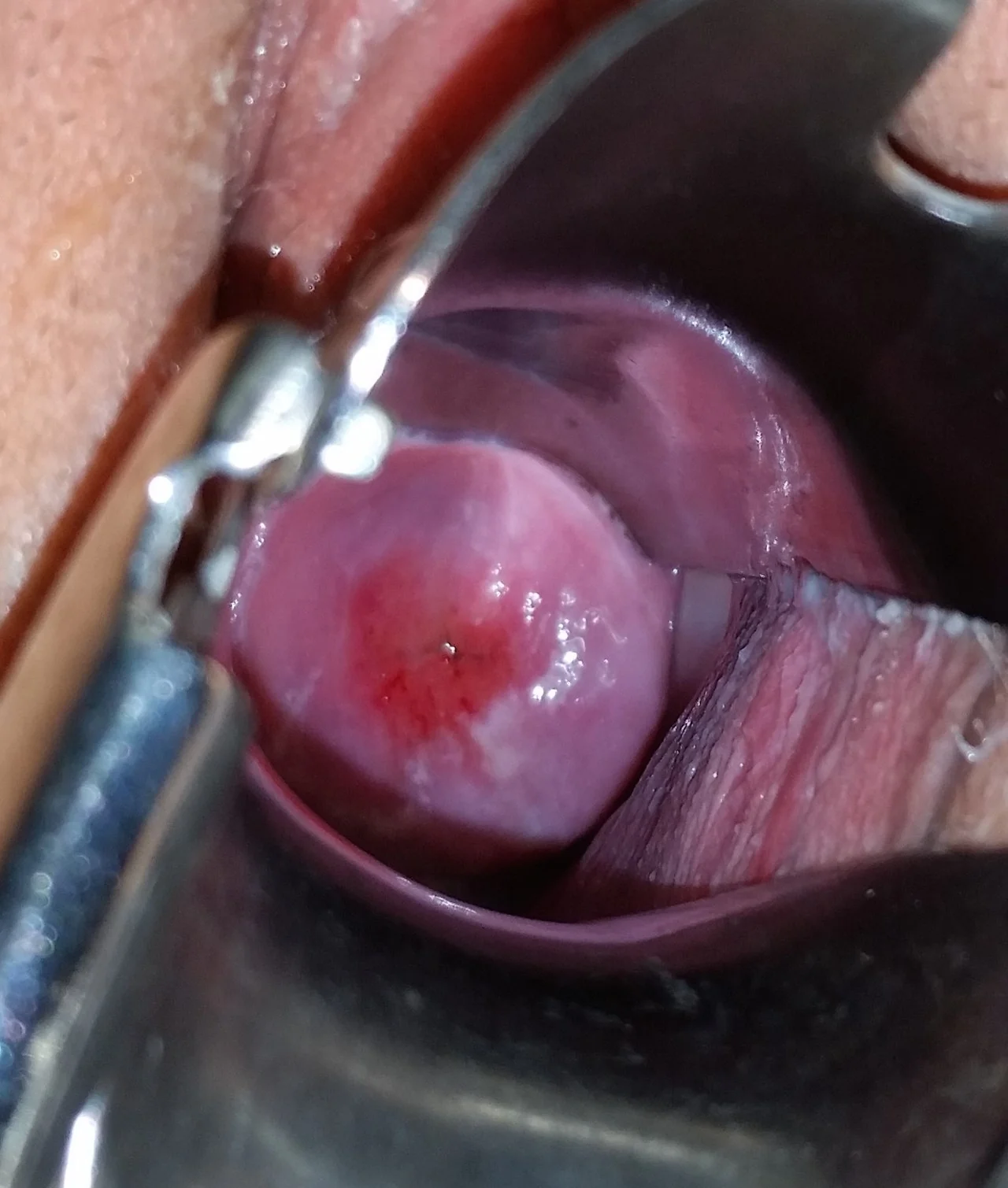
- Appearance: a red, velvety ring around the external os, contrasting with the paler, smoother squamous epithelium - easily mistaken for pathology on a naive look.
- Presentation: often asymptomatic and found incidentally; can cause increased mucoid discharge and postcoital or intermenstrual spotting because columnar epithelium is thinner and more vascular.
- Key principle: postcoital bleeding is never assumed to be 'just ectropion' until cervical cancer and infection have been considered and excluded, especially with an abnormal-looking cervix or risk factors.
- Management: no treatment needed if asymptomatic; for troublesome discharge/bleeding, stopping oestrogen-containing contraception or cervical cautery/ablation are options.
- Cervical screening: an ectropion does not affect eligibility for or interpretation of routine cervical screening.
- Transformation zone: as an ectropion regresses, the exposed columnar epithelium undergoes squamous metaplasia - and this transformation zone is where almost all cervical intraepithelial neoplasia and cervical cancer arise.
Introduction
Cervical ectropion (also called cervical erosion or ectopy) is the eversion of the endocervical columnar epithelium onto the surface of the ectocervix, so that it extends beyond the normal squamocolumnar junction and becomes visible on speculum examination.1 It is a normal physiological variant rather than a disease process, and understanding this distinction is the single most important thing to take from this topic.
The cervix is normally covered by two types of epithelium meeting at the squamocolumnar junction: smooth, pale pink squamous epithelium on the ectocervix (the part visible on speculum examination), and red, glandular columnar epithelium lining the endocervical canal. In an ectropion, hormonal changes cause the squamocolumnar junction to move outward, exposing the more delicate columnar epithelium on the ectocervix where it is visible and vulnerable to contact bleeding.
Aetiology
Ectropion is driven by oestrogen, which causes the cervix to enlarge and the squamocolumnar junction to evert outward.1 It is therefore common and physiological in situations of high oestrogen exposure:
- Adolescence and the reproductive years, particularly soon after menarche
- Pregnancy
- Combined hormonal contraceptive use (the pill, patch or ring)
- Less commonly, exogenous oestrogen exposure from other sources
As oestrogen levels fall - after pregnancy, on stopping combined hormonal contraception, or after the menopause - the columnar epithelium typically undergoes squamous metaplasia, transforming into more resilient squamous epithelium and the ectropion regresses. This transformation zone, where columnar epithelium is gradually replaced by metaplastic squamous epithelium, is clinically important because it is where the great majority of cervical intraepithelial neoplasia and cervical cancers arise (see the cervical cancer article).
Clinical features
Ectropion is very often asymptomatic and found incidentally during a speculum examination or cervical screening test.2 When symptomatic, features reflect the fact that columnar epithelium is thinner, more vascular, and produces more mucus than squamous epithelium:
- Increased vaginal discharge, typically clear or mucoid
- Postcoital bleeding (spotting after intercourse, from contact trauma to the fragile columnar epithelium)
- Intermenstrual spotting, particularly light bleeding
- Usually painless and without associated systemic symptoms
On speculum examination, an ectropion appears as a well-defined, red, velvety ring of tissue around the external os, contrasting sharply with the smoother, paler pink squamous epithelium of the rest of the ectocervix. This appearance can look alarming to an inexperienced examiner, but the well-demarcated, symmetrical, uniform appearance is reassuring and typical of a benign ectropion rather than malignancy.
Differential diagnosis and red flags
Because ectropion, cervicitis and early cervical cancer can all cause a red-appearing cervix and postcoital bleeding, they must be carefully distinguished, and ectropion should always be treated as a diagnosis of exclusion in the presence of any red flag feature.3
| Feature | Ectropion | Concerning for cervicitis/malignancy |
|---|---|---|
| Appearance | Well-demarcated, symmetrical, uniform red ring around the os | Irregular, friable, ulcerated, or a visible mass/growth |
| Bleeding pattern | Light postcoital or intermenstrual spotting | Heavy, persistent, or associated with pelvic pain |
| Discharge | Clear/mucoid | Purulent, offensive discharge (suggests infection) |
| Risk factors | Young, oestrogen-exposed (pregnancy, COCP) | Older age, smoking, immunosuppression, abnormal screening history |
| Screening history | Not relevant to diagnosis | Overdue or previously abnormal cervical screening raises concern |
Investigations
A classic-appearing ectropion in a woman with an up-to-date, normal cervical screening history and no red flag features needs no further investigation beyond the clinical examination itself.2 If there is any diagnostic uncertainty, or symptoms warrant it:
- Ensure cervical screening (HPV/cytology) is up to date - perform opportunistically if due
- Endocervical and high vaginal swabs if infection (chlamydia, gonorrhoea, bacterial vaginosis) is suspected as a cause of discharge or bleeding
- Colposcopy and biopsy if the cervix has an atypical or suspicious appearance, or bleeding persists despite treatment of an identified benign cause
Management
No treatment is needed for an asymptomatic ectropion - this is a normal finding, and the priority is reassurance rather than intervention.1
For women with troublesome symptoms (persistent discharge or recurrent postcoital bleeding) once other causes have been excluded, options include:
- Stopping combined hormonal contraception (switching to a non-oestrogen-containing method), which allows the ectropion to regress as oestrogen exposure falls
- Cervical cautery or ablation (e.g. cryotherapy, electrocautery, or silver nitrate application) to destroy the columnar epithelium and encourage re-epithelialisation with squamous epithelium, reserved for persistent symptomatic cases
Prognosis
Cervical ectropion is entirely benign and typically regresses spontaneously as oestrogen exposure falls - after pregnancy, on stopping combined hormonal contraception, or with the menopause. It does not increase the risk of cervical cancer, does not require treatment in the absence of bothersome symptoms, and has no effect on fertility. Ongoing routine cervical screening according to the national programme remains the relevant preventive measure, entirely independent of whether an ectropion is present.
References
- NICE Clinical Knowledge Summaries (CKS). Cervical ectropion. Available here
- Royal College of Obstetricians and Gynaecologists. Cervical ectropion - patient information. Available here
- NICE NG12. Suspected cancer: recognition and referral - cervical cancer. 2021. Available here
This article is written for revision and education. It is not clinical guidance and must not be used to make decisions about the care of a patient. Always check current NICE guidance and local protocols.