
Hereditary Cancer Syndromes
Key points
- Scale: around 5-10% of cancers arise from a high-penetrance inherited predisposition, and most are autosomal dominant tumour suppressor syndromes.
- Two-hit hypothesis: a germline variant inactivates one allele in every cell; a somatic second hit knocks out the remaining copy, so cancer occurs earlier and more often.
- Red flags: young age at diagnosis, multiple primaries, bilateral disease in paired organs, rare tumour types, and several affected relatives on the same side of the family.
- BRCA1/BRCA2: hereditary breast and ovarian cancer; BRCA1 on chromosome 17 with triple-negative tumours, BRCA2 on chromosome 13 with male breast, prostate and pancreatic risk.
- Lynch syndrome: mismatch repair defects (MLH1, MSH2, MSH6, PMS2) causing right-sided colorectal and endometrial cancer; all new colorectal cancers in the UK are tested for it.
- Familial adenomatous polyposis: APC on chromosome 5; hundreds to thousands of adenomas from adolescence and effectively 100% cancer risk by age 40 without prophylactic colectomy.
- Testing pathway: test an affected family member first where possible, then offer targeted cascade testing to relatives once the familial variant is known.
- Management: enhanced surveillance, risk-reducing surgery, and chemoprevention - aspirin in Lynch syndrome has randomised evidence of benefit.
Introduction
Cancer is a genetic disease at the cellular level - it always arises from accumulated DNA damage - but only a minority of cancers are inherited. Around 5-10% of cancers occur in people carrying a high-penetrance germline variant that they inherited and can pass on, and identifying those families is one of the highest-value activities in clinical genetics.1
The value lies in what follows the diagnosis. A person identified as carrying a pathogenic BRCA1 or Lynch syndrome variant can be offered enhanced surveillance that detects cancer early, risk-reducing surgery that prevents it outright, or chemoprevention that lowers the risk substantially. Their relatives can then be cascade tested, and those who test negative discharged from a lifetime of anxiety and unnecessary screening.
This article covers how to recognise a family that warrants referral, the mechanism common to most of these syndromes, the three that dominate UK practice and examinations, and the principles of testing and risk management. The individual cancers themselves are covered in their own articles.
Mechanism: tumour suppressors and the two-hit hypothesis
Most hereditary cancer syndromes are caused by germline loss-of-function variants in tumour suppressor genes - genes whose normal job is to restrain cell division, repair DNA damage, or trigger apoptosis in damaged cells. Knudson's two-hit hypothesis, derived originally from studying retinoblastoma, explains why these behave as they do.
- A tumour suppressor needs both alleles inactivated before its function is lost in a cell, so at cellular level the mechanism is recessive
- Someone with a germline variant is born with one allele already inactivated in every cell of the body - the first hit is inherited and universal
- Only one further somatic event is then needed in any single cell to lose the remaining copy, which is statistically far more likely than two independent hits in the same cell
- The result is inheritance that looks autosomal dominant at the level of the family - a 50% transmission risk and cancers in successive generations - despite being recessive at the level of the cell
- Because the first hit is present from conception, cancers occur earlier, more often, and more frequently bilaterally or as multiple primaries than in the sporadic form of the same tumour
A smaller group of syndromes involve oncogenes - genes that actively drive proliferation when overactive. Here a single gain-of-function variant is sufficient without a second hit, as in the RET variants causing multiple endocrine neoplasia type 2, which is why prophylactic thyroidectomy in those families can be recommended in early childhood.
Recognising a hereditary cancer family
Most cancer is sporadic, and most family histories of cancer reflect nothing more than how common cancer is. The task is to identify the minority of pedigrees that suggest a single-gene cause, and the features below are what distinguish them.
Conversely, several features point away from a hereditary cause and are worth stating explicitly when reassuring a worried patient: cancers occurring at typical ages, in relatives on both sides of the family, of unrelated types, in a family with heavy shared environmental exposures such as smoking, and with no bilateral or multiple primary disease.
The major syndromes
| Syndrome | Gene(s) | Principal cancers |
|---|---|---|
| Hereditary breast and ovarian cancer | BRCA1 (chr 17), BRCA2 (chr 13) | Breast, ovarian; also prostate, pancreatic and male breast with BRCA2 |
| Lynch syndrome (HNPCC) | MLH1, MSH2, MSH6, PMS2 (mismatch repair) | Colorectal (right-sided), endometrial, ovarian, gastric, urothelial, small bowel |
| Familial adenomatous polyposis | APC (chr 5) | Colorectal, duodenal/ampullary, desmoid tumours, thyroid |
| Li-Fraumeni syndrome | TP53 | Sarcoma, breast, brain, adrenocortical carcinoma, leukaemia - often in childhood |
| Multiple endocrine neoplasia 1 | MEN1 | Parathyroid, pancreatic islet cell, pituitary |
| Multiple endocrine neoplasia 2 | RET | Medullary thyroid carcinoma, phaeochromocytoma, parathyroid |
| Von Hippel-Lindau | VHL | Clear cell renal carcinoma, phaeochromocytoma, haemangioblastoma |
| Peutz-Jeghers syndrome | STK11 | Gastrointestinal, breast, pancreatic; with mucocutaneous pigmentation and hamartomatous polyps |
| Cowden syndrome | PTEN | Breast, thyroid, endometrial; with macrocephaly and skin trichilemmomas |
| Retinoblastoma | RB1 | Retinoblastoma (often bilateral), later osteosarcoma |
Hereditary breast and ovarian cancer
BRCA1 and BRCA2 encode proteins essential for homologous recombination repair of double-strand DNA breaks. Losing that repair pathway allows genomic instability to accumulate, and it also creates a therapeutic vulnerability exploited by PARP inhibitors.
- BRCA1 (chromosome 17) - lifetime breast cancer risk around 60-70% and ovarian cancer risk around 40%; tumours are more often triple negative and high grade
- BRCA2 (chromosome 13) - similar breast cancer risk, lower ovarian risk, and an increased risk of male breast cancer, prostate cancer and pancreatic cancer
- Autosomal dominant inheritance with incomplete penetrance - a substantial minority of carriers never develop cancer, which is essential to convey honestly in counselling
- Founder variants occur at high frequency in the Ashkenazi Jewish population, which lowers the threshold for testing in that group
- PARP inhibitors (olaparib, niraparib) exploit synthetic lethality: a cell already lacking homologous recombination cannot tolerate loss of the alternative PARP-mediated repair pathway, so the drug kills tumour cells while sparing normal ones
Risk management
- Enhanced breast surveillance - annual MRI from age 30 (earlier than mammography, which is less sensitive in dense young breast tissue), with mammography added from 406
- Risk-reducing bilateral mastectomy - reduces breast cancer risk by around 90-95%, and is a personal decision requiring careful, unhurried counselling and reconstruction discussion
- Risk-reducing bilateral salpingo-oophorectomy - typically offered from age 35-40 in BRCA1 and slightly later in BRCA2, once childbearing is complete; there is no effective ovarian cancer screening, which is why surgery carries such weight here
- Chemoprevention - tamoxifen or anastrozole may be discussed for breast risk reduction depending on age and menopausal status
- Consider surgical menopause consequences - oophorectomy before natural menopause needs discussion of HRT, bone health and cardiovascular risk
Lynch syndrome
Lynch syndrome, previously called hereditary non-polyposis colorectal cancer (HNPCC), results from germline variants in the DNA mismatch repair genes MLH1, MSH2, MSH6 and PMS2. Failure of mismatch repair leaves errors in repetitive DNA sequences uncorrected, producing microsatellite instability - the molecular signature used to detect it.2
- Colorectal cancer - lifetime risk around 50-80% if untreated, characteristically right-sided (proximal), arising from few polyps but progressing rapidly through the adenoma-carcinoma sequence
- Endometrial cancer - the second commonest, and in women may be the first cancer to present, so a young woman with endometrial cancer warrants Lynch testing
- Other cancers - ovarian, gastric, small bowel, urothelial, hepatobiliary and brain
- The rapid polyp-to-cancer progression is why surveillance is by colonoscopy every 1-2 years rather than by faecal testing, and why the interval is much shorter than in population screening
Identification
The Amsterdam criteria were the historical clinical rule, but universal tumour testing has largely superseded them. All new colorectal cancers in the UK are now tested for mismatch repair deficiency, using immunohistochemistry for loss of the four MMR proteins or PCR for microsatellite instability, with germline testing following an abnormal tumour result. NICE recommends the same universal approach for endometrial cancer.3
Management
- Colonoscopic surveillance every 1-2 years, starting in the twenties, with the exact age and interval determined by which gene is involved
- Aspirin chemoprevention - the CAPP2 randomised trial showed a substantial reduction in colorectal cancer incidence with regular aspirin, and NICE now recommends offering it to people with Lynch syndrome4
- Risk-reducing hysterectomy and bilateral salpingo-oophorectomy - discussed with women once childbearing is complete, given the high endometrial risk and absence of good surveillance
- Consideration of extended colonic resection if colorectal cancer develops, since the remaining colon retains a high risk of metachronous cancer
- Immunotherapy - MMR-deficient tumours have a high mutational burden and respond well to checkpoint inhibitors, an important therapeutic consequence of the underlying genetics
Familial adenomatous polyposis
FAP is caused by germline variants in the APC tumour suppressor gene on chromosome 5, a key regulator of the Wnt signalling pathway. Its natural history is the most predictable of any hereditary cancer syndrome, and consequently its management is the most decisive.
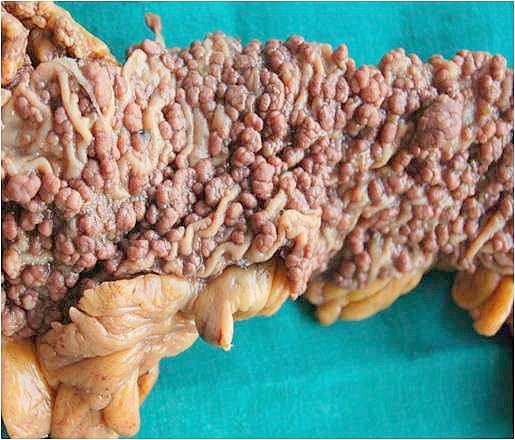
- Hundreds to thousands of colorectal adenomas developing from adolescence onwards
- Colorectal cancer risk approaching 100% by age 40 if the colon is left in place - the polyp burden makes endoscopic clearance impossible
- Prophylactic colectomy is therefore the mainstay, typically in the late teens or early twenties, with the timing individualised to polyp burden; the choice between total colectomy with ileorectal anastomosis and proctocolectomy with ileal pouch depends on rectal polyp density
- Extracolonic disease persists after colectomy - duodenal and ampullary adenomas require ongoing upper gastrointestinal surveillance, and desmoid tumours are a major cause of morbidity and death in operated patients
- Congenital hypertrophy of the retinal pigment epithelium (CHRPE) is a benign but useful clinical marker in some families
- Gardner syndrome (with osteomas, epidermoid cysts and dental abnormalities) and Turcot syndrome (with brain tumours) are phenotypic variants of the same APC pathology
- Attenuated FAP produces fewer polyps with later onset and may be managed with intensive surveillance rather than early colectomy
- MUTYH-associated polyposis is an important autosomal recessive mimic - a polyposis phenotype without the vertical family history, so absence of affected parents does not exclude a genetic cause
Testing and referral
Eligibility for germline testing in the NHS is set out in the National Genomic Test Directory, which specifies the clinical criteria and the appropriate test for each indication. Many pathways are now mainstreamed - oncologists, breast surgeons and gastroenterologists arrange testing directly, referring to clinical genetics for complex counselling, unusual phenotypes and family cascade work.5
- Draw a three-generation pedigree, recording each cancer, the age at diagnosis, and which side of the family it lies on - unverified family reports should ideally be confirmed against records or registries where a major decision rests on them
- Test an affected relative first wherever possible. Testing an unaffected person without a known familial variant is far less informative, because a negative result cannot distinguish 'no familial variant exists' from 'the variant exists but this person did not inherit it'
- Where the affected relative is deceased or unavailable, testing an unaffected relative may still be offered, with careful explanation of this limitation
- Once a pathogenic variant is identified, offer targeted cascade testing to at-risk relatives - a fast, cheap, definitive single-variant test
- Interpret a variant of uncertain significance (VUS) cautiously - it must not be used to justify risk-reducing surgery or to test relatives, and management continues to be based on the family history alone until it is reclassified
Ethical and practical issues
- Testing children is deferred for adult-onset syndromes such as BRCA, but offered where it changes childhood management, as in FAP, MEN2 and retinoblastoma
- Confidentiality within families - a result is informative about untested relatives, and patients are supported to share it themselves rather than the team disclosing it; breaching confidentiality is exceptional and requires senior and legal advice
- Insurance - under the UK Code on Genetic Testing and Insurance, insurers must not ask about predictive genetic test results, with a narrow Huntington's disease exception; this is a common and easily answered patient concern
- Reproductive options - prenatal diagnosis and pre-implantation genetic testing are available for some cancer predisposition syndromes, and are ethically contested precisely because carriers may never develop cancer
- Psychological impact - anxiety, survivor guilt in relatives who test negative, and difficult decisions about irreversible risk-reducing surgery all warrant formal psychological support rather than a single counselling appointment
Prognosis
Carrying a cancer predisposition variant is not a diagnosis of cancer. Penetrance is incomplete in most syndromes, so a meaningful proportion of carriers never develop the disease, and this should be stated plainly in counselling rather than left implicit - patients frequently hear 'BRCA positive' as 'I will get cancer'.
For those who do develop cancer, outcomes are broadly comparable to sporadic disease of the same stage, and in some settings better: cancers found through surveillance are detected earlier, and the underlying molecular defect can be therapeutically exploited, as with PARP inhibitors in BRCA-associated disease and checkpoint inhibitors in mismatch repair-deficient tumours. The clearest prognostic gains, though, come from prevention - prophylactic colectomy in FAP and risk-reducing salpingo-oophorectomy in BRCA carriers avert cancers that would otherwise be very likely to occur, which is why identifying these families at all is the intervention that matters most.
References
- Rahman N. Realizing the promise of cancer predisposition genes. Nature. 2014. Available here
- Idos G, Valle L. Lynch Syndrome. GeneReviews, NCBI Bookshelf. Available here
- NICE DG27 and DG42. Molecular testing strategies for Lynch syndrome in people with colorectal and endometrial cancer. Available here
- Burn J, Sheth H, Elliott F et al. Cancer prevention with aspirin in hereditary colorectal cancer (Lynch syndrome), 10-year follow-up of the CAPP2 randomised trial. The Lancet. 2020. Available here
- NHS England Genomic Medicine Service. National Genomic Test Directory. Available here
- NICE CG164. Familial breast cancer: classification, care and managing breast cancer and related risks in people with a family history of breast cancer. 2013, updated 2019. Available here
This article is written for revision and education. It is not clinical guidance and must not be used to make decisions about the care of a patient. Always check current NICE guidance and local protocols.