
Attention Deficit Hyperactivity Disorder
Key points
- ADHD: a neurodevelopmental disorder with a persistent pattern of inattention and/or hyperactivity-impulsivity that directly interferes with functioning or development.
- Onset and pervasiveness: symptoms must be present before age 12 and evident in at least two settings - typically home and school - since context-specific difficulty suggests another cause.
- Three presentations: predominantly inattentive, predominantly hyperactive-impulsive, and combined - the inattentive type is under-diagnosed, particularly in girls.
- It persists into adulthood: in roughly two-thirds of cases, though hyperactivity often shifts to inner restlessness while inattention and disorganisation remain.
- First-line in children under 5: ADHD-focused parent training - medication is not offered without specialist advice.
- First-line medication: methylphenidate in children and young people; lisdexamfetamine or methylphenidate in adults, after environmental modification has been tried.
- Monitoring: height and weight (stimulants suppress appetite and can blunt growth), plus blood pressure and heart rate at every dose change and every 6 months.
- Untreated ADHD carries real harm: educational underachievement, accidents, substance misuse, criminality and unemployment - and stimulant treatment reduces, not increases, later substance use risk.
Introduction
Attention deficit hyperactivity disorder (ADHD) is a neurodevelopmental disorder characterised by a persistent pattern of inattention and/or hyperactivity-impulsivity that is inconsistent with the person's developmental level and directly interferes with functioning, education, work or relationships.1
It affects around 5% of children and 2-3% of adults worldwide, and is one of the commonest reasons for referral to child and adolescent mental health services. Historically it was framed as a childhood condition that people grew out of; the current understanding is that it persists into adulthood in around two-thirds of cases, though the presentation changes - overt hyperactivity typically diminishes and is replaced by an internal sense of restlessness, while inattention, disorganisation and emotional dysregulation frequently persist and can be more disabling in adult life than they were in childhood.
It is a genuinely contested area in public discourse, with concerns about both over-diagnosis and under-diagnosis. The evidence supports both being true simultaneously in different groups: boys with disruptive hyperactivity are identified readily, while girls and adults with predominantly inattentive presentations are frequently missed for years, often being labelled as lazy, disorganised or anxious instead.
Aetiology
ADHD is a highly heritable neurodevelopmental condition involving impaired executive function and dysregulated catecholamine signalling in frontostriatal circuits.
- Genetics - heritability is around 70-80%, among the highest of any psychiatric disorder, and is polygenic rather than attributable to any single gene
- Catecholamine dysregulation - reduced dopaminergic and noradrenergic signalling in the prefrontal cortex and striatum. Stimulants work by increasing synaptic dopamine and noradrenaline in these circuits, which is why a drug that stimulates the CNS improves rather than worsens concentration.
- Executive dysfunction - impairment of working memory, response inhibition, planning, sustained attention and self-monitoring, which explains why difficulty is greatest for tasks that are effortful, delayed in reward, or self-directed
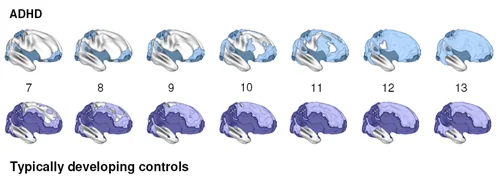
- Delayed cortical maturation - imaging shows a delay of around 2-3 years in the maturation of prefrontal cortical thickness, alongside structural and functional differences in the striatum and cerebellum
- Reward and delay aversion - a steeper discounting of delayed rewards, so distant consequences exert far less behavioural influence than immediate ones, which explains why deadlines work only once they are imminent
- Environmental contributors - prematurity and low birth weight, prenatal alcohol, nicotine and substance exposure, and lead exposure. Severe early deprivation is associated with an ADHD-like presentation.
- Not caused by - parenting quality, sugar, screen time or food additives. These may modify presentation or coexist, but the evidence does not support them as causes, and telling parents otherwise causes real harm.
Risk factors
- Family history of ADHD - a first-degree relative confers substantially increased risk
- Male sex at presentation, though this partly reflects diagnostic bias rather than true prevalence difference
- Prematurity and low birth weight
- Prenatal exposure to alcohol, nicotine or substances
- Perinatal hypoxia or brain injury
- Epilepsy and other neurodevelopmental conditions
- Severe early deprivation or institutional care
- Comorbid autism spectrum disorder, learning disability, tic disorders or specific learning difficulties such as dyslexia
Clinical features
Symptoms fall into two domains. A diagnosis requires a sufficient number of symptoms from one or both domains, present before age 12, evident in at least two settings, and causing clear functional impairment.
Inattention
- Fails to give close attention to detail; careless mistakes in schoolwork or at work
- Difficulty sustaining attention in tasks or play, particularly where the task is not intrinsically engaging
- Does not seem to listen when spoken to directly
- Does not follow through on instructions and fails to finish tasks, despite intending to
- Difficulty organising tasks and activities; poor time management and chronic lateness
- Avoids or dislikes tasks requiring sustained mental effort
- Loses things necessary for tasks - keys, phone, paperwork, homework
- Easily distracted by extraneous stimuli, and in adults by unrelated thoughts
- Forgetful in daily activities
Hyperactivity and impulsivity
- Fidgets, taps hands or feet, squirms in seat
- Leaves seat when remaining seated is expected
- Runs or climbs inappropriately; in adults this manifests as an internal sense of restlessness rather than overt movement
- Unable to play or work quietly
- 'On the go', acting as if driven by a motor
- Talks excessively
- Blurts out answers before questions are completed
- Difficulty waiting their turn
- Interrupts or intrudes on others' conversations or activities
| Age group | Typical presentation |
|---|---|
| Preschool | Marked overactivity, difficulty with turn-taking, accidents and injuries, exclusion from nursery |
| School age | Classroom disruption, incomplete work, underachievement relative to ability, peer difficulties, disciplinary problems |
| Adolescence | Overt hyperactivity declines; disorganisation, poor exam performance, risk-taking, substance experimentation, driving offences |
| Adulthood | Inner restlessness, chronic disorganisation and lateness, procrastination, job instability, relationship difficulty, emotional dysregulation, financial chaos |
Differential diagnosis and comorbidity
Comorbidity is the rule rather than the exception - the majority of people with ADHD have at least one coexisting condition, and treating ADHD alone frequently leaves substantial impairment unaddressed.
- Autism spectrum disorder - frequently coexists; both can be diagnosed together, and inattention in ASD may relate to differing interests and sensory load rather than an attentional deficit
- Anxiety disorders - restlessness and poor concentration are shared features; anxiety-driven inattention typically has a later onset and fluctuates with anxiety levels
- Depression - poor concentration is a core symptom, but is episodic rather than lifelong
- Bipolar disorder - distractibility and overactivity occur in mania, but episodically and with elevated mood, whereas ADHD is stable and lifelong
- Learning difficulties and specific learning disorders - dyslexia and dyscalculia cause task avoidance that resembles inattention; formal educational assessment differentiates them
- Hearing or visual impairment - a simple and important exclusion in a child who 'does not listen'
- Sleep disorders - obstructive sleep apnoea in children can produce hyperactivity and inattention that resolve fully with treatment
- Attachment difficulties, trauma and safeguarding concerns - can closely mimic ADHD and require careful, separate assessment
- Thyroid dysfunction and iron deficiency - reasonable to consider where clinically indicated
- Substance misuse - both a differential and a common comorbidity in adolescents and adults
Assessment and investigations
ADHD is a clinical diagnosis made by a specialist - a psychiatrist, paediatrician or appropriately trained specialist practitioner - and requires a full assessment, not a questionnaire score alone.2
- Full developmental and psychiatric history, establishing that symptoms were present before age 12 and have been persistent rather than episodic
- Collateral information from school or workplace - a teacher report is essential in children, and school reports from earlier years are invaluable in adult assessment
- Observation of the child in more than one setting where feasible
- Rating scales - Conners, SNAP-IV or the Strengths and Difficulties Questionnaire in children; DIVA or the Adult ADHD Self-Report Scale (ASRS) in adults. These support but never replace clinical assessment.
- Physical examination - including height, weight, blood pressure and pulse as a baseline before any medication, plus a cardiovascular history and family history of sudden cardiac death
- Consider hearing and vision testing, and sleep assessment, particularly in children
- No routine bloods, imaging or EEG are required unless a specific alternative diagnosis is suspected - a common exam distractor
Management
NICE recommends a stepped approach beginning with environmental modification and education, with medication reserved for persisting significant impairment.2
Non-pharmacological
- Environmental modification first, for everyone - seating near the front of the class, breaking tasks into short chunks, written instructions, structured routines, reduced distraction, and additional time in examinations
- ADHD-focused parent training programmes - first-line and offered before medication in children under 5, and offered to parents of school-age children alongside other treatment
- Education about the condition for the child, family and school - reframing the difficulties as neurodevelopmental rather than wilful is itself therapeutic
- Support at school - liaison with the SENCO, an education, health and care (EHC) plan assessment where impairment is significant
- CBT in adults - targeting organisational skills, procrastination and the emotional consequences of years of underachievement
- Workplace adjustments in adults under the Equality Act 2010, since ADHD may constitute a disability
Medication
Medication is offered to children aged 5 and over, young people, and adults whose symptoms cause persistent significant impairment after environmental modifications have been tried.
| Drug | Class | Notes |
|---|---|---|
| Methylphenidate | Stimulant - dopamine and noradrenaline reuptake inhibitor | First-line in children and young people; available as immediate and modified release |
| Lisdexamfetamine | Stimulant prodrug of dexamfetamine | First-line option in adults; also used in children where methylphenidate has failed a 6-week trial |
| Dexamfetamine | Stimulant | Option where lisdexamfetamine is effective but its longer duration is not tolerated |
| Atomoxetine | Non-stimulant - selective noradrenaline reuptake inhibitor | Where stimulants are ineffective, not tolerated or unsuitable; takes several weeks to work; risk of hepatic injury and suicidal ideation |
| Guanfacine | Non-stimulant - alpha-2A agonist | Option in children and young people; causes sedation and hypotension |
Stimulants are controlled drugs and require appropriate prescribing arrangements.4 Shared care between specialist services and primary care is standard once the dose is stable, and treatment should be reviewed at least annually, including a discussion of whether continued medication is still needed.3
Complications
Untreated or poorly managed ADHD carries substantial cumulative harm. Educational underachievement relative to ability is near-universal, with higher rates of exclusion and of leaving education early. Accidental injury is markedly increased in childhood, and road traffic collisions and driving offences are increased in adolescence and adulthood.
Longer term, there are higher rates of substance use disorder, criminal justice involvement, unemployment and job instability, relationship breakdown, and financial difficulty. Comorbid depression and anxiety are common and frequently arise secondarily from years of failure and criticism. Self-esteem is often severely affected, and the risk of self-harm and suicide is elevated, particularly in adolescent girls and in adults diagnosed late.
Red flags
Prognosis
Around two-thirds of children with ADHD continue to experience impairing symptoms into adulthood, though the presentation shifts, with overt hyperactivity typically declining while inattention, disorganisation and emotional dysregulation persist. A meaningful minority experience substantial remission of symptoms by adulthood.
Outcomes are considerably better with early identification and treatment: medication combined with educational and behavioural support improves academic attainment, reduces accidental injury, and reduces the risk of later substance misuse and criminality. Poorer outcomes are associated with untreated comorbidity, particularly conduct disorder, low IQ, family adversity and late diagnosis. Many adults with ADHD function very well when the condition is recognised and appropriate adjustments are made - and a substantial part of the harm associated with ADHD comes not from the symptoms themselves but from the years spent being told they represent laziness or poor character.
References
- World Health Organization. ICD-11 for Mortality and Morbidity Statistics. Attention deficit hyperactivity disorder. 2024. Available here
- NICE NG87. Attention deficit hyperactivity disorder: diagnosis and management. 2018, updated 2019. Available here
- NICE CKS. Attention deficit hyperactivity disorder. Available here
- BNF. Methylphenidate hydrochloride - monitoring requirements. Available here
This article is written for revision and education. It is not clinical guidance and must not be used to make decisions about the care of a patient. Always check current NICE guidance and local protocols.