
Osteoporosis in Older People
Key points
- Osteoporosis: a systemic skeletal disease of low bone mass and microarchitectural deterioration, resulting in increased bone fragility and fracture risk.
- Fracture risk tools: FRAX and QFracture estimate 10-year fracture probability from clinical risk factors, with or without a DEXA T-score, guiding who needs treatment.
- DEXA T-score: diagnostic threshold for osteoporosis is a T-score of -2.5 or below at the hip or spine, but treatment decisions in older people are driven more by overall fracture risk than by the T-score alone.
- Fragility fracture: a fracture from a fall from standing height or less - itself sufficient to warrant fracture risk assessment and, in most cases, treatment, often without needing a DEXA scan first.
- Bisphosphonates: first-line pharmacological treatment - alendronic acid or risedronate orally, or IV zoledronic acid where oral is unsuitable or adherence is a concern.
- Calcium and vitamin D: correct deficiency before or alongside starting a bone-protective drug - bisphosphonates are less effective and hypocalcaemia risk is higher if deficiency is untreated.
- Falls and bone health together: fracture prevention requires both bone-strengthening treatment and falls risk reduction - treating one without the other leaves significant residual risk.
- Duration and drug holidays: oral bisphosphonate treatment is typically reviewed after 5 years (3 years for IV zoledronic acid), with a risk-based decision to continue, stop, or switch.
Introduction
Osteoporosis is a systemic skeletal disease characterised by low bone mass and microarchitectural deterioration of bone tissue, leading to increased bone fragility and susceptibility to fracture. It is common in older people, particularly postmenopausal women, and is clinically important chiefly because of the fractures it causes - hip, vertebral and wrist fractures in particular - which carry substantial morbidity and, for hip fractures especially, significant mortality in older people.1
This topic sits at the intersection of general practice and geriatric medicine because fracture risk assessment and prevention are largely delivered proactively in primary care, while managing an established fragility fracture and its aftermath (orthogeriatric care, rehabilitation, secondary prevention) is a core inpatient geriatric medicine skill - see also 2 for the closely linked topic of falls.
Pathophysiology
Bone is continuously remodelled throughout life by osteoclasts (resorbing bone) and osteoblasts (forming it). Peak bone mass is reached in the late twenties, after which a slow net loss begins. Osteoporosis develops when resorption outpaces formation, thinning and perforating the trabecular struts that give cancellous bone its strength - so the loss is architectural as well as quantitative, which is why fracture risk rises faster than bone density alone would predict.
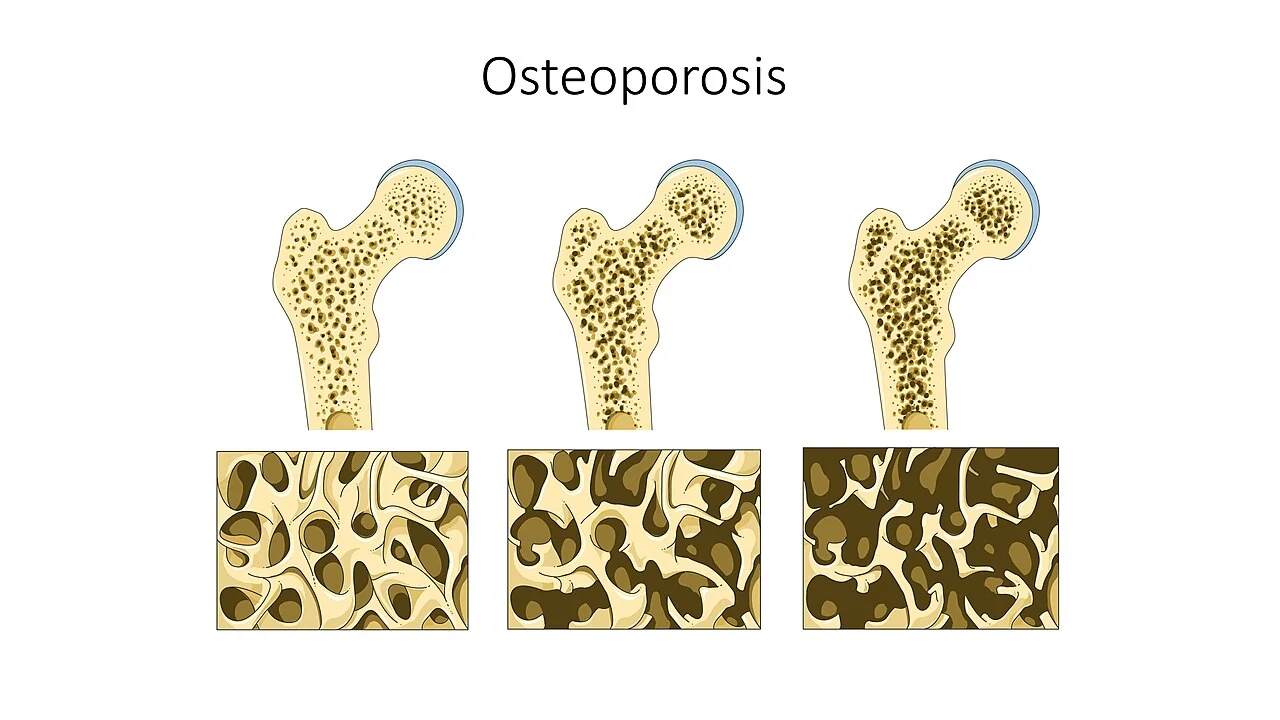
The menopause is the single most important event in this process for women: oestrogen restrains osteoclast activity, so its withdrawal produces a period of accelerated bone loss in the years immediately following the last menstrual period. This explains both the female predominance of osteoporosis and why premature menopause or prolonged amenorrhoea are specific risk factors. In men, the equivalent driver is hypogonadism, and androgen deprivation therapy for prostate cancer is a common iatrogenic cause.
Risk factors
| Category | Examples |
|---|---|
| Non-modifiable | Increasing age, female sex, postmenopausal status, family history of hip fracture, previous fragility fracture, ethnicity (higher risk in White and Asian populations) |
| Lifestyle | Smoking, excess alcohol intake, low body weight/BMI, physical inactivity, poor dietary calcium/vitamin D intake |
| Medical conditions | Rheumatoid arthritis and other inflammatory disease, hyperthyroidism, hyperparathyroidism, chronic kidney disease, malabsorption (e.g. coeliac disease), premature menopause or hypogonadism, chronic liver disease |
| Medication | Long-term oral corticosteroid use (the single most important drug-related risk factor), aromatase inhibitors, androgen deprivation therapy, some anticonvulsants, proton pump inhibitors with long-term use |
Fracture risk assessment
UK practice uses validated risk calculators to estimate 10-year fracture probability, rather than relying on bone density alone, since fracture risk depends on multiple factors beyond bone mineral density.
| Tool | What it estimates | Notes |
|---|---|---|
| FRAX | 10-year probability of major osteoporotic fracture and of hip fracture | Can be calculated with or without a DEXA T-score; widely used to decide who needs a DEXA scan and who needs treatment |
| QFracture | 10-year fracture risk using UK primary care-derived risk factors | Does not require a T-score; incorporates a wider range of clinical risk factors than FRAX |
NICE recommends assessing fracture risk in anyone aged 50 or over with a risk factor for osteoporosis (see above), and in anyone with a fragility fracture regardless of age, using FRAX or QFracture. The result stratifies patients into low, intermediate or high risk, guiding whether a DEXA scan and/or treatment is indicated.3
DEXA scanning
Dual-energy X-ray absorptiometry (DEXA) measures bone mineral density, expressed as a T-score (standard deviations from young adult peak bone mass) at the hip and lumbar spine.
| T-score | Category |
|---|---|
| -1.0 and above | Normal bone density |
| -1.0 to -2.5 | Osteopenia (low bone mass) |
| -2.5 or below | Osteoporosis |
| -2.5 or below, with a fragility fracture | Severe (established) osteoporosis |
Clinical presentation
Osteoporosis itself is asymptomatic - it causes no pain, and there are no physical signs until a fracture occurs. This is precisely why risk assessment and case-finding matter: waiting for a clinical presentation means waiting for a fracture.
| Site | Typical mechanism | Clinical features |
|---|---|---|
| Vertebral | Often no identifiable trauma at all - may occur with bending, lifting or coughing | Frequently asymptomatic and found incidentally on imaging; otherwise acute back pain, progressive height loss and thoracic kyphosis ('dowager's hump') |
| Hip (proximal femur) | Fall from standing height | Pain, inability to weight-bear, shortened and externally rotated leg; the most serious in terms of mortality and loss of independence |
| Wrist (distal radius, Colles') | Fall onto an outstretched hand | Pain, swelling and 'dinner-fork' deformity; often the earliest fragility fracture, typically in younger postmenopausal women |
Vertebral fractures deserve particular attention because most are never clinically diagnosed. Height loss of more than about 4 cm from a patient's recalled young-adult height, or new thoracic kyphosis, should prompt consideration of previously unrecognised vertebral fractures, which independently predict further fracture and warrant treatment even when they were never symptomatic.
Investigations to exclude secondary causes
Before attributing low bone density purely to primary (age/menopause-related) osteoporosis, screen for common secondary causes, particularly in atypical presentations (young age, male sex, unexpectedly severe osteoporosis).
- FBC, ESR/CRP - myeloma and inflammatory disease
- U&Es, LFTs - renal and hepatic disease
- Calcium, phosphate, ALP - primary hyperparathyroidism, osteomalacia, Paget's disease
- TSH - hyperthyroidism
- Vitamin D - deficiency is extremely common and should be corrected regardless of the primary cause
- Coeliac screen (anti-tTG) - malabsorption
- Testosterone in men - hypogonadism
- Serum protein electrophoresis - myeloma, particularly with vertebral fracture or unexplained bone pain
Management
Lifestyle and general measures
- Adequate dietary calcium and vitamin D intake, or supplementation where deficient or intake is inadequate - correct deficiency before or alongside starting a bisphosphonate
- Weight-bearing and resistance exercise, which also addresses sarcopenia and falls risk together (see 4)
- Smoking cessation and reducing excess alcohol intake
- Falls risk assessment and multifactorial intervention, since fracture prevention requires reducing both bone fragility and the likelihood of a fall - see 2
Calcium and vitamin D
Vitamin D deficiency is common in older people, particularly those who are housebound or institutionalised, and should be corrected before or alongside starting bone-protective drug treatment - bisphosphonates are less effective and carry a higher risk of hypocalcaemia if underlying deficiency is not addressed first.
Glucocorticoid-induced osteoporosis
Long-term oral corticosteroid therapy is the commonest drug cause of osteoporosis, and bone loss is fastest in the first 3-6 months of treatment - so bone protection should be considered at the point of starting steroids rather than after a year of exposure. Anyone starting long-term oral corticosteroids should have their fracture risk assessed, and older patients or those with prior fragility fracture generally warrant bone-protective treatment started alongside the steroid rather than waiting for a DEXA result.
Bisphosphonates
Oral bisphosphonates (alendronic acid, risedronate) are first-line, working by inhibiting osteoclast-mediated bone resorption.5
| Drug | Route | Key practical points |
|---|---|---|
| Alendronic acid / risedronate | Oral, weekly | Take on an empty stomach with water, remain upright for 30 minutes; contraindicated in significant oesophageal disease and swallowing difficulty |
| Zoledronic acid | IV, annual infusion | Useful where oral adherence, tolerability or absorption is a concern; monitor renal function and correct calcium/vitamin D deficiency before infusion to avoid hypocalcaemia and an acute-phase reaction |
| Denosumab | Subcutaneous injection, 6-monthly | A RANKL inhibitor, an option where bisphosphonates are unsuitable or not tolerated; stopping abruptly causes rebound vertebral fracture risk, so a planned transition to another agent is needed if discontinued |
| Teriparatide / romosozumab | Specialist, injectable | Anabolic agents for very high-risk or severe osteoporosis, generally initiated by a specialist |
Duration and drug holidays
Oral bisphosphonate treatment is typically reviewed after 5 years (3 years for IV zoledronic acid), with a repeat fracture risk assessment (and often DEXA) informing whether to continue, take a treatment break ('drug holiday'), or switch agent - based on ongoing fracture risk rather than a fixed rule to stop for everyone.
Managing the established fragility fracture
A fragility fracture, particularly hip fracture, is both an acute orthopaedic and geriatric medicine problem. Orthogeriatric care - CGA integrated with fracture management (see 6) - improves outcomes, and every fragility fracture should trigger:
- Prompt surgical fixation where indicated, with early mobilisation
- Fracture risk assessment and bone-protective treatment initiation, if not already in place, as secondary fracture prevention
- Falls risk assessment, since the fracture itself is strong evidence the patient is at high risk of further falls
- Vitamin D and calcium correction
- Consideration of a Fracture Liaison Service referral, where available - a systematic pathway ensuring fragility fracture patients receive risk assessment and treatment, shown to reduce subsequent fracture rates
Red flags
Prognosis
Treatment meaningfully reduces fracture risk - bisphosphonates reduce vertebral fracture risk substantially and hip fracture risk to a lesser but still significant degree in trial evidence. Hip fracture in particular carries significant mortality in the following year, disproportionately in frail older patients, which is why prompt, coordinated orthogeriatric care and secondary fracture prevention after a first fragility fracture are prioritised so heavily - preventing a second fracture matters at least as much as treating the first.
Beyond mortality, the functional consequences of hip fracture are severe: a substantial proportion of previously independent patients never regain their prior level of mobility, and a significant minority who were living at home before the fracture are discharged to long-term care. Vertebral fractures, though rarely fatal, accumulate to produce chronic back pain, height loss, kyphosis with restricted lung expansion, reduced appetite from abdominal compression, and a marked loss of confidence and quality of life.
References
- Royal Osteoporosis Society. Clinical guidance for osteoporosis. Available here
- NICE CG161. Falls in older people: assessing risk and prevention. 2013. Available here
- NICE CG146 / NG96. Osteoporosis: assessing the risk of fragility fracture. Available here
- Cruz-Jentoft AJ, Bahat G, Bauer J et al. Sarcopenia: revised European consensus (EWGSOP2). Age and Ageing. 2019. Available here
- NICE TA464. Bisphosphonates for treating osteoporosis. Available here
- British Orthopaedic Association / British Geriatrics Society. Blue Book on Fragility Fracture Care. Available here
This article is written for revision and education. It is not clinical guidance and must not be used to make decisions about the care of a patient. Always check current NICE guidance and local protocols.