
Urticaria and Angioedema
Key points
- Urticaria: itchy, erythematous or pale, raised wheals caused by mast cell degranulation and histamine-mediated dermal oedema; individual wheals characteristically resolve within 24 hours, though new ones can keep appearing.
- Angioedema: swelling of the deeper dermis, subcutaneous and submucosal tissue, often less itchy and more painful than urticaria, and capable of causing airway compromise when it affects the lips, tongue or larynx.
- Classification: acute (under 6 weeks, often viral, allergic or idiopathic) versus chronic (over 6 weeks, further split into chronic spontaneous and chronic inducible urticaria).
- Chronic spontaneous urticaria: an autoimmune mechanism, driven by autoantibodies against the IgE receptor or IgE itself, is found in a significant proportion of cases.
- Chronic inducible urticaria: wheals triggered by a specific physical stimulus - dermographism, cold, heat, pressure, exercise (cholinergic) or sunlight - reproducible on direct testing.
- First-line management: a non-sedating second-generation antihistamine, which can be increased up to four times the standard licensed dose in chronic urticaria before adding other agents.
- Key distinction: mast cell-mediated angioedema responds to antihistamines and adrenaline; bradykinin-mediated angioedema (hereditary angioedema, ACE inhibitor-induced) does not, and needs a different emergency treatment.
- Red flag: airway-threatening angioedema and anaphylaxis are emergencies; wheals lasting over 24 hours, bruising or resolving with scarring suggest urticarial vasculitis rather than ordinary urticaria.
Introduction
Urticaria - commonly called hives - is one of the commonest skin presentations, affecting around 1 in 5 people at some point in their lives. Most episodes are acute, self-limiting and never fully investigated; a minority become chronic, recurring most days for months or years and having a substantial impact on sleep and quality of life.1
Angioedema is closely related and can occur with urticaria, alone, or as part of anaphylaxis. The two share mast cell degranulation as a common mechanism in most cases, but a separate, bradykinin-mediated form of angioedema exists that looks similar on the surface yet needs an entirely different emergency treatment - a distinction that is frequently tested and genuinely changes management at the bedside.
Pathophysiology
Most urticaria and angioedema is driven by mast cell and basophil degranulation, releasing histamine and other mediators (leukotrienes, prostaglandins, cytokines) that cause vasodilation, increased vascular permeability and sensory nerve stimulation. This produces the classic wheal (a superficial dermal swelling with surrounding erythema) and, when the same process occurs in deeper dermal and subcutaneous tissue, angioedema.
Triggers for degranulation
- IgE-mediated (type I hypersensitivity) - a specific allergen (food, drug, latex, insect venom) cross-links IgE on the mast cell surface
- Direct mast cell activation - some drugs (opioids, NSAIDs, radiocontrast media) and physical stimuli degranulate mast cells without needing IgE
- Autoimmune - autoantibodies against the high-affinity IgE receptor (FcεRI) or against IgE itself are found in a substantial proportion of patients with chronic spontaneous urticaria, explaining why it behaves as a chronic autoimmune disease rather than a persistent allergy5
- Complement-mediated - activation of complement, for example in serum sickness or some autoimmune conditions
The separate bradykinin pathway
Bradykinin-mediated angioedema is mechanistically distinct and does not involve mast cells at all, which is precisely why antihistamines, corticosteroids and adrenaline do not work for it. Bradykinin is a potent vasodilator normally broken down by ACE and other enzymes.
- Hereditary angioedema - caused by a deficiency or dysfunction of C1 esterase inhibitor, which normally restrains bradykinin generation via the kinin-kallikrein pathway
- ACE inhibitor-induced angioedema - ACE inhibitors block the enzyme that degrades bradykinin, allowing it to accumulate; onset can occur at any point during treatment, including years after starting
Classification
Urticaria is classified by duration and, if chronic, by whether a specific trigger can be identified.2
| Category | Definition | Typical cause |
|---|---|---|
| Acute urticaria | Under 6 weeks | Viral infection, food or drug allergy, or no identifiable cause |
| Chronic spontaneous urticaria | Over 6 weeks, no specific trigger identified | Autoimmune mechanism in a significant proportion; often idiopathic |
| Chronic inducible urticaria | Over 6 weeks, reproducibly triggered by a specific physical stimulus | Dermographism, cold, heat, pressure, exercise (cholinergic), sunlight, water (aquagenic) |
Chronic spontaneous and chronic inducible urticaria are not mutually exclusive, and a patient can have features of both. The distinction matters because inducible subtypes can be confirmed with a specific physical challenge test, giving the patient a concrete explanation and a specific avoidance strategy.
Clinical features
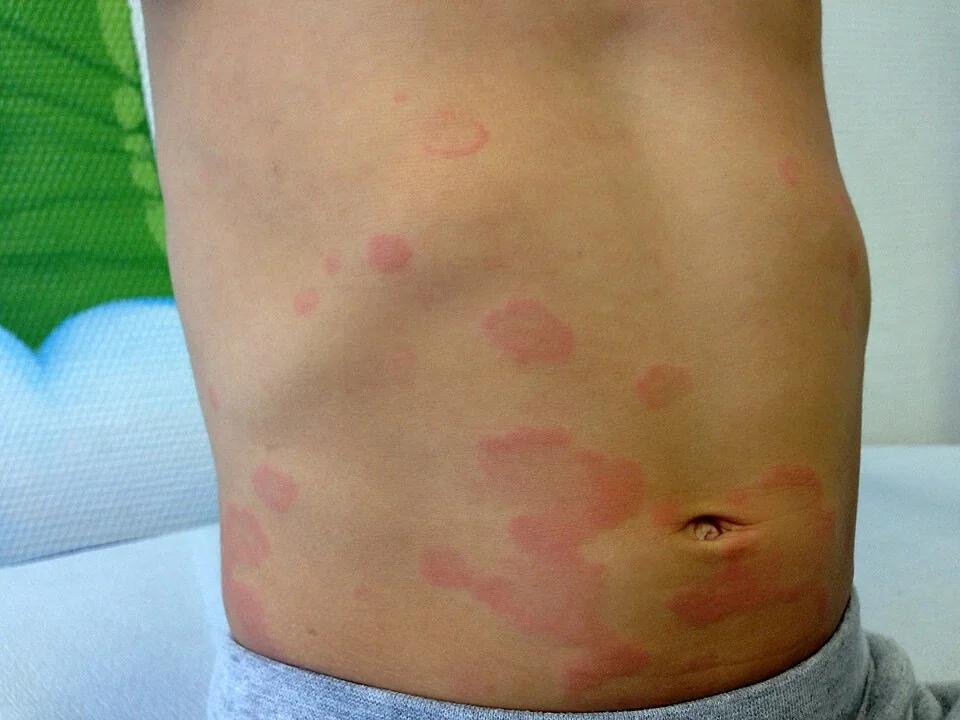
The individual wheal is a raised, erythematous or centrally pale, intensely itchy swelling, typically a few millimetres to several centimetres across, which characteristically fades and resolves within 24 hours without leaving a mark - though the overall episode can continue for much longer as new wheals appear elsewhere. Lesions blanch with pressure and can coalesce into larger plaques.
Angioedema affects the lips, eyelids, tongue, genitals and extremities, producing a diffuse, often asymmetrical swelling that is less itchy but frequently more uncomfortable or painful than urticaria, and can persist for 24-72 hours. Involvement of the tongue, palate or larynx threatens the airway and is discussed further under Red flags.8
Chronic inducible subtypes
- Symptomatic dermographism - wheals appear within minutes along a line of firm stroking or scratching
- Cold urticaria - wheals on rewarming after cold exposure, confirmed with an ice cube test
- Cholinergic urticaria - small, punctate wheals triggered by a rise in core body temperature from exercise, hot showers or emotional stress
- Delayed pressure urticaria - deep, painful swelling several hours after sustained pressure, for example from a bag strap or tight waistband
- Solar urticaria - wheals within minutes of sun exposure on uncovered skin
Assessing chronic disease activity
The Urticaria Activity Score over 7 days (UAS7), a simple diary combining daily wheal count and itch severity, is used to grade chronic spontaneous urticaria and to monitor the response to treatment over time.
Clinical examination
- Wheal morphology and distribution, and whether individual lesions are still present after 24 hours (which would be atypical and should prompt review for vasculitis)
- Dermographism - gently stroke unaffected skin with a tongue depressor and look for a wheal forming within minutes
- Angioedema sites - lips, eyelids, tongue, and airway assessment (voice change, stridor, drooling) if there is any facial or oral swelling
- Systemic features - fever, joint pain or bruising within lesions, which point away from simple urticaria
- Signs of anaphylaxis - wheeze, hypotension, tachycardia, if urticaria is part of a broader systemic allergic reaction
Differential diagnosis
- Urticarial vasculitis - individual lesions persist beyond 24 hours, are often painful or burning rather than itchy, and resolve with bruising or pigmentation rather than clearing completely; needs biopsy if suspected
- Anaphylaxis - urticaria and angioedema accompanied by airway, breathing or circulatory compromise, needing immediate emergency treatment rather than routine urticaria management
- Hereditary or ACE inhibitor-induced angioedema - recurrent angioedema without urticaria or itch, and no response to antihistamines or adrenaline
- Mastocytosis - urticaria pigmentosa lesions that urticate on rubbing (Darier's sign), often with systemic mast cell activation symptoms
- Erythema multiforme - fixed, target-shaped lesions that do not migrate or resolve within 24 hours, often related to herpes simplex or a drug reaction
- Contact urticaria - a localised wheal appearing within minutes of direct skin contact with a specific substance (for example latex or certain foods)
Investigations
Acute urticaria is a clinical diagnosis and rarely needs investigation beyond identifying an obvious trigger from the history. Chronic urticaria warrants a more considered but still limited work-up.
- FBC and CRP/ESR - to screen for an underlying systemic process if chronic urticaria is accompanied by other symptoms
- Thyroid function and thyroid autoantibodies - autoimmune thyroid disease coexists with chronic spontaneous urticaria more often than expected by chance
- Specific physical challenge testing - ice cube test for cold urticaria, exercise or hot bath challenge for cholinergic urticaria, and similar tests tailored to the suspected inducible subtype
- Skin biopsy - if urticarial vasculitis is suspected (lesions lasting over 24 hours, bruising, or systemic symptoms)
- C4 level and C1 esterase inhibitor level/function - if hereditary angioedema is suspected, for example recurrent angioedema without urticaria, a family history, or onset in childhood or adolescence
Management
Acute urticaria
Remove or avoid any identified trigger, and treat with a non-sedating second-generation antihistamine (cetirizine, loratadine or fexofenadine). A short course of oral corticosteroids can be considered for severe, widespread acute urticaria, though routine use is discouraged because of rebound flares on stopping.
Chronic urticaria - stepwise ladder
- Standard-dose non-sedating antihistamine, taken regularly rather than only when symptomatic
- Increase up to four times the standard licensed dose if control is inadequate after 2-4 weeks - an important and frequently tested step, since many clinicians stop at the standard dose unnecessarily3
- Add omalizumab (anti-IgE monoclonal antibody) for chronic spontaneous urticaria uncontrolled on high-dose antihistamines, now well established as an effective and NICE-approved option7
- Ciclosporin - for the minority who remain uncontrolled on omalizumab, used under specialist supervision because of its renal and blood pressure monitoring requirements
Angioedema
- Mast cell-mediated angioedema - treated the same as urticaria (antihistamines, corticosteroids), with adrenaline reserved for angioedema that is part of anaphylaxis with airway or systemic compromise6
- ACE inhibitor-induced angioedema - stop the ACE inhibitor immediately and do not rechallenge; an angiotensin receptor blocker is a reasonable alternative, since the risk of cross-reaction is low but not zero
- Hereditary angioedema - acute attacks are treated with C1 esterase inhibitor concentrate, the bradykinin receptor antagonist icatibant, or a kallikrein inhibitor, not with antihistamines, corticosteroids or adrenaline, which are ineffective; long-term prophylaxis is available for those with frequent attacks4
Complications
- Sleep disturbance and reduced quality of life - chronic urticaria has an impact on daily functioning comparable to other major chronic diseases
- Anaphylaxis - where urticaria and angioedema form part of a broader IgE-mediated systemic reaction
- Airway obstruction - from angioedema affecting the tongue, palate or larynx, which can be rapidly fatal if not recognised and treated promptly
- Psychological impact - anxiety around unpredictable flares, particularly in chronic spontaneous urticaria where no trigger can be identified or reassured against
Red flags
Prognosis
Acute urticaria typically resolves within days to a few weeks, particularly when related to a viral illness or a single identified trigger that is then avoided. Chronic spontaneous urticaria has a more variable course: around half of patients remit within a year, but a substantial minority continue to have symptoms for several years, and a small proportion for a decade or more.2
With the stepwise antihistamine-to-omalizumab ladder, the majority of patients with chronic urticaria achieve good symptom control, even if complete, permanent remission cannot be promised. Hereditary angioedema is a lifelong condition managed with attack treatment and, where attacks are frequent, long-term prophylaxis, and outcomes have improved substantially with modern bradykinin-targeted therapies compared with older plasma-derived treatments alone.
References
- NICE Clinical Knowledge Summaries. Urticaria. Available here
- Zuberbier T, Abdul Latiff AH, Abuzakouk M et al. The international EAACI/GA2LEN/EuroGuiDerm/APAAACI guideline for the definition, classification, diagnosis and management of urticaria. Allergy. 2022. Available here
- BNF. Urticaria - treatment summary. Available here
- Longhurst HJ, Bork K. Hereditary angioedema: an update on causes, manifestations and treatment. British Journal of Hospital Medicine. 2019. Available here
- Kaplan AP, Greaves M. Pathogenesis of chronic urticaria. Clinical and Experimental Allergy. 2009. Available here
- Resuscitation Council UK. Emergency treatment of anaphylactic reactions. Available here
- NICE TA339. Omalizumab for previously treated chronic spontaneous urticaria. 2015. Available here
- Bernstein JA, Cremonesi P, Hoffmann TK, Hollingsworth J. Angioedema in the emergency department: a practical guide to differential diagnosis and management. International Journal of Emergency Medicine. 2017. Available here
This article is written for revision and education. It is not clinical guidance and must not be used to make decisions about the care of a patient. Always check current NICE guidance and local protocols.