
Rosacea
Key points
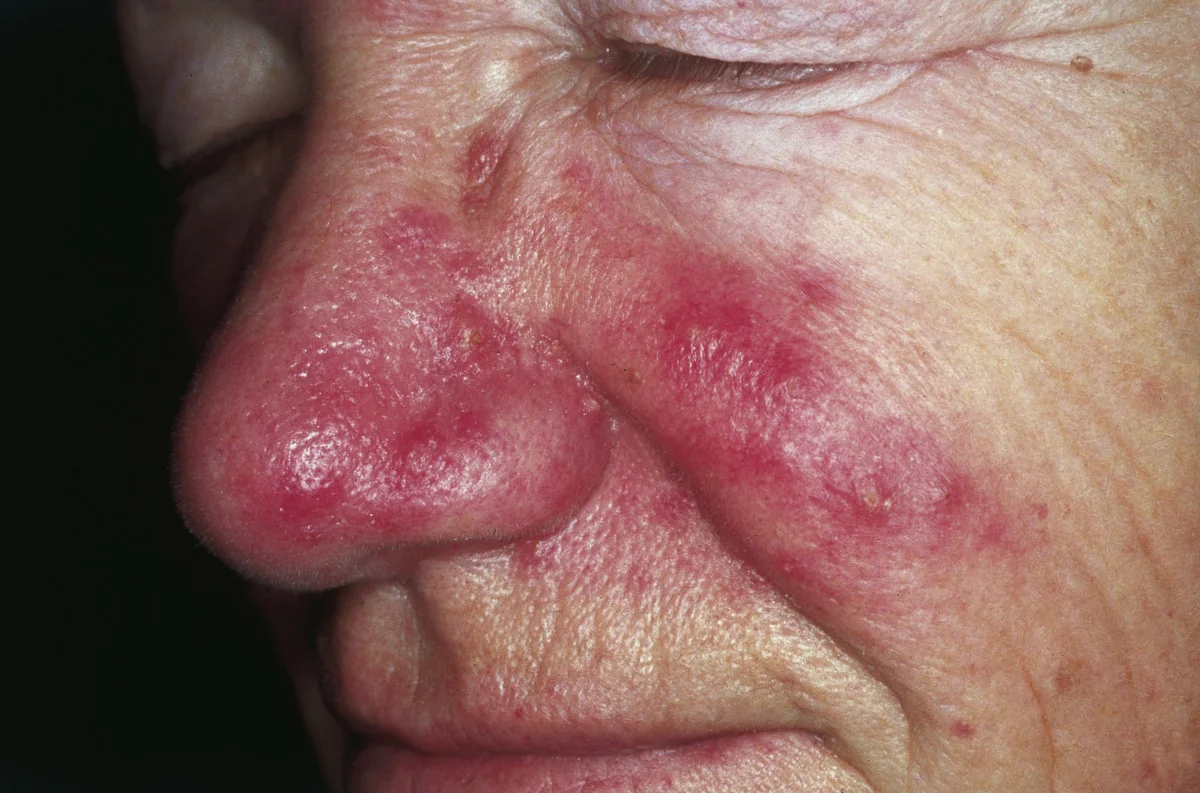
- Rosacea: a chronic inflammatory skin condition of the central face in adults, causing episodic flushing, persistent erythema, telangiectasia and, in some patients, papules and pustules.
- No comedones: the absence of comedones is the key feature distinguishing rosacea from acne vulgaris, despite the overlapping papulopustular appearance.
- Subtypes: erythematotelangiectatic, papulopustular, phymatous and ocular - patients can have features of more than one, and the classification now favours describing the dominant features present rather than forcing a single label.
- Triggers: sun exposure, heat, alcohol, spicy food, hot drinks and stress all provoke flushing through cutaneous vasodilation, and identifying a patient's personal triggers is central to management.
- Mechanism: abnormal innate immune signalling (raised cathelicidin peptides), vascular dysregulation, and colonisation with Demodex mites all contribute, though no single cause explains every case.
- Management: sun protection and trigger avoidance for everyone, then topical metronidazole, azelaic acid or ivermectin for papulopustular disease, oral tetracyclines for more severe or ocular disease, and topical brimonidine or laser for persistent erythema and telangiectasia.
- Ocular rosacea: affects up to half of patients, causing blepharitis, dry eyes and conjunctivitis, and can precede the skin changes entirely.
- Red flag: rosacea keratitis threatens sight and needs urgent ophthalmology assessment; untreated phymatous disease causes progressive, disfiguring soft tissue overgrowth, classically of the nose (rhinophyma).
Introduction
Rosacea is a chronic inflammatory condition affecting the central face, typically presenting in adults over 30 and more often diagnosed in women, though the phymatous subtype is more common and more severe in men. It has a relapsing course, with flares often precipitated by identifiable environmental and lifestyle triggers.1
It is frequently mistaken for acne, sunburn, or simply a 'ruddy complexion', which delays diagnosis and treatment. Because rosacea is chronic and visible, and because flares are often provoked in public or social situations - alcohol, embarrassment, exercise - the psychological impact on confidence and social interaction can be considerable, and is worth asking about directly.2
Pathophysiology
The exact cause of rosacea is not fully understood, but three broad processes are implicated, and most current treatments target one or more of them.
- Vascular dysregulation - an exaggerated flushing response and abnormal dilation of the facial cutaneous vasculature, producing the persistent erythema and telangiectasia
- Innate immune dysregulation - keratinocytes in rosacea-affected skin process the antimicrobial peptide cathelicidin abnormally, generating fragments that are pro-inflammatory and pro-angiogenic, which helps explain both the inflammatory lesions and the vascular changes4
- Demodex folliculorum mites - normally commensal in hair follicles, these are found in much higher density in rosacea-affected skin, and may provoke or amplify the inflammatory response, which is the rationale for topical ivermectin
A neurovascular component is also increasingly recognised: the same trigeminal sensory pathways that mediate flushing to heat, spicy food and emotional stress appear to be dysregulated in rosacea, contributing to the intense, disproportionate flushing many patients describe.
Risk factors and triggers
- Fair skin (Fitzpatrick type I-II) and Celtic or Northern European ancestry
- Family history of rosacea
- Female sex for erythematotelangiectatic and papulopustular subtypes; male sex for phymatous disease, which tends to be more severe
- Sun exposure - a major trigger and driver of chronic vascular damage
- Alcohol, particularly red wine
- Hot drinks and spicy food
- Extremes of temperature, hot baths, and vigorous exercise
- Emotional stress
Clinical features
Rosacea affects the central face - the cheeks, nose, chin and forehead - and typically spares the periocular skin. Four overlapping patterns are described.
| Subtype | Features |
|---|---|
| Erythematotelangiectatic | Persistent centrofacial erythema and visible telangiectasia, with episodic flushing; skin may feel sensitive or burn with topical products |
| Papulopustular | Erythema plus inflammatory papules and pustules, without comedones - the pattern most often confused with acne |
| Phymatous | Thickened skin with irregular surface nodularity from sebaceous gland and connective tissue hyperplasia; classically the nose (rhinophyma), but can affect the chin, forehead, ears or eyelids |
| Ocular | Blepharitis, conjunctival injection, dry or gritty eyes, and recurrent chalazia; can occur with any skin subtype or, in a minority, precede skin signs entirely |
Flushing is often the earliest symptom, preceding fixed erythema by months to years. Patients frequently report a burning or stinging sensation on the face, particularly with sun exposure, heat or topical products, which can make cosmetic and skincare use difficult and adds to the impact on daily life.
Clinical examination
- Distribution - centrofacial, sparing the periocular skin, versus the wider distribution of acne which can involve the chest and back
- Vascular changes - persistent erythema and visible telangiectasia, best seen in good light
- Inflammatory lesions - papules and pustules, and specifically the absence of comedones
- Phymatous change - thickened, irregular skin, most often examined on the nose
- Eyes - lid margin telangiectasia, blepharitis, conjunctival injection, and any corneal changes, which should prompt ophthalmology referral
Differential diagnosis
- Acne vulgaris - comedones are present, and the distribution extends beyond the central face to the chest and back
- Systemic lupus erythematosus (malar rash) - a butterfly-shaped erythema over the cheeks and nasal bridge that classically spares the nasolabial folds, without the telangiectasia, papules or pustules of rosacea, and accompanied by other systemic features
- Seborrhoeic dermatitis - greasy scale affecting the nasolabial folds, eyebrows and scalp, which can coexist with rosacea and confuse the picture
- Perioral dermatitis - grouped papules and pustules around the mouth with a clear rim of sparing at the vermilion border, often related to topical corticosteroid use
- Contact dermatitis or photosensitivity reaction - a clear temporal relationship to a new product or medication, and a distribution matching the exposure
- Carcinoid syndrome - episodic flushing with diarrhoea and wheeze should prompt consideration of this rare cause rather than simple rosacea-related flushing
Investigations
Rosacea is a clinical diagnosis. Investigations are used only to exclude an alternative cause when the presentation is atypical.
- Antinuclear antibody (ANA) - if the distribution or accompanying features raise concern for lupus
- Skin biopsy - rarely needed, reserved for atypical or diagnostically uncertain presentations
- Referral to ophthalmology with slit-lamp examination - for any ocular symptoms, to assess for blepharitis, keratitis or other corneal involvement
Management
Management combines general skin care measures with treatment targeted at the dominant subtype present.5
General measures for everyone
- Daily broad-spectrum sun protection - sunscreen (SPF 30 or higher) is one of the most effective and evidence-based measures available
- Identify and avoid personal triggers - using a symptom diary where the pattern is unclear
- Gentle, fragrance-free skincare - avoiding astringents, exfoliants and alcohol-based products that can irritate sensitive rosacea skin
- Camouflage make-up - green-tinted correctors can reduce the visibility of erythema and help patients who find the appearance distressing
Erythema and telangiectasia
- Topical brimonidine - an alpha-2 agonist that produces short-term vasoconstriction and reduces visible erythema for several hours; does not treat inflammatory lesions
- Vascular laser or intense pulsed light therapy - effective for persistent telangiectasia and background erythema not responding to topical treatment, delivered in a specialist setting
Papulopustular disease
- Topical metronidazole or azelaic acid - first-line for mild-to-moderate papulopustular rosacea6
- Topical ivermectin - targets Demodex mite density as well as inflammation, and is an effective alternative first-line option
- Oral tetracyclines (doxycycline, often at a low, sub-antimicrobial anti-inflammatory dose) - for moderate-to-severe papulopustular disease, or where topical treatment alone is insufficient; erythromycin is the alternative in pregnancy or childhood
- Isotretinoin (low dose) - reserved for severe, resistant papulopustular or phymatous disease under specialist supervision
Phymatous disease
Established phymatous change (rhinophyma and its equivalents elsewhere) does not respond well to topical or oral medical treatment, since it reflects fixed tissue overgrowth rather than active inflammation alone. Surgical debulking, laser ablation or electrosurgery are used to restore normal contour once the phyma is established, and are considered earlier if disfigurement is affecting the patient significantly.
Ocular rosacea
Managed jointly with ophthalmology: lid hygiene measures for blepharitis, artificial tears for dryness, and oral tetracyclines for more significant inflammation, since they also have anti-inflammatory effects independent of any antimicrobial action.7
Complications
- Rhinophyma and other phymatous change - progressive, potentially disfiguring soft tissue overgrowth if untreated
- Ocular complications - chronic blepharitis, recurrent chalazia, and, less commonly, keratitis that can threaten vision if not treated promptly
- Psychological impact - embarrassment, reduced self-esteem and social avoidance related to visible facial flushing and erythema, often disproportionate to the objective severity
- Persistent oedema (Morbihan syndrome) - a rare complication with chronic, non-pitting facial swelling that responds poorly to standard treatment
Red flags
Prognosis
Rosacea is a chronic condition with a relapsing and remitting course; it is not cured by any current treatment, but the great majority of patients achieve good control of erythema and inflammatory lesions with consistent sun protection, trigger avoidance and appropriate topical or oral therapy.3
Established phymatous change and background telangiectasia respond poorly to medical treatment once fixed, which is why early recognition and consistent treatment of the inflammatory phase - rather than waiting for structural change to develop - gives the best long-term cosmetic and functional outcome.
References
- NICE Clinical Knowledge Summaries. Rosacea. Available here
- British Association of Dermatologists. Rosacea patient information leaflet. Available here
- van Zuuren EJ, Fedorowicz Z, Tan J et al. Interventions for rosacea: updated Cochrane systematic review. British Journal of Dermatology. 2019. Available here
- Steinhoff M, Schauber J, Leyden JJ. New insights into rosacea pathophysiology: a review of recent findings. Journal of the American Academy of Dermatology. 2013. Available here
- Schaller M, Almeida LM, Bewley A et al. Rosacea treatment update: recommendations from the global ROSacea COnsensus 2019 panel. British Journal of Dermatology. 2020. Available here
- BNF. Rosacea - treatment summary. Available here
- Vieira AC, Hofling-Lima AL, Mannis MJ. Ocular rosacea - a review. Arquivos Brasileiros de Oftalmologia. 2012. Available here
- National Rosacea Society. Trigger factors that aggravate rosacea. Available here
This article is written for revision and education. It is not clinical guidance and must not be used to make decisions about the care of a patient. Always check current NICE guidance and local protocols.