
Schizophrenia
Key points
- Schizophrenia: a psychotic disorder featuring positive symptoms (delusions, hallucinations, disorganised thought), negative symptoms (apathy, flat affect, social withdrawal) and cognitive impairment, persisting for at least a month.
- Dopamine hypothesis: excess mesolimbic dopamine activity drives positive symptoms; relative mesocortical dopamine deficit contributes to negative and cognitive symptoms - the basis for antipsychotic treatment and its side effects.
- Schneider's first-rank symptoms: specific psychotic phenomena (thought insertion/withdrawal/broadcast, passivity, third-person running commentary, delusional perception) that are highly suggestive of schizophrenia when present.
- Diagnosis: requires characteristic symptoms present for most of the time for at least a month, with no alternative organic, substance-related or mood-disorder explanation.
- Always exclude organic and substance causes: a first episode of psychosis needs physical examination, bloods, and often imaging and a drug screen before schizophrenia is diagnosed.
- First-line treatment: an oral second-generation (atypical) antipsychotic, combined with CBT for psychosis and family intervention.
- Treatment resistance: failure to respond to two adequate antipsychotic trials (including at least one atypical) at adequate dose and duration - the next step is clozapine.
- Physical health: antipsychotics carry major cardiometabolic risk, and people with schizophrenia have markedly reduced life expectancy - annual physical health monitoring is essential.
Introduction
Schizophrenia is a severe mental illness characterised by disturbances in thinking, perception, emotional response and behaviour, conventionally grouped into positive symptoms (an excess or distortion of normal function - delusions, hallucinations, disorganised thought and behaviour), negative symptoms (a loss of normal function - apathy, blunted affect, social withdrawal, poverty of speech) and cognitive impairment (deficits in attention, memory and executive function).1
It affects around 1% of the population worldwide, typically presenting in late adolescence or early adulthood - somewhat earlier in men (late teens to mid-20s) than women (mid-20s to early 30s), with a smaller second peak in women around the menopause. It is one of the leading causes of disability globally, and life expectancy is reduced by an average of 15-20 years compared with the general population, largely from cardiovascular disease rather than suicide alone.
It is frequently misunderstood in the public imagination as 'split personality' - it is not. It is a disorder of the integration of thought, perception and self, and understanding the specific phenomenology of its symptoms, particularly first-rank symptoms, is central to both diagnosis and exam success.
Aetiology and pathophysiology
Schizophrenia is understood through a stress-vulnerability model: a substantial genetic and neurodevelopmental predisposition, which becomes symptomatic when triggered by environmental stress, most often around the developmental transition of late adolescence.
The dopamine hypothesis
The leading neurochemical model proposes that positive symptoms result from excess dopamine activity in the mesolimbic pathway, while negative and cognitive symptoms are linked to relatively reduced dopamine activity in the mesocortical pathway. This is supported indirectly: dopamine agonists (amphetamines) can induce psychosis, and all effective antipsychotics block D2 receptors.
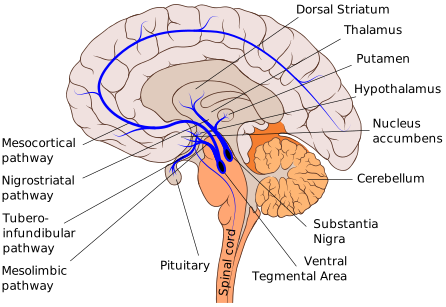
This same diagram explains antipsychotic side effects: non-selective D2 blockade also affects the nigrostriatal pathway (causing extrapyramidal side effects) and the tuberoinfundibular pathway (causing hyperprolactinaemia), which is why side-effect profile is as important as efficacy when choosing a drug.
Other contributing factors
- Genetics: heritability of around 80%, polygenic, with risk sharply higher in first-degree relatives and highest in monozygotic twins (around 50% concordance)
- Neurodevelopmental factors: obstetric complications, prenatal infection or malnutrition, and early developmental delay are all associated with increased risk, supporting a 'two-hit' model where an early developmental insult interacts with later maturational and environmental stress
- Glutamate (NMDA receptor hypofunction): an alternative/complementary model, supported by the psychotomimetic effects of NMDA antagonists such as ketamine
- Structural changes: enlarged cerebral ventricles and reduced grey matter volume are found on group-level neuroimaging, though not diagnostic in an individual
- Cannabis use: particularly high-potency cannabis used from a young age, is a well-established risk factor for both triggering psychosis and precipitating relapse
Risk factors
- Family history of schizophrenia or other psychotic disorder - the strongest risk factor
- Cannabis use, particularly heavy use of high-potency cannabis in adolescence
- Obstetric complications and prenatal infection or malnutrition
- Urban upbringing
- Migration, particularly for ethnic minority groups in some host populations
- Advanced paternal age
- Significant early developmental or social difficulties
- Male sex, and younger age of onset in men
Clinical features
Positive symptoms
- Delusions - fixed, false beliefs held with conviction, not amenable to reason and out of keeping with the person's culture. Persecutory delusions are commonest; grandiose, delusions of reference (believing unrelated events refer specifically to oneself) and religious delusions also occur.
- Hallucinations - most commonly auditory, classically third-person voices discussing or commenting on the patient, or voices giving a running commentary on their actions
- Disorganised thought and speech (formal thought disorder) - loosening of association, tangentiality, derailment, and in severe cases word salad
- Disorganised or catatonic behaviour - unpredictable agitation, stupor, mutism, waxy flexibility, or purposeless motor activity
Schneider's first-rank symptoms
A set of psychotic phenomena described by Kurt Schneider that, while not perfectly specific, are strongly suggestive of schizophrenia when an organic or substance cause has been excluded:
- Thought alienation - thought insertion, thought withdrawal, or thought broadcast (the belief that thoughts are being placed into, removed from, or broadcast out of one's mind)
- Passivity phenomena - the belief that one's actions, emotions or impulses are being controlled by an external force
- Third-person auditory hallucinations - voices discussing the patient or giving a running commentary
- Delusional perception - a normal perception is given an intense, private, delusional significance (for example, a traffic light turning red is experienced as absolute proof that the patient is the Messiah)
Negative symptoms
- Affective flattening - reduced range and intensity of emotional expression
- Alogia - poverty of speech
- Avolition - reduced motivation to initiate or persist in goal-directed activity
- Anhedonia and asociality - loss of interest in pleasurable activities and social withdrawal
- Negative symptoms are often more disabling long-term than positive symptoms, and respond less well to antipsychotic treatment
Cognitive symptoms
Impairment of attention, working memory, processing speed and executive function, present from early in the illness and a major determinant of long-term functional outcome, independent of positive symptom control.
Mental state examination
| Domain | Typical findings |
|---|---|
| Appearance and behaviour | Self-neglect, odd or inappropriate dress, responding to unseen stimuli, catatonic features in severe cases |
| Speech | Formal thought disorder - loosening of association, tangentiality, neologisms; poverty of speech in negative symptoms |
| Mood and affect | Blunted, flat or incongruent affect; may appear perplexed or fearful in acute psychosis |
| Thought form | Disorganised, derailed, or normal between episodes |
| Thought content | Delusions - persecutory, grandiose, referential; thought alienation and passivity phenomena |
| Perception | Auditory hallucinations, classically third-person or running commentary; other modalities less common and should prompt consideration of an organic cause |
| Cognition | Impaired attention, memory and executive function, often from early in the illness |
| Insight | Frequently impaired or absent - the person may not accept they are unwell, which affects engagement with treatment and is relevant to Mental Health Act assessment |
Differential diagnosis
- Substance-induced psychosis: stimulants, cannabis (especially synthetic cannabinoids) and hallucinogens can all cause a similar picture - always take a careful substance history and consider a urine drug screen
- Delirium: acute onset, fluctuating consciousness and disorientation, usually with an identifiable physical precipitant - always exclude in a first presentation, especially in older adults
- Schizoaffective disorder: prominent mood symptoms occurring alongside psychosis for a substantial proportion of the illness, rather than psychosis persisting independently of mood episodes
- Bipolar disorder with psychotic features: psychotic symptoms occur only during mood episodes and are typically mood-congruent
- Severe depression with psychotic features: mood-congruent nihilistic or guilt-laden delusions, in the context of a clear depressive episode
- Delusional disorder: a single, well-systematised, encapsulated delusion without hallucinations, thought disorder or functional decline outside the delusion's direct implications
- Autism spectrum disorder: social withdrawal and unusual thinking from childhood, without true hallucinations or delusions
- Personality disorder (schizotypal): odd beliefs and eccentric behaviour without frank, sustained psychosis
- Organic causes: temporal lobe epilepsy, encephalitis (including anti-NMDA receptor encephalitis), space-occupying lesions, Huntington's disease, and endocrine or metabolic disturbance
Investigations
A first episode of psychosis always warrants a thorough work-up to exclude an organic or substance-related cause before schizophrenia is diagnosed.
- Physical examination and full neurological examination
- FBC, U&Es, LFTs, TFTs, calcium, glucose - metabolic and endocrine causes
- B12 and folate
- Urine drug screen - stimulants, cannabis and other substances
- ECG - baseline before antipsychotics, particularly for QTc prolongation
- Neuroimaging (CT or MRI head) - particularly for atypical presentations, focal neurological signs, later-onset first episode, or where an organic cause is otherwise suspected
- EEG - if there are features suggesting a seizure disorder
- HIV and syphilis serology in relevant clinical contexts
- Referral to an Early Intervention in Psychosis (EIP) service for anyone with a first episode - early, intensive, multidisciplinary treatment improves long-term outcome
Management
Pharmacological
An oral second-generation (atypical) antipsychotic is first-line, chosen jointly with the patient based on side-effect profile, since efficacy across agents (other than clozapine) is broadly similar.2 Start at a low dose and titrate, assess response over 4-6 weeks at an adequate dose, and record the indication, the target symptoms and the expected side effects at the outset so that response can be judged against something specific.
| Clinical situation | Reasonable choice | Avoid |
|---|---|---|
| Significant metabolic risk or obesity | Aripiprazole, amisulpride | Olanzapine, clozapine |
| Sexual dysfunction or prolactin concerns | Aripiprazole (tends to lower prolactin) | Risperidone, amisulpride |
| Prominent insomnia and agitation | Olanzapine, quetiapine (sedating) | Aripiprazole (can be activating) |
| Prolonged QTc or cardiac disease | Aripiprazole | Haloperidol, high-dose quetiapine |
| Poor adherence with oral medication | Long-acting injectable formulation | Relying on oral alone |
| Failure of two adequate trials | Clozapine | Adding a third antipsychotic |
Long-acting injectable (depot) antipsychotics deserve specific mention: they are not a punishment or a last resort, and many patients prefer them to a daily tablet. They are particularly valuable where non-adherence has driven relapse, since they remove the ambiguity about whether medication is being taken and give clear warning when a dose is missed.
| Mechanism | Effect |
|---|---|
| D2 blockade - nigrostriatal | Extrapyramidal side effects: parkinsonism, acute dystonia, akathisia, tardive dyskinesia |
| D2 blockade - tuberoinfundibular | Hyperprolactinaemia - galactorrhoea, amenorrhoea, sexual dysfunction, reduced bone density |
| Histamine H1 blockade | Sedation, weight gain |
| Muscarinic blockade | Dry mouth, constipation, blurred vision, urinary retention |
| Alpha-1 blockade | Postural hypotension |
| Metabolic (esp. olanzapine, clozapine) | Weight gain, dyslipidaemia, type 2 diabetes |
Treatment-resistant schizophrenia
Defined as failure to respond adequately to two different antipsychotics at an adequate dose for an adequate duration (usually 6-8 weeks each), at least one of which is a second-generation agent. The next step is clozapine, which is more effective than any other antipsychotic in treatment-resistant disease but requires mandatory regular full blood count monitoring because of the risk of agranulocytosis.
Psychosocial interventions
- CBT for psychosis - offered to everyone, helping the person re-evaluate and cope with distressing beliefs and voices3
- Family intervention - reduces relapse and readmission, particularly important where the person lives with family
- Early Intervention in Psychosis services for the first 3 years after a first episode
- Supported employment and social interventions to address functional and negative symptoms, which respond poorly to medication alone
- Physical health monitoring at least annually - weight, waist circumference, blood pressure, HbA1c, lipids, smoking status - given the very high cardiometabolic burden of both the illness and its treatment
Relapse prevention
Relapse is the main driver of long-term disability, and each episode carries the risk of incomplete recovery to the previous baseline. Most relapses have identifiable, modifiable causes, and asking about them systematically is more useful than simply increasing the dose.
- Non-adherence - the commonest cause by a considerable margin. Ask non-judgementally about missed doses, and explore the reason: side effects, feeling well, cost, forgetfulness, or a belief that the illness has resolved.
- Cannabis and stimulant use - strongly associated with relapse and with poorer response to treatment
- Life stress and high expressed emotion at home - critical comments, hostility or emotional over-involvement in the family environment predict relapse independently, which is why family intervention works
- Sleep disruption - both an early warning sign and a precipitant
- Physical illness or an intercurrent infection
- Identify the individual relapse signature with the patient and family - the specific early changes that precede an episode - and agree in advance what will happen when they appear
Complications
Suicide risk is substantially elevated, particularly early in the illness, during depressive episodes, and around times of relapse or loss of insight. Cardiometabolic disease - driven both by antipsychotic side effects and by higher rates of smoking, poor diet and inactivity - is the leading cause of the markedly reduced life expectancy seen in schizophrenia. Social consequences include unemployment, homelessness, relationship breakdown and stigma. Comorbid substance misuse, particularly cannabis, worsens both symptom control and outcome.
Red flags
Prognosis
The course of schizophrenia is variable. Roughly a third of patients achieve good long-term functional recovery, a third have an intermittent course with relapses and residual symptoms between episodes, and a third experience a persistent, more disabling course despite treatment. Negative and cognitive symptoms, rather than positive symptoms, are usually the strongest determinants of long-term functional outcome.
Better prognosis is associated with acute onset, a clear precipitant, good premorbid functioning, later age of onset, prominent mood symptoms, and good treatment adherence and engagement with early intervention services. Poorer prognosis is associated with insidious onset, prominent negative symptoms, early onset, poor premorbid function, and ongoing cannabis or other substance use.
References
- World Health Organization. ICD-11 for Mortality and Morbidity Statistics. Schizophrenia. 2024. Available here
- NICE CG178. Psychosis and schizophrenia in adults: prevention and management. 2014, updated 2016. Available here
- NICE CKS. Psychosis and schizophrenia. Available here
- BNF. Clozapine - monitoring requirements. Available here
This article is written for revision and education. It is not clinical guidance and must not be used to make decisions about the care of a patient. Always check current NICE guidance and local protocols.