
Toxoplasmosis
Key points
- Toxoplasma gondii: a protozoan parasite whose definitive host is the cat; humans are infected by ingesting oocysts (cat faeces, contaminated soil or water) or tissue cysts (undercooked meat).
- In immunocompetent adults: usually asymptomatic or a mild, self-limiting glandular-fever-like illness that needs no treatment.
- Congenital toxoplasmosis: risk of transmission rises with gestational age at maternal infection, but severity is worse the earlier in pregnancy it occurs - the classic triad is chorioretinitis, hydrocephalus and intracranial calcification.
- Cerebral toxoplasmosis: the commonest cause of a focal brain lesion in advanced HIV (CD4 typically below 150-200) - multiple ring-enhancing lesions on imaging, treated empirically with a trial of therapy.
- First-line treatment: pyrimethamine plus sulfadiazine, with folinic acid (not folic acid) co-prescribed to protect the bone marrow from pyrimethamine's antifolate effect.
- UK antenatal screening: not routine (unlike some other European countries) - toxoplasmosis in pregnancy is generally identified through clinical suspicion rather than universal serology.
- Prophylaxis: co-trimoxazole is given to HIV patients with a low CD4 count and positive toxoplasma serology, doubling up with its role in PCP prevention.
Introduction
Toxoplasmosis is caused by Toxoplasma gondii, a protozoan parasite whose only definitive host - the animal in which it can complete its full sexual life cycle - is the domestic cat. Cats shed infectious oocysts in their faeces; humans and many other animals are intermediate hosts, infected by ingesting these oocysts (from contaminated soil, water or unwashed produce) or by eating undercooked meat containing tissue cysts, most classically lamb or pork.
Infection is extremely common worldwide and, in a healthy adult, almost always trivial or entirely silent. It is examined because of two very different high-stakes scenarios where the same organism causes serious disease: congenital infection during pregnancy, and reactivation in significant immunosuppression, particularly advanced HIV.
Clinical features in the immunocompetent host
The large majority of infections in healthy people - commonly quoted as 80-90% - are entirely asymptomatic. A minority develop a mild, self-limiting illness that resembles infectious mononucleosis: low-grade fever, malaise, and lymphadenopathy, often affecting the posterior cervical nodes. It typically resolves without specific treatment, and no antimicrobial therapy is needed in an otherwise well, immunocompetent adult.
Congenital toxoplasmosis
Maternal infection during pregnancy can cross the placenta and infect the fetus. Two facts about timing are worth holding separately, because they point in opposite directions and are easy to muddle: the probability of transmission to the fetus increases with gestational age at maternal infection (the placenta becomes more permeable later in pregnancy), but the severity of fetal disease is greatest when infection occurs earlier in pregnancy, during organogenesis.
The classic triad taught for congenital toxoplasmosis is chorioretinitis, hydrocephalus and intracranial calcification, though many infected infants are asymptomatic at birth and go on to develop chorioretinitis, learning difficulties or other neurological sequelae later in childhood if the infection is not identified and treated. Other features can include microcephaly, seizures, hepatosplenomegaly, jaundice and thrombocytopenia.
Where maternal infection is suspected or confirmed, diagnosis relies on maternal serology (evidence of seroconversion), amniotic fluid PCR to look for fetal infection, and neonatal serology and clinical assessment after birth.
Toxoplasmosis in immunosuppression: cerebral disease
In significant immunosuppression - most classically advanced HIV with a CD4 count below around 150-200 cells/µL, but also seen in transplant recipients and other significantly immunosuppressed patients - latent infection can reactivate, most importantly in the brain.
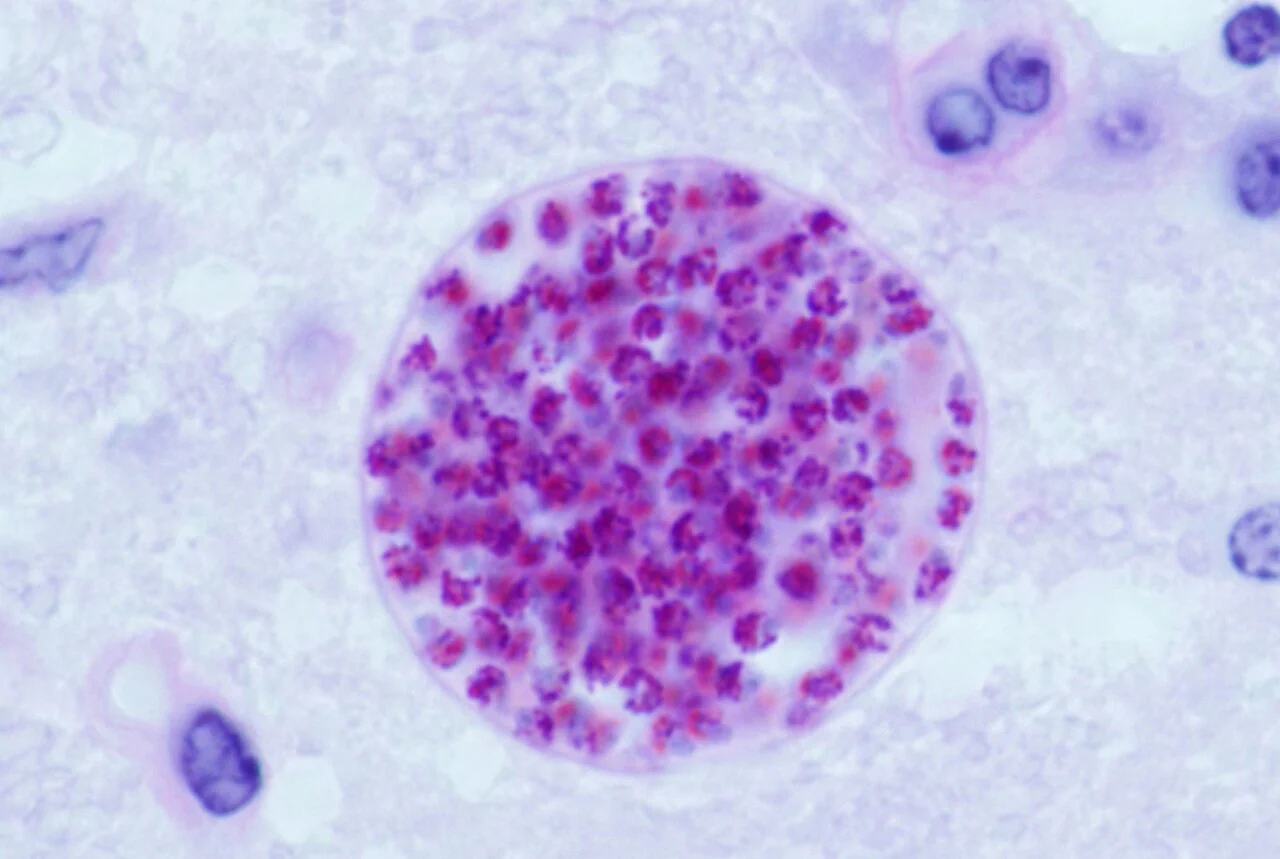
Cerebral toxoplasmosis is the commonest cause of a focal brain lesion in advanced HIV. It typically presents subacutely with headache, fever, confusion, focal neurological deficits and seizures. Imaging (CT or MRI) classically shows multiple ring-enhancing lesions, often with surrounding oedema.
Immunosuppressed patients can also develop toxoplasma chorioretinitis, pneumonitis, or disseminated multi-organ disease in the most severe cases.
Differential diagnosis
- Infectious mononucleosis (EBV) and CMV mononucleosis - overlap closely with the mild acquired illness in immunocompetent hosts
- Acute HIV seroconversion - another cause of a glandular-fever-like picture, worth testing for alongside toxoplasmosis where relevant
- Primary CNS lymphoma, tuberculoma, cryptococcoma and progressive multifocal leukoencephalopathy - the differential for a focal brain lesion in advanced HIV, alongside cerebral toxoplasmosis
- Congenital CMV, rubella and herpes simplex infection (the other "TORCH" infections) - part of the differential for a neonate with chorioretinitis, hydrocephalus or intracranial calcification
Investigations
- Serology (IgM and IgG) - IgM suggests recent infection, IgG indicates past exposure and immunity; interpretation in pregnancy needs specialist input given the implications of a positive result
- PCR - of blood, CSF or amniotic fluid, particularly useful in the immunosuppressed (where antibody responses may be blunted or absent) and in suspected congenital infection
- CT or MRI brain - for suspected cerebral toxoplasmosis, looking for the characteristic multiple ring-enhancing lesions
- Ophthalmological assessment - for suspected chorioretinitis, whether congenital or acquired
Management
A mild illness in an immunocompetent adult needs no specific treatment. Treatment is reserved for severe disease, ocular involvement, congenital infection, and disease in the immunosuppressed.
First-line treatment
Pyrimethamine plus sulfadiazine, with folinic acid (leucovorin) co-prescribed, is the standard combination for significant toxoplasmosis, including cerebral disease.
- Clindamycin plus pyrimethamine - an alternative combination where sulfonamide allergy precludes sulfadiazine
- Spiramycin - used in pregnancy for maternal infection, since it does not cross the placenta well and is used to try to reduce the risk of transmission to the fetus; if fetal infection is confirmed, pyrimethamine-sulfadiazine-folinic acid is used instead (generally avoided in the first trimester given pyrimethamine's teratogenic potential, with specialist guidance directing exact timing)
Prophylaxis
Co-trimoxazole is given as prophylaxis to HIV patients with a CD4 count below around 200 cells/µL who are toxoplasma IgG positive, the same agent used for Pneumocystis jirovecii pneumonia prophylaxis at a similar threshold, giving useful dual protection in this group.
Prevention
- Cook meat thoroughly and wash fruit and vegetables before eating
- Avoid changing cat litter during pregnancy, or wear gloves and wash hands thoroughly afterwards if unavoidable
- Wear gloves when gardening, and wash hands afterwards
- Avoid unpasteurised dairy products
Red flags
Prognosis
Acquired toxoplasmosis in a healthy adult has an excellent prognosis and typically resolves without treatment or lasting effect. Congenital toxoplasmosis carries a wide range of outcomes, from an asymptomatic infant who nonetheless needs long-term ophthalmological and developmental follow-up, to severe neurological and visual impairment when infection occurs early in pregnancy. Cerebral toxoplasmosis in the immunosuppressed responds well to prompt treatment in most cases, and outcomes are further improved where the underlying immunosuppression (for example, through effective HIV antiretroviral therapy) can also be addressed.
References
- NICE Clinical Knowledge Summaries. Toxoplasmosis. Available here
- Royal College of Obstetricians and Gynaecologists. Toxoplasmosis in pregnancy. Available here
- British HIV Association (BHIVA). Guidelines for the treatment of opportunistic infection in HIV-positive adults. Available here
- Montoya JG, Liesenfeld O. Toxoplasmosis. The Lancet. 2004. Available here
This article is written for revision and education. It is not clinical guidance and must not be used to make decisions about the care of a patient. Always check current NICE guidance and local protocols.