
Allergic Disorders, Food Allergy and Anaphylaxis
Key points
- Type I hypersensitivity: IgE-mediated mast cell degranulation on re-exposure to an allergen, releasing histamine and other mediators within minutes - the mechanism behind allergic rhinitis, urticaria, food allergy and anaphylaxis.
- Food allergy: IgE-mediated reactions occur within minutes to 2 hours of ingestion (urticaria, angioedema, vomiting, wheeze, anaphylaxis); non-IgE-mediated reactions are delayed by hours to days and present differently, often with GI or skin symptoms.
- Diagnosis: skin prick testing and specific IgE blood testing support a compatible history; the oral food challenge is the gold standard. Unvalidated IgG food testing is not evidence-based and should not be used.
- Anaphylaxis: a severe, life-threatening reaction with airway, breathing or circulatory compromise - skin changes alone, without ABC involvement, do not define anaphylaxis.
- Adrenaline: the only life-saving treatment for anaphylaxis - given IM into the anterolateral thigh, repeated every 5 minutes if needed. Antihistamines and steroids are adjuncts, not substitutes.
- Biphasic reactions: a recognised risk after apparent recovery from anaphylaxis - patients need a period of observation before discharge, with duration guided by the severity and course of the reaction.
- Mast cell tryptase: supports a retrospective diagnosis of anaphylaxis when measured at the time of the reaction and again later for comparison against baseline.
Introduction
Allergy is an inappropriate immune response to a normally harmless substance. Most clinically important allergic disease - allergic rhinitis, urticaria, food allergy and anaphylaxis - is driven by Type I (immediate) hypersensitivity, in the Gell and Coombs classification: an IgE-mediated reaction that develops within minutes of re-exposure to an allergen. This article covers that shared mechanism and its clinical spectrum, culminating in anaphylaxis, the emergency that ties the whole topic together and the part most heavily tested.
Urticaria and angioedema, and cow's milk protein allergy in infants, are covered in more detail in their own dedicated articles; here they are placed in the broader context of IgE-mediated disease.
Mechanism: Type I hypersensitivity
On first exposure, an allergen is processed and presented to T-helper cells, driving B cells to produce allergen-specific IgE, which binds to high-affinity receptors on mast cells and basophils - this sensitisation step causes no symptoms. On re-exposure, the allergen cross-links this bound IgE, triggering mast cell degranulation and the release of histamine, leukotrienes and prostaglandins, producing symptoms within minutes: vasodilatation, increased vascular permeability, smooth muscle contraction and mucus secretion. A late-phase reaction, driven by recruited eosinophils and other inflammatory cells, can follow 4-6 hours later, which is part of why some reactions appear to recur after initial improvement.
Allergic rhinitis
Sneezing, rhinorrhoea, nasal congestion and itchy, watery eyes, either seasonal (classically pollen-driven hay fever) or perennial (house dust mite, pet dander, mould).
- Allergen avoidance where practical
- Non-sedating oral antihistamines (e.g. cetirizine, loratadine) as first-line treatment
- Intranasal corticosteroids for moderate-to-severe or persistent symptoms
- Leukotriene receptor antagonists as an add-on in selected patients
- Allergen immunotherapy (subcutaneous or sublingual) for severe disease refractory to standard treatment, gradually desensitising the immune response to a specific allergen
Urticaria and angioedema (overview)
Urticaria produces itchy, well-demarcated, transient wheals; angioedema is deeper swelling of the dermis and subcutaneous tissue, which can involve the lips, eyes or, critically, the airway. Reactions are classed as acute (under 6 weeks, often triggered by an allergen or infection) or chronic (over 6 weeks, frequently autoimmune or idiopathic rather than allergic). Full detail on causes, differentials and management is covered in the dedicated dermatology article; the point to hold here is that airway-involving angioedema is managed as an anaphylaxis-equivalent emergency regardless of whether a clear allergic trigger is identified.
Food allergy
Food allergy is divided into IgE-mediated and non-IgE-mediated disease, which differ in both timing and presentation.
| IgE-mediated | Non-IgE-mediated | |
|---|---|---|
| Onset after exposure | Minutes to about 2 hours | Hours to days |
| Typical features | Urticaria, angioedema, vomiting, wheeze; can progress to anaphylaxis | Gastrointestinal symptoms (vomiting, diarrhoea, blood/mucus in stool), eczema flares - as seen in cow's milk protein allergy in infants |
| Diagnostic tests | Skin prick testing and specific IgE are useful | These tests are not useful, since the reaction is not IgE-driven; diagnosis rests on history and exclusion/reintroduction |
The commonest food allergens are milk, egg, peanut, tree nuts, wheat, soya, fish, shellfish and sesame - these, alongside several others, make up the allergens that UK food businesses are legally required to declare on packaging and menus.
Diagnosis
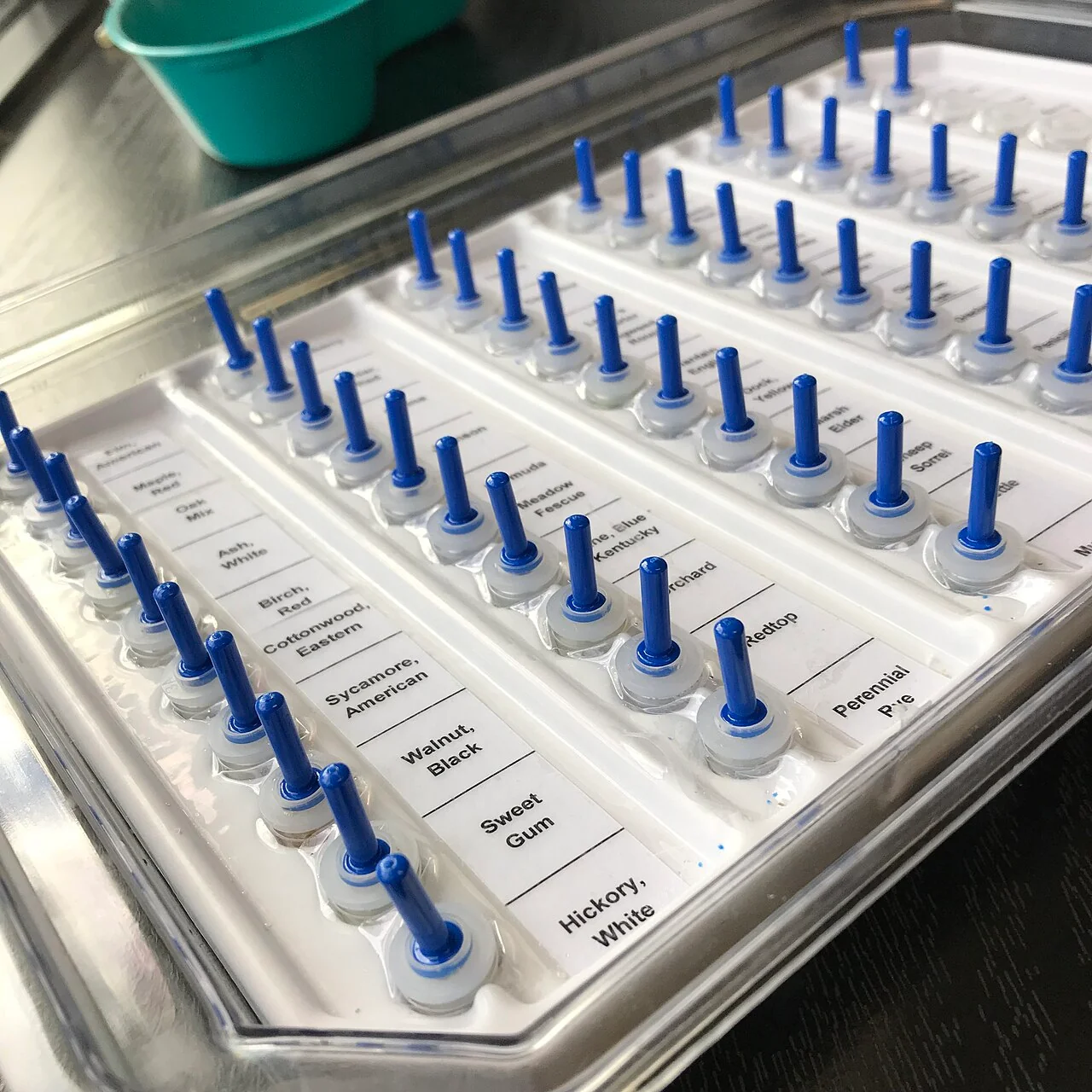
- Skin prick testing - a wheal at least 3mm larger than the negative control supports sensitisation, but a positive result alone does not confirm clinical allergy without a compatible history
- Specific IgE blood testing (e.g. ImmunoCAP) - useful where skin testing is impractical (for example, severe eczema, or a patient on antihistamines that cannot be stopped)
- Component-resolved diagnostics - testing against specific allergen proteins (rather than the whole food extract) to refine the estimated risk of a severe reaction in selected cases
- Oral food challenge - the gold standard, performed under close medical supervision given the risk of triggering a genuine reaction, including anaphylaxis
Anaphylaxis
Anaphylaxis is a severe, life-threatening systemic hypersensitivity reaction, characterised by rapid onset of airway, breathing or circulatory problems, usually but not always with skin or mucosal changes. Common triggers include food, drugs (antibiotics, NSAIDs, contrast media are frequent culprits), insect venom, latex, and, less commonly, exercise.
Recognition
Management
Follows an ABCDE structure, with adrenaline as the single life-saving treatment.
- Remove the trigger where possible and call for help immediately
- IM adrenaline (1:1000) into the anterolateral thigh - the standard adult dose is 500 micrograms (0.5 mL), with age-specific paediatric doses; repeated every 5 minutes if there is no improvement
- Lie the patient flat with legs raised to support circulation, unless breathing difficulty makes this intolerable (sit up), or the patient is pregnant (left lateral position, to avoid aortocaval compression)
- High-flow oxygen
- IV fluid bolus for hypotension
- Antihistamines and corticosteroids are adjuncts only - current resuscitation guidance has downgraded their role compared with older teaching, since they do not reverse the acute, life-threatening features the way adrenaline does
- Ongoing monitoring, since a single dose of adrenaline may not be sufficient and repeated doses or IV adrenaline (specialist-led) may be needed in refractory cases
After the acute event
- Mast cell tryptase - ideally measured as soon as possible after emergency treatment has started, again at 1-2 hours, and at a later baseline (e.g. 24 hours or in follow-up) for comparison; a rise and fall supports the diagnosis retrospectively, though a normal level does not exclude anaphylaxis
- Observation for a biphasic reaction - symptoms can recur hours after apparent resolution without further allergen exposure; the observation period is individualised to the severity and course of the reaction, guided by current resuscitation council guidance
- Referral to an allergy specialist to identify the trigger and plan future avoidance
- Prescription and training in the use of an adrenaline auto-injector, with a written personalised allergy action plan for the patient (and, in children, their school or carers)
Drug allergy
Penicillin allergy is the most commonly recorded drug allergy, but true IgE-mediated allergy is considerably rarer than the number of patients labelled with it - many reported reactions are non-allergic side effects (such as a viral rash mistaken for a drug reaction) or reactions that were never truly IgE-mediated. Taking a careful allergy history, and referring for formal allergy testing or de-labelling where appropriate, matters for antimicrobial stewardship: unnecessarily avoiding penicillins pushes prescribing towards broader-spectrum alternatives. Cross-reactivity between penicillins and cephalosporins is lower than historically taught, generally quoted around 1-2%, and should not automatically exclude cephalosporin use in someone with a penicillin allergy label, particularly where the original reaction was mild or non-specific.
Aspirin-exacerbated respiratory disease (AERD) is a distinct, non-IgE-mediated hypersensitivity to NSAIDs, presenting as the triad of asthma, nasal polyps and NSAID sensitivity, driven by abnormal leukotriene metabolism rather than a classical allergic mechanism.
Red flags
Prognosis
Allergic rhinitis and mild-to-moderate food allergy are generally well managed with avoidance and standard treatment, and many childhood food allergies (particularly to milk and egg) resolve over time, while others (peanut, tree nut) more often persist into adulthood. Anaphylaxis carries a real risk of death if adrenaline is delayed or withheld, but prognosis is excellent with prompt recognition and treatment, and patients equipped with a clear action plan and an adrenaline auto-injector, alongside specialist follow-up, generally do very well even after a severe reaction.
References
- NICE CG116. Anaphylaxis: assessment and referral after emergency treatment. Available here
- Resuscitation Council UK. Emergency treatment of anaphylactic reactions. Available here
- NICE CG116. Food allergy in under 19s: assessment and diagnosis. Available here
- British Society for Allergy and Clinical Immunology (BSACI). Guidelines for allergy testing. Available here
- NICE Clinical Knowledge Summaries. Allergic rhinitis. Available here
This article is written for revision and education. It is not clinical guidance and must not be used to make decisions about the care of a patient. Always check current NICE guidance and local protocols.