
Vascular Dementia
Key points
- Vascular dementia: cognitive decline caused by cerebrovascular disease - large vessel infarcts, small vessel disease, or a combination - the second commonest dementia subtype after Alzheimer's.
- Stepwise decline: the classic pattern - discrete drops in function corresponding to vascular events, with plateaus in between, rather than the smooth decline of Alzheimer's.
- Subcortical small vessel disease: the commonest form in practice - gradual, not always clearly stepwise, with early executive dysfunction and gait/mobility problems.
- Executive dysfunction first: unlike Alzheimer's, vascular dementia often affects planning, processing speed and attention early, with memory relatively better preserved until later.
- Imaging: MRI/CT shows infarcts, white matter changes (leukoaraiosis) or microbleeds, correlating with the clinical picture and supporting diagnosis.
- Management is cardiovascular: secondary stroke prevention - antiplatelet/anticoagulant as indicated, blood pressure and lipid control, smoking cessation - is the core treatment, not a cognitive-specific drug.
- No licensed cognitive drug: cholinesterase inhibitors and memantine are not licensed for pure vascular dementia, though they may be tried in mixed dementia with an Alzheimer's component.
- Mixed dementia: vascular and Alzheimer pathology frequently coexist, and management then addresses both processes together.
Introduction
Vascular dementia is cognitive decline caused by cerebrovascular disease - the cumulative effect of large vessel infarcts, small vessel disease, or both, on brain structure and function. It is the second commonest cause of dementia after Alzheimer's disease, accounting for a substantial minority of cases in pure form, with a further significant proportion of patients having mixed dementia, combining vascular and Alzheimer pathology.1
For general dementia assessment and screening, see 2; this article covers the features, subtypes and management specific to a vascular aetiology, which differs meaningfully from Alzheimer's in both presentation and treatment.
Subtypes
| Subtype | Mechanism and pattern |
|---|---|
| Multi-infarct (large vessel) dementia | Cumulative effect of multiple discrete cortical/subcortical infarcts, classically producing a stepwise decline with each new event |
| Subcortical (small vessel) dementia | Chronic small vessel ischaemia and white matter change, producing a more gradual course dominated by executive dysfunction and gait impairment - the commonest form seen clinically |
| Strategic single-infarct dementia | A single infarct in a critical location (e.g. thalamus, angular gyrus) causing dementia despite otherwise limited overall infarct burden |
| Post-stroke dementia | Cognitive decline arising in the months following a clinically evident stroke |
Risk factors
The risk factors mirror those for stroke and atherosclerotic vascular disease generally, since the underlying process is the same.
- Hypertension - the single most important modifiable risk factor, particularly for small vessel disease
- Diabetes mellitus
- Atrial fibrillation and other cardioembolic sources
- Smoking
- Dyslipidaemia
- Prior stroke or transient ischaemic attack
- Obesity and physical inactivity
Pathophysiology
Vascular cognitive impairment results from the cumulative effect of ischaemic injury on the brain networks that support cognition, rather than from a single degenerative protein deposition process as in Alzheimer's disease.
- Large vessel disease: atherothrombotic or cardioembolic occlusion producing discrete cortical or subcortical infarcts. Cognitive consequences depend on the volume of tissue lost and, critically, on its location
- Small vessel disease: arteriolosclerosis and lipohyalinosis of the deep penetrating arterioles supplying the white matter and basal ganglia, producing lacunar infarcts and diffuse white matter ischaemia. Hypertension is the dominant driver
- Disconnection: damage to subcortical white matter tracts interrupts the frontal-subcortical circuits linking prefrontal cortex to basal ganglia and thalamus, which is why executive function, processing speed and gait are affected disproportionately early - the cortex itself may be relatively intact
- Hypoperfusion: chronic reduction in cerebral blood flow, and watershed infarction following episodes of profound hypotension, contribute in some patients
- Mixed pathology: vascular injury lowers the threshold at which coexisting Alzheimer pathology becomes clinically apparent, so the two processes are additive rather than merely coincidental
Clinical features
A key distinguishing feature from typical Alzheimer's disease is the early pattern of cognitive deficit: vascular dementia more often impairs executive function, processing speed and attention early, with episodic memory relatively better preserved until later in the disease, the reverse of the typical Alzheimer's pattern.
- Executive dysfunction: difficulty planning, organising, and shifting between tasks
- Slowed processing speed: taking noticeably longer to complete familiar tasks or respond in conversation
- Gait and mobility problems: particularly in subcortical small vessel disease - a shuffling, broad-based, or 'marche à petits pas' gait, sometimes with early falls
- Mood change: depression and emotional lability are common, sometimes preceding overt cognitive decline
- Focal neurological signs: may be present, reflecting the underlying vascular lesions - pyramidal signs, pseudobulbar palsy
- Urinary symptoms: urgency and incontinence occur relatively early compared with Alzheimer's disease
- A history of stroke, TIA, or known cerebrovascular risk factors is common, though not universal, particularly in subcortical small vessel disease which can be clinically silent until dementia manifests
Investigations
As for dementia generally, first-line assessment excludes reversible causes with the standard blood panel (see 2), followed by imaging that is particularly important in suspected vascular dementia to demonstrate the vascular burden.
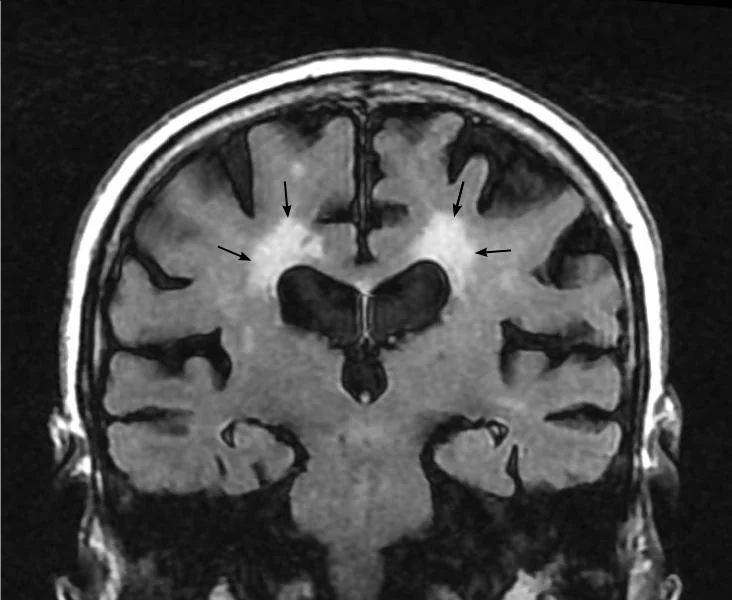
- MRI brain (preferred over CT) - shows infarcts (cortical or subcortical), white matter hyperintensities (leukoaraiosis) reflecting chronic small vessel ischaemia, and cerebral microbleeds (best seen on susceptibility-weighted/gradient-echo sequences)
- CT head - a reasonable alternative where MRI is unavailable or contraindicated, though less sensitive for small vessel disease and microbleeds
- Cardiovascular risk assessment: blood pressure, lipid profile, HbA1c, and screening for atrial fibrillation (ECG, and further rhythm monitoring if indicated)
- Carotid imaging where there is a history suggesting large artery disease as a contributing source
Diagnosis requires both a clinically consistent pattern of cognitive decline and imaging evidence of cerebrovascular disease sufficient to plausibly account for it - imaging findings alone, in the absence of a matching clinical picture, are common incidental findings in older people (see 3) and do not by themselves establish the diagnosis.
Distinguishing vascular from Alzheimer dementia
| Feature | Vascular dementia | Alzheimer's disease |
|---|---|---|
| Onset | May be abrupt, temporally linked to a vascular event | Insidious, no identifiable start point |
| Course | Stepwise in multi-infarct disease; gradual in small vessel disease | Smoothly progressive |
| Earliest deficit | Executive function, processing speed, attention | Episodic memory |
| Insight | Often relatively preserved early | Often reduced early |
| Gait | Impaired early - shuffling, broad-based, falls | Usually normal until late disease |
| Continence | Urinary urgency and incontinence relatively early | Usually late |
| Mood | Depression and emotional lability common, may precede cognitive decline | Apathy common; depression less specifically associated |
| Neurological signs | Focal signs may be present (pyramidal signs, pseudobulbar palsy) | Typically absent until late |
| Imaging | Infarcts, confluent white matter change, microbleeds | Medial temporal/hippocampal atrophy |
Management
Cardiovascular risk reduction is the core treatment
Unlike Alzheimer's disease, there is no specific cognitive-enhancing drug licensed for pure vascular dementia. Management centres on secondary prevention of further cerebrovascular injury, which is what actually slows progression, alongside symptomatic and supportive care.
- Antiplatelet therapy (e.g. aspirin or clopidogrel) following ischaemic stroke/TIA, per standard secondary stroke prevention guidance
- Anticoagulation where atrial fibrillation or another cardioembolic source is identified
- Blood pressure control - a particularly important target given hypertension's central role in small vessel disease, though targets should be individualised in frail older patients to avoid symptomatic hypotension and falls
- Statin therapy for secondary prevention where appropriate
- Diabetes control
- Smoking cessation - see 4
- Physical activity and cardiovascular risk factor optimisation generally
Cognitive drugs in mixed dementia
Where there is a significant coexisting Alzheimer's component (mixed dementia), a trial of a cholinesterase inhibitor or memantine may be considered by a specialist, targeting the Alzheimer's element specifically, but this is not standard treatment for pure vascular dementia.
Symptomatic and supportive management
- Falls and gait assessment, given the prominence of mobility impairment - see 5
- Mood assessment and treatment, since depression is common and treatable
- Continence assessment, given the relatively early urinary involvement
- Cognitive stimulation and structured activity, as for dementia generally
- Carer support and post-diagnostic planning, as described in 2
Prevention
Vascular dementia is, in principle, the most preventable of the common dementias, because its risk factors are the modifiable risk factors for stroke and atherosclerosis - and because population-level improvements in blood pressure control and smoking rates have been accompanied by falling age-specific dementia incidence in several high-income countries.
- Midlife hypertension control carries the strongest evidence of any single modifiable factor - treating hypertension in midlife reduces later dementia risk, and blood pressure lowering trials have shown reductions in incident cognitive impairment
- Smoking cessation, which reduces both stroke risk and the direct vascular endothelial damage that drives small vessel disease
- Diabetes control, since diabetes accelerates both large and small vessel disease
- Detecting and anticoagulating atrial fibrillation, preventing the cardioembolic strokes that cause multi-infarct disease - opportunistic pulse checks in older patients are a cheap, high-yield intervention
- Physical activity, dietary pattern and weight management, acting through the shared cardiometabolic pathway
- Addressing hearing loss and social isolation, which are independently associated with dementia risk across subtypes
The practical implication is that cardiovascular risk management in midlife is also dementia prevention, and framing it that way in a consultation is often more motivating to a patient than an abstract discussion of stroke or myocardial infarction risk alone.
Specific vascular dementia syndromes
A few named entities are worth recognising, both because they appear in exam questions and because they change management or counselling.
| Syndrome | Features |
|---|---|
| Binswanger disease (subcortical leukoencephalopathy) | Extensive confluent white matter disease with prominent executive dysfunction, gait apraxia, urinary incontinence and pseudobulbar affect; strongly associated with long-standing hypertension |
| CADASIL | An inherited (NOTCH3 mutation) small vessel arteriopathy causing migraine with aura, recurrent subcortical strokes and early dementia in patients typically in their 40s-50s, often without conventional vascular risk factors; warrants genetic counselling |
| Cerebral amyloid angiopathy | Amyloid deposition in cortical vessel walls causing lobar haemorrhages and cortical microbleeds; important because it substantially raises the bleeding risk of anticoagulation |
| Post-stroke cognitive impairment | Cognitive decline emerging in the months after a clinically evident stroke; assess formally rather than assuming recovery will parallel physical recovery |
Suspect CADASIL in a patient presenting with early-onset stroke or vascular cognitive impairment, a history of migraine with aura, a strong family history of early stroke or dementia, and an unexpectedly heavy white matter disease burden for their age - particularly involving the anterior temporal poles, which is relatively characteristic. Recognition matters because it changes family counselling entirely, even though management remains largely supportive and focused on conventional risk factor control.
Red flags
Prognosis
The course is variable: multi-infarct disease can show a stepwise pattern with periods of relative stability punctuated by acute declines, while subcortical small vessel disease tends towards a more gradually progressive course. Overall prognosis is influenced heavily by ongoing vascular risk - patients with well-controlled risk factors and no further vascular events have a better trajectory than those with recurrent cerebrovascular events, which is the central rationale for aggressive secondary prevention as the mainstay of management.
Median survival after diagnosis is generally shorter than in Alzheimer's disease, reflecting both the cognitive illness itself and the competing cardiovascular mortality that comes with the same underlying vascular burden - patients frequently die of myocardial infarction or stroke rather than of the dementia. This dual risk is worth bearing in mind when discussing prognosis and planning care, since it means cardiovascular events, not only cognitive decline, should feature in anticipatory care planning conversations.
References
- Alzheimer's Society. Vascular dementia. Available here
- NICE NG97. Dementia: assessment, management and support for people living with dementia and their carers. 2018. Available here
- Welch HG, Black WC. Overdiagnosis in cancer. Journal of the National Cancer Institute. 2010. Available here
- NICE NG209. Tobacco: preventing uptake, promoting quitting and treating dependence. 2021. Available here
- NICE CG161. Falls in older people: assessing risk and prevention. 2013. Available here
This article is written for revision and education. It is not clinical guidance and must not be used to make decisions about the care of a patient. Always check current NICE guidance and local protocols.