
Irritable Bowel Syndrome: Diagnosis and Management
Key points
- IBS: a chronic functional bowel disorder characterised by abdominal pain related to defecation, with altered stool frequency or form, and no structural abnormality.
- Diagnosis: a positive clinical diagnosis based on symptom criteria plus limited investigation, not a diagnosis of exclusion requiring extensive testing.
- Subtypes: classified by predominant stool form as IBS-C (constipation), IBS-D (diarrhoea), IBS-M (mixed) or IBS-U (unclassified).
- Essential exclusions: coeliac serology, full blood count, CRP/ESR in everyone; faecal calprotectin to exclude inflammatory bowel disease; CA125 in women with suggestive symptoms.
- First-line treatment: dietary and lifestyle advice, then antispasmodics for pain, laxatives for constipation (not lactulose), and loperamide for diarrhoea.
- Second-line: a low-dose tricyclic antidepressant such as amitriptyline, used for its effect on gut pain rather than mood.
- Diet: regular meals, adequate fluid, limiting caffeine, alcohol and fizzy drinks; a low FODMAP diet only under dietitian supervision.
- Prognosis: symptoms fluctuate lifelong but life expectancy is normal; the priority is symptom control and a confident explanation.
Introduction
Irritable bowel syndrome (IBS) is a chronic functional gastrointestinal disorder defined by recurrent abdominal pain associated with defecation or a change in bowel habit, in the absence of any structural or biochemical abnormality that explains the symptoms.1
It affects around 10-20% of adults in the UK, is roughly twice as common in women, and typically begins before the age of 40. It is one of the commonest reasons for gastroenterology referral and accounts for a substantial burden of primary care consultations, reduced quality of life and time off work.
"Functional" does not mean the symptoms are imagined. There are recognised physiological abnormalities including visceral hypersensitivity (a lowered threshold for perceiving normal gut distension as painful), altered gut motility, disturbed gut-brain axis signalling, low-grade mucosal immune activation, altered gut microbiota, and a strong association with previous gastroenteritis (post-infectious IBS) and with psychological stress, anxiety and depression.
Clinical features
The cardinal symptom is abdominal pain or discomfort that is related to defecation - typically relieved by opening the bowels - and associated with a change in stool frequency or form. Pain is often crampy, in the lower abdomen, and variable in site.
Supporting features that increase diagnostic confidence include:1
- Abdominal bloating and distension, characteristically worse through the day
- Symptoms worsened by eating
- Passage of mucus per rectum
- Altered stool passage: straining, urgency, or a feeling of incomplete evacuation
- Symptoms fluctuating over months to years, often with identifiable stress-related triggers
- Associated non-GI symptoms: lethargy, nausea, backache, bladder symptoms, headache and dyspareunia
Subtypes
IBS is subclassified by the predominant stool form, which guides treatment. The Bristol Stool Chart is used to characterise stool consistency objectively rather than relying on a patient's own description of "diarrhoea" or "constipation".
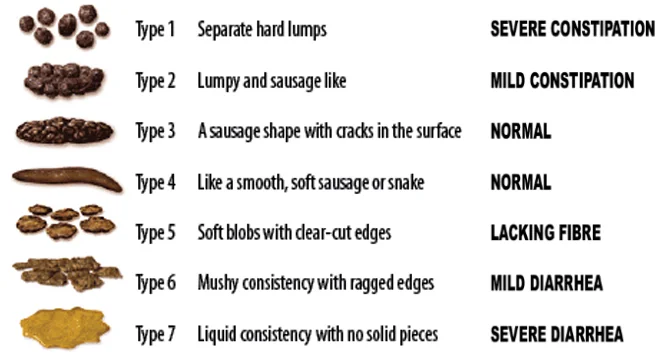
| Subtype | Predominant stool pattern |
|---|---|
| IBS-C | Constipation predominant - hard or lumpy stools (Bristol types 1-2) |
| IBS-D | Diarrhoea predominant - loose or watery stools (Bristol types 6-7) |
| IBS-M | Mixed - alternating between hard and loose stools |
| IBS-U | Unclassified - insufficient abnormality of stool consistency to meet the above |
Diagnostic criteria
IBS should be made as a positive diagnosis on the basis of the history, supported by limited investigation to exclude specific mimics - not as a label of last resort after exhaustive negative testing.1
NICE criteria
NICE advises considering IBS in anyone with abdominal pain or discomfort, bloating, or a change in bowel habit for at least 6 months. The diagnosis is made if abdominal pain or discomfort is either relieved by defecation or associated with altered stool frequency or form, plus at least two of: altered stool passage (straining, urgency, incomplete evacuation); abdominal bloating or distension; symptoms worsened by eating; or passage of rectal mucus.
Rome IV criteria
The internationally used Rome IV criteria require recurrent abdominal pain on average at least 1 day per week in the last 3 months, with symptom onset at least 6 months previously, associated with two or more of: pain related to defecation; a change in stool frequency; or a change in stool form.
Investigations
Investigation is deliberately limited, aiming to exclude the conditions that most commonly mimic IBS without subjecting patients to unnecessary invasive tests.1
Tests for everyone with suspected IBS
- Full blood count - anaemia would point away from IBS
- CRP or ESR - inflammatory markers should be normal
- Coeliac serology (IgA tTG with total IgA) - coeliac disease is a common and readily treatable mimic
- Faecal calprotectin in patients with diarrhoea, to distinguish IBS from inflammatory bowel disease2
- CA125 in women with symptoms suggestive of ovarian cancer, such as persistent bloating, early satiety, pelvic pain or urinary urgency
Tests that are not required
NICE explicitly states that ultrasound, rigid or flexible sigmoidoscopy, colonoscopy, barium enema, thyroid function tests, faecal ova and parasite testing, faecal occult blood and hydrogen breath testing are not needed to confirm the diagnosis in the absence of red flags. Endoscopy is reserved for patients with alarm features or an atypical course.
In patients with predominant diarrhoea, particularly following cholecystectomy or terminal ileal disease, consider bile acid malabsorption, which can be tested for with a SeHCAT scan and responds to bile acid sequestrants such as colestyramine.
Differential diagnosis
- Coeliac disease: bloating, diarrhoea and fatigue with positive serology and villous atrophy
- Inflammatory bowel disease: bloody diarrhoea, systemic upset, raised calprotectin and inflammatory markers
- Colorectal cancer: particularly in older patients or with rectal bleeding, weight loss or iron-deficiency anaemia
- Bile acid malabsorption: watery diarrhoea, often post-cholecystectomy or after ileal resection
- Lactose intolerance and other food intolerances
- Ovarian cancer: persistent bloating, early satiety and pelvic pain in women - the reason for CA125 testing
- Microscopic colitis: watery non-bloody diarrhoea in older patients, with normal endoscopic appearance but abnormal histology
- Diverticular disease, thyroid disease, giardiasis and small intestinal bacterial overgrowth
Management
Management begins with explanation and reassurance. A clear, confident account of what IBS is - a genuine disorder of gut-brain communication and visceral sensitivity, not a sign of serious disease - is itself therapeutic and reduces repeated presentation and anxiety.
Diet and lifestyle
- Regular meals, taken unhurried, without skipping or long gaps
- Adequate fluid intake, at least 8 cups daily, mainly water
- Limit caffeine, alcohol and fizzy drinks
- Limit high-fibre foods, resistant starch and fresh fruit (to around 3 portions daily) if these worsen symptoms
- For bloating and wind, trial oats and linseeds; avoid sorbitol in patients with diarrhoea
- Increase soluble fibre (ispaghula) rather than insoluble fibre such as bran, which typically worsens symptoms
- Regular physical activity and attention to stress
- A low FODMAP diet may be effective in refractory cases but should only be undertaken with specialist dietitian supervision, as it is restrictive and requires structured reintroduction3
Pharmacological treatment - first line
| Symptom | Treatment | Notes |
|---|---|---|
| Abdominal pain and cramping | Antispasmodics: mebeverine, hyoscine butylbromide, or peppermint oil | Taken as required, often before meals |
| Constipation (IBS-C) | Laxatives - soluble fibre (ispaghula) or a macrogol | Avoid lactulose, which is fermented and worsens bloating and wind |
| Diarrhoea (IBS-D) | Loperamide | Titrate the dose against stool consistency |
| Refractory constipation | Linaclotide | Considered after at least 12 months of optimised laxatives have failed |
Second-line and psychological therapy
A low-dose tricyclic antidepressant, usually amitriptyline starting at 5-10 mg at night, is second-line. It is prescribed for its effect on visceral pain and gut motility rather than as an antidepressant, and this should be explained to patients to aid acceptance. SSRIs are an alternative if a TCA is not tolerated.
Psychological therapies - cognitive behavioural therapy, gut-directed hypnotherapy or psychological therapy - are recommended for patients whose symptoms persist beyond 12 months despite pharmacological treatment (refractory IBS), and have good evidence of benefit given the central role of the gut-brain axis.
Red flags
Prognosis
IBS is a chronic condition that typically follows a fluctuating course over many years, with periods of remission and relapse often related to stress, diet or intercurrent illness. Importantly, it does not shorten life expectancy, does not progress to inflammatory bowel disease or cancer, and does not cause structural bowel damage - a point worth stating explicitly to patients, as fear of underlying serious disease is a major driver of distress and repeat presentation.1
Around a third of patients improve substantially over time, a third remain stable, and a third have persistent troublesome symptoms. Better outcomes are associated with a clear early diagnosis, a good therapeutic relationship, and treatment of coexisting anxiety or depression. Repeated re-investigation of unchanged symptoms in a patient with an established diagnosis and no red flags is unhelpful and tends to reinforce illness behaviour.
References
- NICE CG61. Irritable bowel syndrome in adults: diagnosis and management. 2008 (updated 2017). Available here
- NICE DG11. Faecal calprotectin diagnostic tests for inflammatory diseases of the bowel. 2013. Available here
- Vasant DH et al. British Society of Gastroenterology guidelines on the management of irritable bowel syndrome. Gut. 2021. Available here
- NICE NG12. Suspected cancer: recognition and referral. 2015 (updated 2023). Available here
- Cabot Health, CC BY-SA 3.0, via Wikimedia Commons. Available here
- NICE Clinical Knowledge Summaries (CKS). Irritable bowel syndrome. 2024. Available here
- NHS. Irritable bowel syndrome (IBS). 2024. Available here
This article is written for revision and education. It is not clinical guidance and must not be used to make decisions about the care of a patient. Always check current NICE guidance and local protocols.