
Scabies
Key points
- Scabies: an infestation of the skin with the mite Sarcoptes scabiei var. hominis, transmitted by prolonged, direct skin-to-skin contact rather than brief casual contact.
- The itch: intense, classically worse at night, and caused by a delayed type IV hypersensitivity reaction to mite proteins, eggs and faecal pellets - which is why itch takes 3-6 weeks to develop after a first infestation but can appear within 1-2 days on re-infestation.
- Distribution: finger webs, flexor wrists, elbows, axillae, periareolar skin, genitals and buttocks; the face and scalp are characteristically spared in adults but can be involved in infants and the immunosuppressed.
- Burrows: thin, grey-white, serpiginous tracks a few millimetres to a centimetre long, representing the mite's path through the stratum corneum, and the most specific clinical sign.
- Crusted (Norwegian) scabies: a hyperinfestation with thousands to millions of mites, occurring in immunosuppressed, elderly or neurologically impaired patients, presenting with widespread hyperkeratotic crusting and, confusingly, often little or no itch.
- Diagnosis: usually clinical, supported by dermoscopy or microscopy of skin scrapings showing mites, eggs or faecal pellets where confirmation is needed.
- Management: topical permethrin 5% cream applied to the whole body and repeated after 7 days, with simultaneous treatment of all household and close contacts regardless of symptoms.
- Red flag: crusted scabies is highly contagious, often needs oral ivermectin alongside topical treatment, and requires infection control precautions to prevent institutional outbreaks.
Introduction
Scabies is a common, intensely itchy infestation caused by the mite Sarcoptes scabiei var. hominis, which burrows into the stratum corneum to live and lay eggs. It affects all ages and social groups, spreads readily within households, and is a frequent cause of outbreaks in care homes and other institutional settings where prolonged close contact between residents is unavoidable.1
The single most important practical point is that transmission requires prolonged, direct skin-to-skin contact - the mite survives poorly away from human skin and does not jump or fly, so brief contact (a handshake) carries negligible risk. This has direct implications for contact tracing and for reassuring patients about who genuinely needs treatment.2
Pathophysiology
The female mite, around 0.4 mm long, burrows into the stratum corneum, laying 2-3 eggs a day over her 4-6 week lifespan and depositing faecal pellets (scybala) along the burrow. Eggs hatch into larvae that mature through nymph stages to adults over roughly 10-14 days, allowing the population on an untreated host to expand rapidly.
The itch and rash of scabies are not a direct effect of the mite burrowing but a delayed (type IV) hypersensitivity reaction to mite antigens - proteins from the mite itself, its eggs, and its faecal pellets. This immunological basis explains two classic clinical features: itch is absent for 3-6 weeks after a first infestation, while the immune response builds, but can begin within 24-48 hours on re-infestation, since the immune system has already been primed.4
Risk factors
- Close contact within a household, including sexual contact, which is an efficient route of transmission
- Institutional settings - care homes, nurseries, prisons and other environments with prolonged close contact between residents
- Overcrowding and poor access to washing facilities
- Immunosuppression (HIV, immunosuppressive drugs, malignancy) and neurological or cognitive impairment reducing the ability to scratch or seek care - both strongly associated with crusted scabies specifically
- Older age and frailty, particularly in care home outbreaks
- Learning disability - associated with a recognised excess of crusted scabies, likely reflecting a combination of reduced scratching response and care-setting exposure
Clinical features
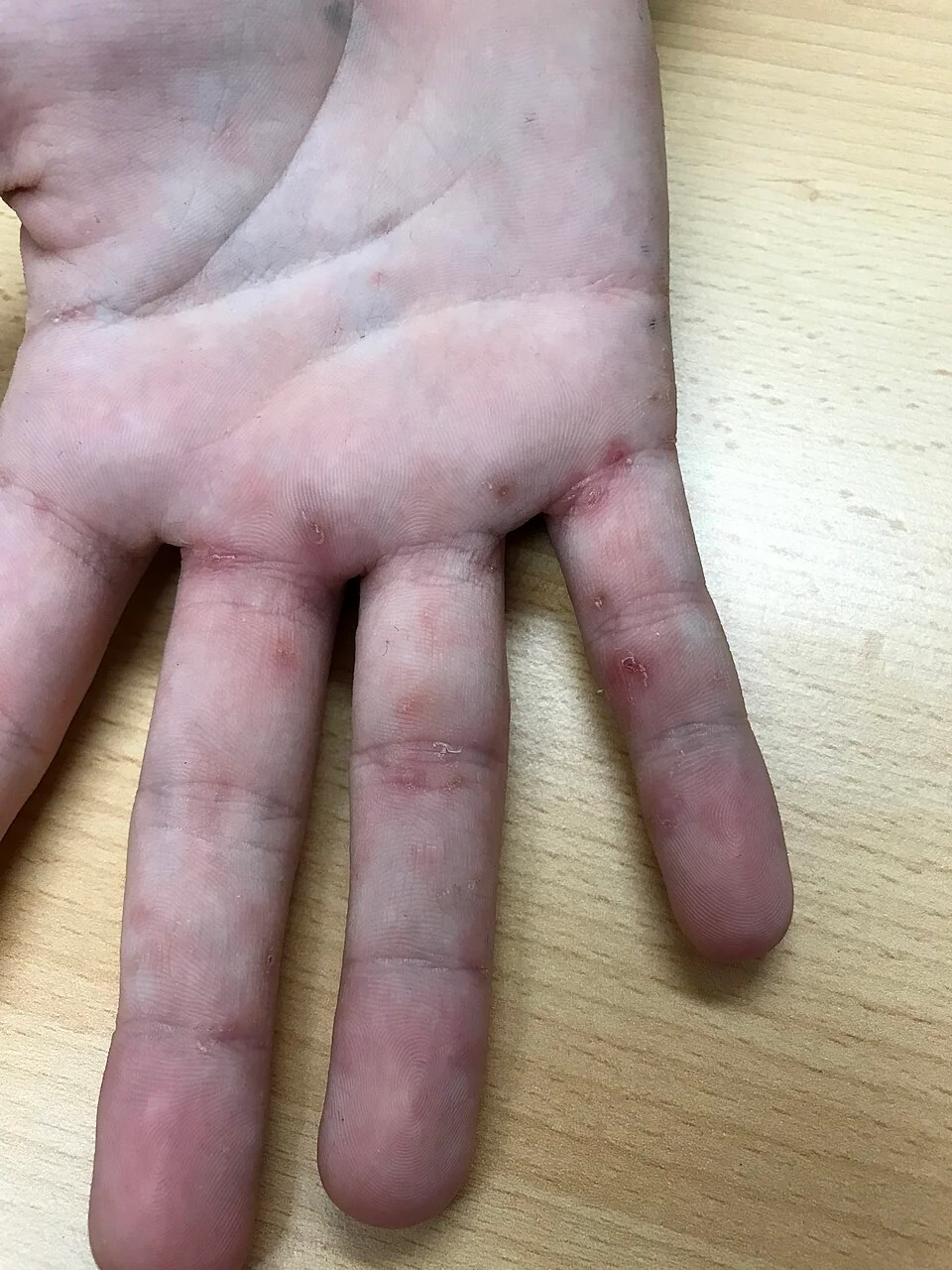
The dominant symptom is widespread, intense itch, characteristically worse at night and often disproportionate to the visible rash early on. The rash itself is polymorphic - a mixture of burrows, erythematous papules, and excoriations from scratching, which frequently obscures the more specific burrows entirely by the time a patient presents.
| Site | Notes |
|---|---|
| Finger webs and sides of fingers | Classic and often the easiest site to find an intact burrow |
| Flexor aspect of the wrists | Another reliably examined site |
| Elbows, axillae | Common sites of papules and excoriation |
| Periareolar skin (women) and genitals (men) | Scabetic nodules are particularly characteristic here |
| Buttocks and waistline | |
| Face and scalp | Spared in adults, but commonly involved in infants and in crusted scabies at any age |
Burrows
The burrow is the most specific sign: a thin, grey-white or skin-coloured, slightly raised, linear or serpiginous track a few millimetres to about a centimetre long, sometimes with a tiny dark dot (the mite) visible at one end. Burrows are often destroyed by scratching, so their absence does not exclude the diagnosis.
Nodular scabies
Scabetic nodules - firm, itchy, red-brown nodules, particularly on the genitals, groin and axillae - represent a persistent, exuberant hypersensitivity reaction and can persist for weeks to months after successful mite eradication, which is important to explain to patients so ongoing nodules are not mistaken for treatment failure.
Crusted (Norwegian) scabies
A distinct, severe presentation with widespread, thick, hyperkeratotic, crusted plaques, often affecting the hands, feet, scalp and nails, and sometimes generalised. Counterintuitively, itch is often mild or absent, because the immune response that produces the itch in ordinary scabies is blunted in these typically immunosuppressed or neurologically impaired patients - allowing the mite population to expand into the millions. Crusted scabies is highly contagious, even through brief contact or contaminated fomites, because of this enormous mite burden.6
Clinical examination
- Systematic examination of the classic sites - finger webs, wrists, elbows, axillae, periareolar and genital skin, and the buttocks - since a diagnosis based on itch alone is unreliable
- Look specifically for burrows, ideally with dermoscopy, before the area is disrupted by scratching
- Assess extent and secondary change - excoriation, eczematisation and any signs of secondary bacterial infection
- Examine hands, feet, scalp and nails carefully for hyperkeratotic crusting if crusted scabies is a possibility, particularly in an immunosuppressed, elderly or care-dependent patient
- Screen household and close contacts wherever possible, since finding burrows in a symptomatic contact supports the diagnosis in an index case with a less clear-cut presentation
Differential diagnosis
- Atopic or other eczema - widespread itch and excoriation, but without burrows and typically a personal or family history of atopy
- Urticaria - transient wheals rather than fixed burrows or nodules
- Insect bites (papular urticaria) - grouped papules, often with a clear exposure history, without the classic finger web and genital distribution
- Dermatitis herpetiformis - intensely itchy grouped vesicles on extensor surfaces, associated with coeliac disease, rather than burrows
- Delusional parasitosis - a fixed, false belief of infestation without objective evidence of mites or burrows on examination or microscopy
- Other causes of generalised pruritus (chronic kidney disease, cholestasis, lymphoma, iron deficiency) - considered if examination does not support scabies but itch persists
Investigations
Scabies is usually diagnosed clinically from the distribution, burrows and a compatible history, particularly if other household members are also itchy. Confirmation is more useful where the diagnosis is uncertain or before committing to intensive treatment of crusted scabies.
- Dermoscopy - can reveal the mite itself as a small, triangular, pigmented structure at the end of a burrow (the 'delta-wing jet' sign), without needing to disturb the skin
- Skin scraping and microscopy - a burrow is scraped with a scalpel blade and examined under light microscopy for mites, eggs or faecal pellets, providing definitive confirmation
- Skin biopsy - occasionally used in atypical or crusted scabies where the diagnosis remains unclear
Management
Topical treatment
- Permethrin 5% cream is first-line - applied to the whole body from the neck down in adults (including the face and scalp in infants, the elderly, and the immunosuppressed, since these groups can have scalp involvement), left on for 8-12 hours or overnight, then washed off7
- A second application 7 days later is essential, timed to kill mites that have hatched from eggs that survived the first treatment, since permethrin does not reliably kill eggs
- Malathion 0.5% aqueous lotion is an alternative if permethrin is not tolerated or contraindicated
- Apply to the whole body, including under the nails and in skin folds, and reapply to the hands after washing during the treatment period
Environmental measures
- Wash bedding, clothing and towels used in the 72 hours before treatment at a hot temperature (at least 50°C), or seal them in a plastic bag for at least 72 hours, since the mite cannot survive long away from human skin
- No need for extensive environmental decontamination beyond this, given how poorly the mite survives off the host
Crusted scabies
Needs more intensive treatment because of the enormous mite burden: combined topical permethrin and oral ivermectin, often for multiple doses over several weeks, plus a keratolytic (for example topical salicylic acid or urea cream) to help break down the thick crust and allow topical treatment to penetrate.5 Given how contagious it is, isolation or cohorting and strict infection control precautions (gloves and aprons for contact) are needed, particularly in a care home or hospital setting, and a lower threshold for treating all contacts and staff applies.
Symptomatic relief
Itch can persist for 2-4 weeks after successful treatment as the hypersensitivity reaction settles, even once all mites are dead - this should be explained clearly to avoid unnecessary repeat treatment. A sedating antihistamine at night and a moderate-potency topical corticosteroid can help control this post-treatment itch.
Complications
- Secondary bacterial infection (impetiginisation) from scratching, usually staphylococcal or streptococcal
- Post-streptococcal glomerulonephritis - a recognised, though uncommon, consequence of secondarily infected scabies in endemic settings
- Persistent post-scabetic nodules and itch, which can be mistaken for treatment failure
- Institutional outbreaks, particularly from unrecognised crusted scabies in a care home or hospital ward
- Significant psychological distress and social stigma, given the association (often inaccurate) between scabies and poor hygiene
Red flags
Prognosis
With correctly applied treatment - the whole body, repeated at 7 days, with simultaneous treatment of all contacts - ordinary scabies is reliably cured. Persistent itch for several weeks afterwards is expected and does not by itself indicate treatment failure or reinfestation.8
Crusted scabies has a less certain course and a meaningfully higher relapse rate, reflecting both the enormous mite burden and the underlying immunosuppression or care needs that predisposed to it in the first place; some patients need repeated courses of combined oral and topical treatment before clearance is achieved. Recognising and treating crusted scabies promptly is also the most effective way to prevent institutional outbreaks, since a single missed case can seed transmission to many contacts.
References
- NICE Clinical Knowledge Summaries. Scabies. Available here
- British Association of Dermatologists. Scabies patient information leaflet. Available here
- UK Health Security Agency. Guidance on the management of scabies outbreaks in care homes and other long-term care facilities. Available here
- Chosidow O. Scabies. New England Journal of Medicine. 2006. Available here
- Currie BJ, McCarthy JS. Permethrin and ivermectin for scabies. New England Journal of Medicine. 2010. Available here
- Roberts LJ, Huffam SE, Walton SF, Currie BJ. Crusted scabies: clinical and immunological findings in seventy-eight patients and a review of the literature. Journal of Infection. 2005. Available here
- BNF. Permethrin. Available here
- Romani L, Whitfeld MJ, Koroivueta J et al. Mass drug administration for scabies control in a population with endemic disease. New England Journal of Medicine. 2015. Available here
This article is written for revision and education. It is not clinical guidance and must not be used to make decisions about the care of a patient. Always check current NICE guidance and local protocols.