
Prosthetic Heart Valves: Choice, Anticoagulation and Complications
Key points
- Two families: mechanical valves last a lifetime but require anticoagulation; bioprosthetic valves avoid anticoagulation but degenerate over 10-20 years.
- The trade-off: durability against bleeding risk. Younger patients usually receive mechanical valves, older patients bioprosthetic ones.
- Anticoagulation: mechanical valves need lifelong warfarin, with the INR target set by valve type and position.
- DOACs are contraindicated: with mechanical valves - the RE-ALIGN trial found more thrombosis and more bleeding than with warfarin.
- Normal findings: a crisp click from a mechanical valve, and a soft systolic flow murmur from an aortic prosthesis.
- Always abnormal: a muffled or absent click, any new murmur, or any diastolic murmur.
- Prosthetic valve endocarditis: carries a high mortality and often needs surgery. Take blood cultures before antibiotics.
- Prophylaxis: NICE does not recommend routine antibiotic prophylaxis before dental procedures, but stresses oral hygiene and dental review.
Introduction
Around 10,000 heart valve operations are performed in the UK each year, and patients with prosthetic valves are encountered across every specialty - in clinic, before surgery, in the emergency department and in general practice. Recognising a normal prosthesis, and recognising when one has failed, is core general medicine rather than a cardiology subspecialty skill.
A replacement valve is not a cure. It exchanges the original problem for a new set of risks - anticoagulation, thrombosis, infection and eventual structural failure - which is why these patients need lifelong follow-up.
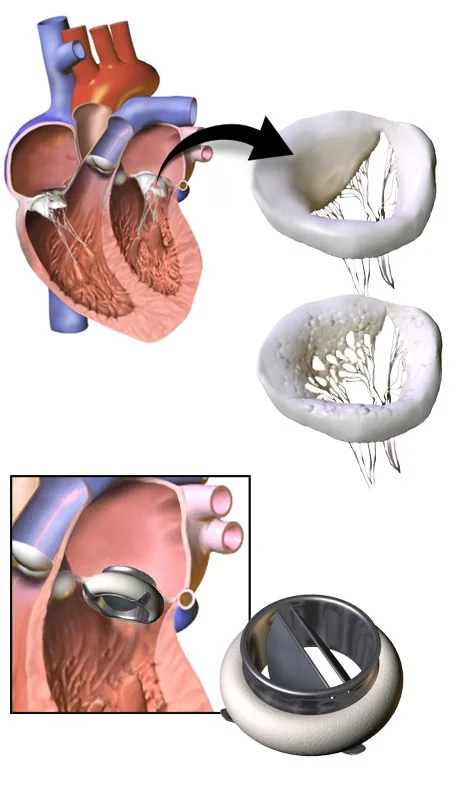
Types of valve
Mechanical
Made from pyrolytic carbon and metal alloys. The modern standard is the bileaflet valve, with two hinged semicircular leaflets. Older designs - the tilting disc, and the historical ball-and-cage - are still encountered in patients who received them decades ago, and are more thrombogenic, which raises their INR target.
Bioprosthetic
- Xenograft - the usual choice, made from porcine valve tissue or bovine pericardium mounted on a frame
- Homograft (allograft) - a human donor valve, used particularly in endocarditis of the aortic root, where prosthetic material is best avoided
- Autograft (Ross procedure) - the patient's own pulmonary valve is moved into the aortic position and replaced with a homograft. Used mainly in children and young adults, since the autograft grows with the patient.
Choosing between them
| Mechanical | Bioprosthetic | |
|---|---|---|
| Durability | Effectively lifelong | Structural degeneration over 10-20 years, faster in younger patients and in renal failure |
| Anticoagulation | Lifelong warfarin | Usually antiplatelet therapy only, with short-term anticoagulation after mitral surgery |
| Main risk | Bleeding and thromboembolism | Reoperation for structural failure |
| Typical candidate | Younger patients, or anyone already needing anticoagulation | Older patients, those who cannot take warfarin, and women planning pregnancy |
| Sound | An audible metallic click | Silent |
European guidance suggests a mechanical valve for most patients under about 60 in the aortic position and under about 65 in the mitral position, and a bioprosthesis above around 65, with a wide zone in between where the decision rests on the individual - their bleeding risk, occupation, ability to attend INR monitoring, plans for pregnancy, and above all their own preference after a full discussion.1
Anticoagulation
A mechanical valve is a foreign surface in a high-flow circuit, and without anticoagulation the risk of valve thrombosis and systemic embolism is unacceptable. Anticoagulation is therefore lifelong and non-negotiable.
| Situation | Typical target INR |
|---|---|
| Modern bileaflet valve, aortic position, no additional risk factors | 2.5 (range 2.0-3.0) |
| Mechanical valve, mitral or tricuspid position | 3.0 (range 2.5-3.5) |
| Older-generation valve, or additional risk factors such as atrial fibrillation, previous thromboembolism, left ventricular impairment or mitral stenosis | Higher target, commonly 3.5 |
| Bioprosthetic valve | Usually aspirin alone long term; anticoagulation for the first 3 months after mitral or tricuspid replacement |
Interruptions for surgery and dentistry
- Minor dental work and most skin procedures - can usually proceed without stopping warfarin, provided the INR is within range
- Surgery requiring interruption - warfarin is stopped and bridging with therapeutic low molecular weight heparin or unfractionated heparin is used, because the thrombotic risk of an unprotected mechanical valve is high. This differs from atrial fibrillation, where bridging is usually unnecessary.
- Restart anticoagulation as soon as haemostasis allows, and involve the anticoagulation service rather than improvising
Examining a prosthetic valve
The examination is the same as for any cardiovascular assessment, with three additions: listen for the click, know which murmurs are expected, and look for the complications.
| Finding | Interpretation |
|---|---|
| Crisp metallic click | Normal for a mechanical valve. An aortic prosthesis clicks at S2 (closing); a mitral prosthesis clicks at S1. |
| Soft ejection systolic murmur with an aortic prosthesis | Normal - flow across a slightly narrower effective orifice |
| Muffled, quiet or absent click | Abnormal - suspect valve thrombosis or pannus obstruction |
| Any new murmur, or a change in an existing one | Abnormal - suspect dehiscence, paravalvular leak or endocarditis |
| Any diastolic murmur | Always abnormal |
| Sternotomy scar | Expect one; also check the legs for a vein harvest scar suggesting concurrent bypass grafting |
Also assess the rhythm, look for signs of heart failure, check for anaemia and jaundice suggesting haemolysis, and look for the peripheral stigmata of endocarditis and for bleeding related to anticoagulation.
Complications
Valve thrombosis
Obstruction of a mechanical valve by thrombus, usually following inadequate anticoagulation - a missed period of warfarin, an interruption for surgery, or poor INR control. It presents with breathlessness, reduced exercise tolerance, heart failure or embolism, and a muffled click with a new murmur.
Investigate urgently with transoesophageal echocardiography and fluoroscopy or cardiac CT to assess leaflet movement. Treatment is thrombolysis or emergency surgery, depending on the size of the thrombus, the position of the valve and the patient's condition. Mortality is high.
Prosthetic valve endocarditis
- Early (within 12 months of surgery) - usually acquired perioperatively; coagulase-negative staphylococci and Staphylococcus aureus predominate
- Late (beyond 12 months) - the organism profile resembles native valve endocarditis, with streptococci and staphylococci
- Presentation may be indolent - fever, malaise, weight loss and anaemia - or fulminant with heart failure
- It is more likely than native valve endocarditis to form abscesses and cause valve dehiscence, and more often requires surgery
- Take at least three sets of blood cultures from separate sites before antibiotics, and arrange transoesophageal echocardiography, as transthoracic imaging is often obscured by the prosthesis
Structural valve degeneration
Bioprosthetic valves calcify, tear and stiffen over time, producing stenosis, regurgitation or both. Degeneration is faster in younger patients, in chronic kidney disease and in pregnancy. It presents gradually with the symptoms of the original lesion returning, and is followed with serial echocardiography. Redo surgery or a valve-in-valve transcatheter procedure are the options.
Paravalvular leak and haemolysis
A gap between the sewing ring and the annulus, from suture dehiscence or endocarditis. Small leaks may be asymptomatic; larger ones cause heart failure. The high-velocity jet through a narrow channel shears red cells, producing intravascular haemolysis.
Other complications
- Bleeding from anticoagulation - the commonest complication of a mechanical valve, and the main counterweight to its durability
- Thromboembolism and stroke despite adequate anticoagulation
- Patient-prosthesis mismatch - a valve too small for the patient's body surface area, leaving a residual gradient
- Conduction disease - the conducting system runs close to the aortic valve, so heart block can follow surgery or TAVI and may need a permanent pacemaker
Follow-up
- Baseline echocardiogram after surgery, once the patient has recovered - this is the reference against which all later studies are compared, and its absence makes later assessment much harder
- Annual clinical review, with echocardiography as indicated and routinely for bioprosthetic valves as they age
- INR monitoring in an anticoagulation service, with self-monitoring where suitable
- Dental review at least annually, with good oral hygiene emphasised
- Patient education - carry an anticoagulant alert card, know the target INR, report fever, breathlessness or a change in the click, and seek advice before any procedure
Red flags
Prognosis
Valve replacement performed before irreversible ventricular damage restores life expectancy close to that of the general population of the same age. Operative mortality for elective isolated valve replacement is low in suitable candidates.
The long-term picture is dominated by the trade-off between the two valve types. Mechanical valves rarely fail structurally, but carry a cumulative annual risk of bleeding and thromboembolism that compounds over decades. Bioprosthetic valves avoid that but bring a near-certain reoperation for younger recipients - though valve-in-valve transcatheter procedures have made that prospect considerably less daunting than it once was, and are steadily shifting the calculation towards bioprostheses in younger patients.
Prosthetic valve endocarditis remains the most serious complication, with in-hospital mortality of 20-40%, and it is the main reason these patients need a low threshold for investigating fever.
References
- Vahanian A, Beyersdorf F, Praz F et al. ESC/EACTS Guidelines for the management of valvular heart disease. European Heart Journal. 2021. Available here
- Eikelboom JW, Connolly SJ, Brueckmann M et al. Dabigatran versus warfarin in patients with mechanical heart valves (RE-ALIGN). New England Journal of Medicine. 2013. Available here
- NICE CG64. Prophylaxis against infective endocarditis. 2008, updated 2016. Available here
- NICE NG208. Heart valve disease presenting in adults: investigation and management. 2021. Available here
- Delgado V, Ajmone Marsan N, de Waha S et al. ESC Guidelines for the management of endocarditis. European Heart Journal. 2023. Available here
- BNF. Warfarin sodium - indications and target INR. Available here
- British Heart Foundation. Heart valve surgery. Available here
This article is written for revision and education. It is not clinical guidance and must not be used to make decisions about the care of a patient. Always check current NICE guidance and local protocols.