
Frailty and Sarcopenia
Key points
- Frailty: a state of reduced physiological reserve across multiple organ systems, such that a small stressor event produces a disproportionately large decline in health.
- Sarcopenia: progressive loss of skeletal muscle mass, strength and function with age - a key physical driver of the frailty phenotype.
- Not the same as multimorbidity or age: frailty is a distinct, independently predictive construct - a person can be frail with few diagnosed diseases, or robust despite several.
- Electronic Frailty Index (eFI): a primary care tool using routinely coded data to stratify patients as fit, mild, moderate or severely frail across a whole practice population.
- Rockwood Clinical Frailty Scale: a 9-point clinical judgement scale (1 very fit to 9 terminally ill), widely used at the point of care, particularly in acute settings.
- Frailty syndromes: falls, delirium, incontinence, immobility and susceptibility to side effects are the classic atypical presentations of underlying illness in frail patients.
- Comprehensive Geriatric Assessment: the evidence-based response to identified frailty - a structured, multidimensional assessment and management plan.
- Exercise and protein: resistance exercise plus adequate protein intake is the only intervention with strong evidence to reverse or slow sarcopenia.
Introduction
Frailty is a distinct clinical state, not simply a synonym for old age or a description of multiple diagnoses. It describes a loss of physiological reserve across multiple organ systems such that homeostatic mechanisms are compromised, and a relatively minor stressor - a urinary tract infection, a new medication, a change of environment - can trigger a disproportionately large and sometimes precipitous decline in health and function.1
Recognising frailty matters because it independently predicts adverse outcomes - falls, hospitalisation, disability, care home admission and mortality - better than age or disease count alone, and because it changes how care should be delivered: the same intervention (a new antihypertensive, an elective operation, an admission itself) carries different risks and should be approached differently in a frail person than in a fit person of the same age.
Prevalence rises steeply with age - roughly 10% of people over 65 and between a quarter and a half of those over 85 are frail - but frailty is not synonymous with old age, and a substantial proportion of people in their nineties remain fit by these measures. Frailty can also occur at younger ages in the context of severe chronic disease, which is why it is defined by physiological reserve rather than by a birthday.
Distinguishing frailty from ageing and multimorbidity
| Concept | Definition |
|---|---|
| Normal ageing | Expected, gradual physiological decline that does not by itself compromise reserve to the point of instability |
| Multimorbidity | The coexistence of two or more long-term conditions - see 2 - which may or may not be accompanied by frailty |
| Frailty | A state of reduced physiological reserve across systems, present at any age (though increasingly prevalent with age), independently predictive of adverse outcomes |
A person can have several diagnosed long-term conditions and be robust, while another with few coded diagnoses can be profoundly frail - this is why frailty is assessed as its own construct rather than inferred from a disease count.
Two influential models of frailty
The frailty phenotype (Fried)
Defines frailty as the presence of 3 or more of five physical criteria, with 1-2 criteria representing 'pre-frailty':3
- Unintentional weight loss
- Self-reported exhaustion
- Weakness (reduced grip strength)
- Slow gait speed
- Low physical activity
The cumulative deficit model (Rockwood)
Defines frailty as an accumulation of deficits - symptoms, signs, diseases, disabilities and abnormal test results - expressed as a ratio of deficits present to deficits assessed. This model underlies the tools used most in routine UK practice, because it can be operationalised from data already recorded in a clinical record rather than requiring a dedicated physical assessment.4
Identifying frailty in practice
Electronic Frailty Index (eFI)
The eFI is calculated automatically from routinely recorded primary care data (36 deficits including diagnoses, symptoms and functional problems) and stratifies every patient in a practice population aged 65 and over as fit, mildly frail, moderately frail, or severely frail, without needing an in-person assessment. It is used for population-level identification and to trigger proactive review, forming the basis of the NHS contractual requirement to identify and manage frailty in primary care.5
Rockwood Clinical Frailty Scale (CFS)
A 9-point scale from 1 (very fit) to 9 (terminally ill), assigned by clinical judgement based on function in the preceding 2 weeks (or baseline, if acutely unwell). It is quick, widely used at the point of care - particularly in acute admissions and pre-operative assessment - and correlates with outcomes including mortality and length of stay.
| Score | Description |
|---|---|
| 1-3 | Very fit to managing well - active, independent, no significant functional limitation |
| 4 | Vulnerable - not dependent but symptoms limit activity |
| 5-6 | Mildly to moderately frail - needs help with instrumental (5) or basic (6) activities of daily living |
| 7-8 | Severely to very severely frail - completely dependent for personal care, or approaching end of life |
| 9 | Terminally ill |
Simple bedside tests
- Gait speed: under 0.8 m/s over a short walk is associated with frailty and adverse outcomes
- Timed Up and Go (TUG): time taken to stand from a chair, walk 3 metres, turn, return and sit - over 12 seconds suggests increased falls risk and possible frailty
- Grip strength measured by dynamometer, a simple proxy for sarcopenia
Sarcopenia
Sarcopenia is the progressive, generalised loss of skeletal muscle mass, strength and physical performance with age, and is a key physical driver of the frailty phenotype - muscle weakness underlies slow gait speed, poor grip strength and exhaustion. It results from a combination of reduced physical activity, inadequate protein intake, chronic low-grade inflammation, hormonal change, and disuse during illness or hospitalisation.6
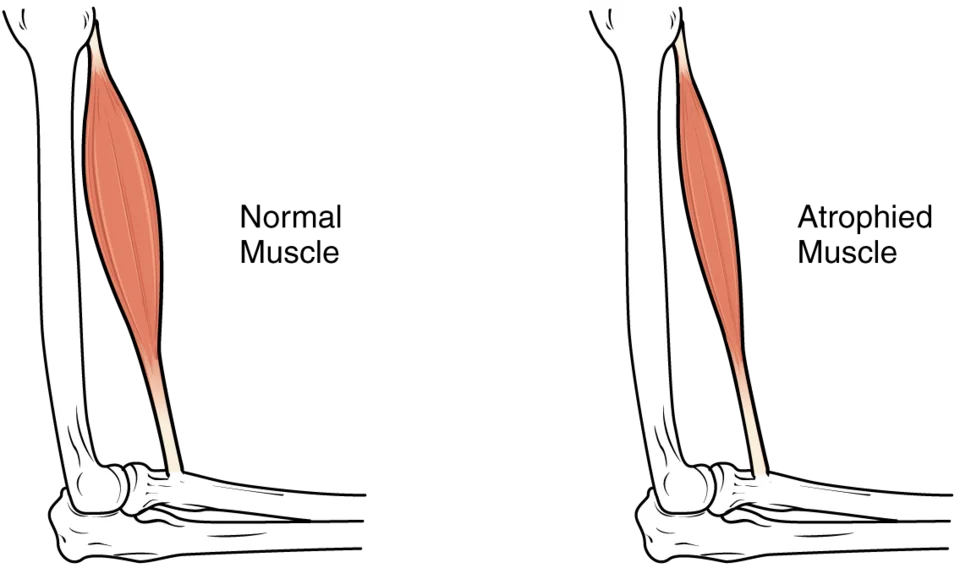
The loss is not uniform across fibre types: type II (fast-twitch) fibres are lost preferentially, which is why older people lose muscle power (force generated quickly) faster than they lose absolute strength. This matters functionally, because recovering from a stumble depends on generating a rapid corrective step, and it explains why resistance training that includes a speed component is more protective against falls than slow strength work alone.
| Step | Assessment |
|---|---|
| Probable sarcopenia | Low muscle strength (e.g. reduced grip strength or chair-stand time) |
| Confirmed sarcopenia | Low muscle strength plus low muscle mass (e.g. by bioimpedance or DEXA) |
| Severe sarcopenia | Low strength, low mass, and low physical performance (e.g. slow gait speed) |
Management
Sarcopenia-specific measures
- Resistance/strength exercise is the single most effective intervention, with evidence for improved muscle mass, strength and function even in very old and frail populations - it should be offered actively, not withheld on the assumption that a frail patient cannot tolerate it
- Adequate protein intake (generally higher than standard adult recommendations in older people, roughly 1.0-1.2 g/kg/day, more in acute illness) supports muscle protein synthesis alongside exercise
- Vitamin D correction where deficient supports musculoskeletal health, though evidence for reversing sarcopenia with vitamin D alone (without exercise) is weaker
- Avoiding unnecessary bed rest during acute illness or hospitalisation, since even a few days of immobility can cause significant, sometimes irreversible, muscle loss in an older person
Frailty-specific measures
Comprehensive Geriatric Assessment (CGA) is the evidence-based, structured response to identified frailty - a multidimensional assessment across medical, functional, psychological and social domains, leading to a coordinated management plan. It is covered in detail as its own topic; see 7.
- Medication review and deprescribing, since frail patients are more susceptible to adverse drug effects and polypharmacy compounds frailty-related risk
- Falls risk assessment and intervention, given the strong overlap between frailty and falls
- Nutritional assessment and support where malnutrition risk is identified
- Advance/anticipatory care planning, discussing ceiling of care and preferences before a crisis forces the decision
Frailty and clinical decision-making
Identifying frailty is only useful if it changes something. Its main practical value is that it alters the risk-benefit calculation of almost any intervention, and it does so more reliably than chronological age - which is why frailty scoring, not date of birth, should inform these decisions.
| Decision | How frailty shifts it |
|---|---|
| Blood pressure target | Accept a higher target; aggressive lowering risks postural hypotension, falls and acute kidney injury for a long-term benefit the patient may not live to realise |
| HbA1c target | Relax towards 58-64 mmol/mol or higher; the priority becomes avoiding hypoglycaemia rather than preventing microvascular complications decades away |
| Statin for primary prevention | Benefit takes years to accrue - often reasonable to stop in severe frailty with limited life expectancy |
| Anticoagulation in atrial fibrillation | Frailty and falls risk are frequently used to withhold anticoagulation, but this is usually wrong - the stroke risk reduction generally outweighs the bleeding risk even in fallers |
| Elective surgery | Frailty predicts postoperative complications, delirium and mortality better than age; triggers prehabilitation and a realistic discussion of expected recovery |
| Cancer treatment intensity | Guides dose modification and choice between curative-intent and palliative approaches, using a geriatric assessment rather than age alone |
Frailty syndromes: atypical presentation of illness
A defining clinical feature of frailty is that acute illness often presents atypically - not with the textbook symptom of the underlying problem, but with a non-specific decline in one of the five classic frailty syndromes:
- Falls
- Delirium (acute confusion)
- Incontinence (new urinary or faecal)
- Immobility (sudden 'off legs' presentation)
- Susceptibility to medication side effects, even at previously well-tolerated doses
Red flags
Prognosis
Frailty is a dynamic, not fixed, state - it can worsen (particularly after an acute illness or hospitalisation) but can also improve with targeted intervention, especially exercise, nutrition and medication optimisation, particularly in mild-to-moderate frailty. Severe frailty is associated with markedly reduced life expectancy and higher risk from any given intervention, which should inform - though not automatically preclude - decisions about investigation, treatment intensity and surgery.
The practical value of identifying frailty early is that it enables proactive, individualised planning - CGA, exercise and nutrition intervention, anticipatory care planning - rather than only reacting once a crisis (a fall, an admission, a rapid functional decline) has already occurred.
A particularly important point is that hospitalisation itself accelerates frailty. Bed rest during an acute admission causes rapid loss of muscle mass and strength - measurable within days in an older person - and a patient can be discharged medically improved but functionally worse than on admission. This is the rationale for early mobilisation, avoiding unnecessary catheters and restraints, encouraging patients to dress in their own clothes and eat sitting out of bed, and minimising length of stay where safe. Preventing hospital-acquired deconditioning is a genuine clinical intervention, not merely good ward etiquette.
References
- British Geriatrics Society. Fit for Frailty guidance. Available here
- NICE NG56. Multimorbidity: clinical assessment and management. 2016. Available here
- Fried LP, Tangen CM, Walston J et al. Frailty in older adults: evidence for a phenotype. Journals of Gerontology Series A. 2001. Available here
- Rockwood K, Song X, MacKnight C et al. A global clinical measure of fitness and frailty in elderly people. CMAJ. 2005. Available here
- NHS England. Electronic Frailty Index (eFI) guidance. Available here
- Cruz-Jentoft AJ, Bahat G, Bauer J et al. Sarcopenia: revised European consensus (EWGSOP2). Age and Ageing. 2019. Available here
- British Geriatrics Society. Comprehensive Geriatric Assessment toolkit. Available here
- NICE CG161. Falls in older people: assessing risk and prevention. 2013. Available here
This article is written for revision and education. It is not clinical guidance and must not be used to make decisions about the care of a patient. Always check current NICE guidance and local protocols.